Coutinho Natália F, Cucatti Silvia, Merlo Rafael B, Silva Filho José Maria C, Villegas Nelson F Borrero, Alvarez Fernando, Nogueira Ana F, Marques Francisco C
"Gleb Wataghin" Institute of Physics - University of Campinas (UNICAMP), Campinas, SP, 13083-859, Brazil.
Institute of Chemistry - University of Campinas (UNICAMP), Campinas, SP, 13083-970, Brazil.
Sci Rep. 2019 Aug 13;9(1):11785. doi: 10.1038/s41598-019-48194-1.
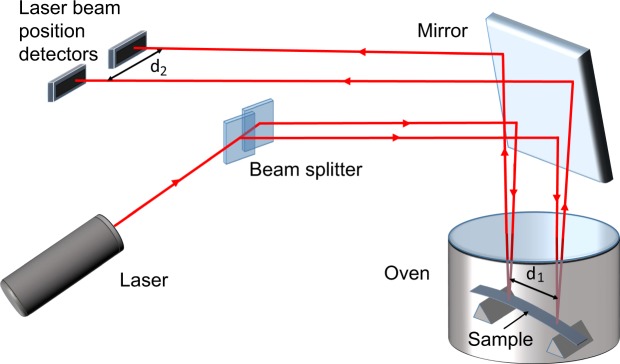
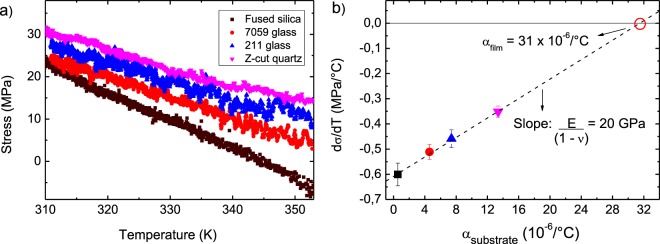
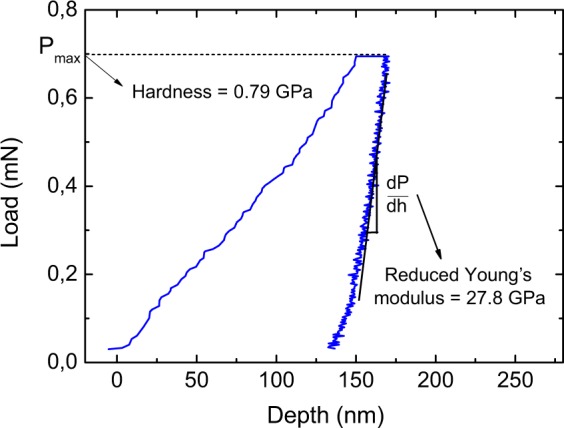
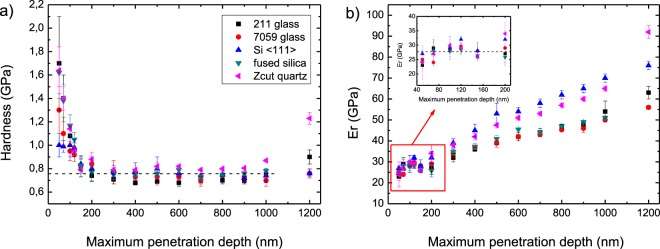
Bismuth triiodide (BiI) has been studied in recent years with the aim of developing lead-free semiconductors for photovoltaics. It has also appeared in X-ray detectors due to the high density of the Bismuth element. This material is attractive as an active layer in solar cells, or may be feasible for conversion into perovskite-like material (MABiI), being also suitable for photovoltaic applications. In this study, we report on the thermomechanical properties (stress, hardness, coefficient of thermal expansion, and biaxial and reduced Young's moduli) of BiI thin films deposited by thermal evaporation. The stress was determined as a function of temperature, adopting the thermally induced bending technique, which allowed us to extract the coefficient of thermal expansion (31 × 10 °C) and Young's biaxial modulus (19.6 GPa) for the films. Nanohardness (~0.76 GPa) and a reduced Young's modulus of 27.1 GPa were determined through nanoindentation measurements.
近年来,人们对三碘化铋(BiI)进行了研究,旨在开发用于光伏的无铅半导体。由于铋元素的高密度,它也出现在X射线探测器中。这种材料作为太阳能电池的活性层具有吸引力,或者转化为类钙钛矿材料(MABiI)可能是可行的,也适用于光伏应用。在本研究中,我们报告了通过热蒸发沉积的BiI薄膜的热机械性能(应力、硬度、热膨胀系数以及双轴和折合杨氏模量)。采用热致弯曲技术测定应力随温度的变化,这使我们能够提取薄膜的热膨胀系数(31×10⁻⁶ °C⁻¹)和双轴杨氏模量(19.6 GPa)。通过纳米压痕测量确定了纳米硬度(约0.76 GPa)和折合杨氏模量27.1 GPa。