Hereditary Endocrine Cancer Group, Human Cancer Genetics Program, Spanish National Cancer Research Centre (CNIO), Madrid, Spain.
INSERM, UMR970, Paris-Cardiovascular Research Center, Equipe Labellisée par la Ligue contre le Cancer, Paris, France.
Theranostics. 2019 Jul 9;9(17):4946-4958. doi: 10.7150/thno.35458. eCollection 2019.
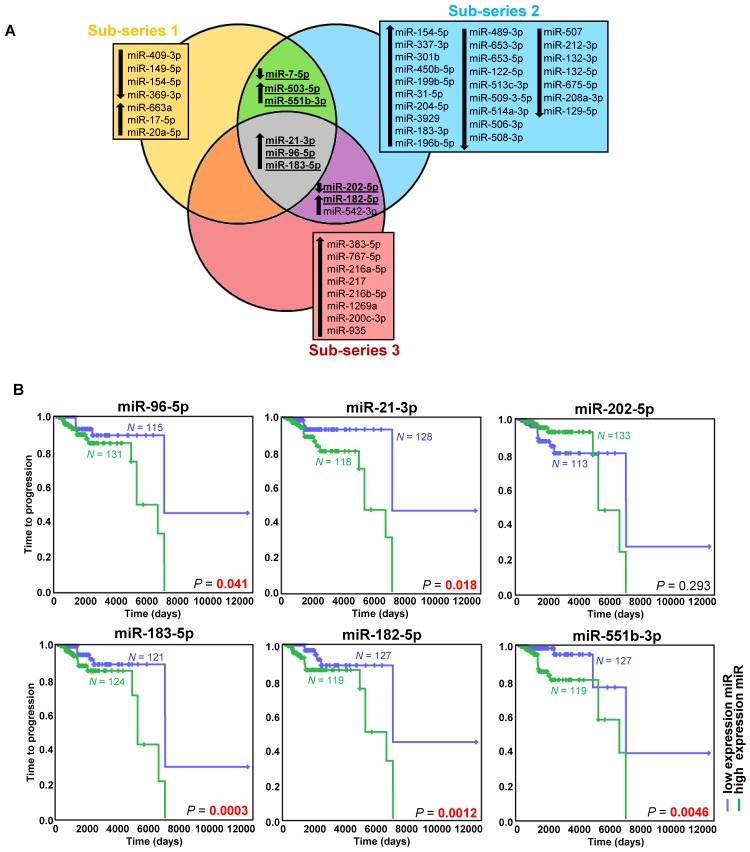
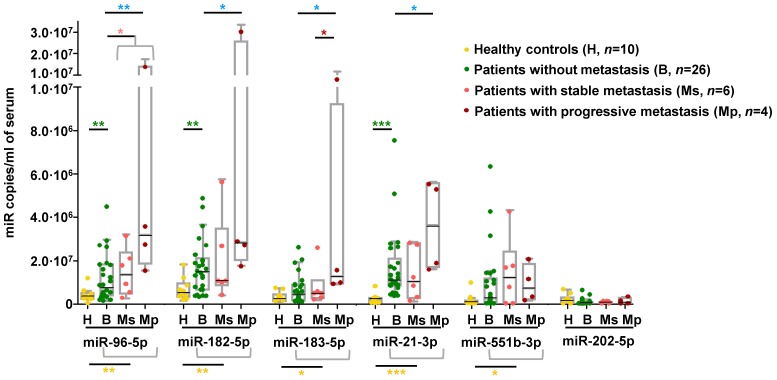
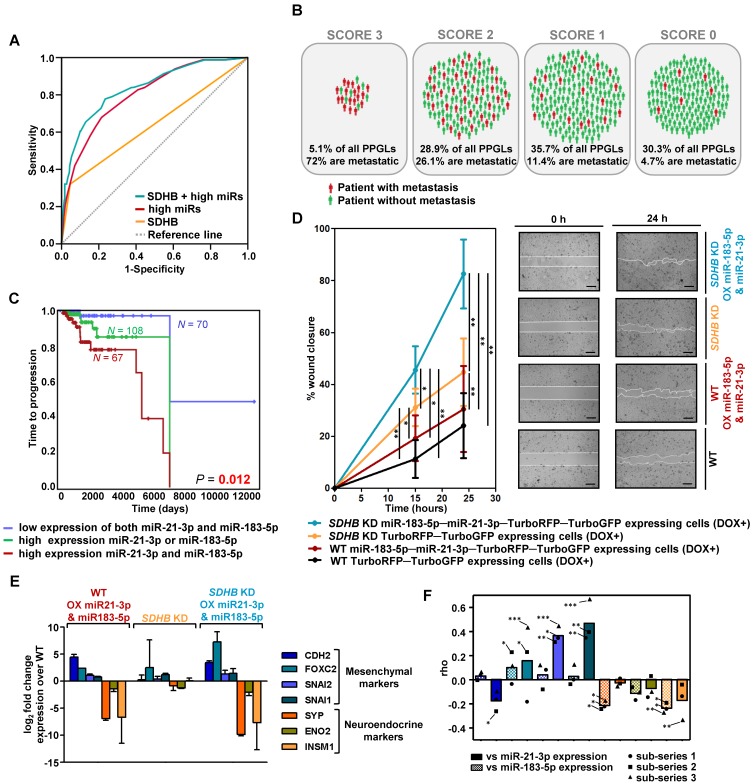
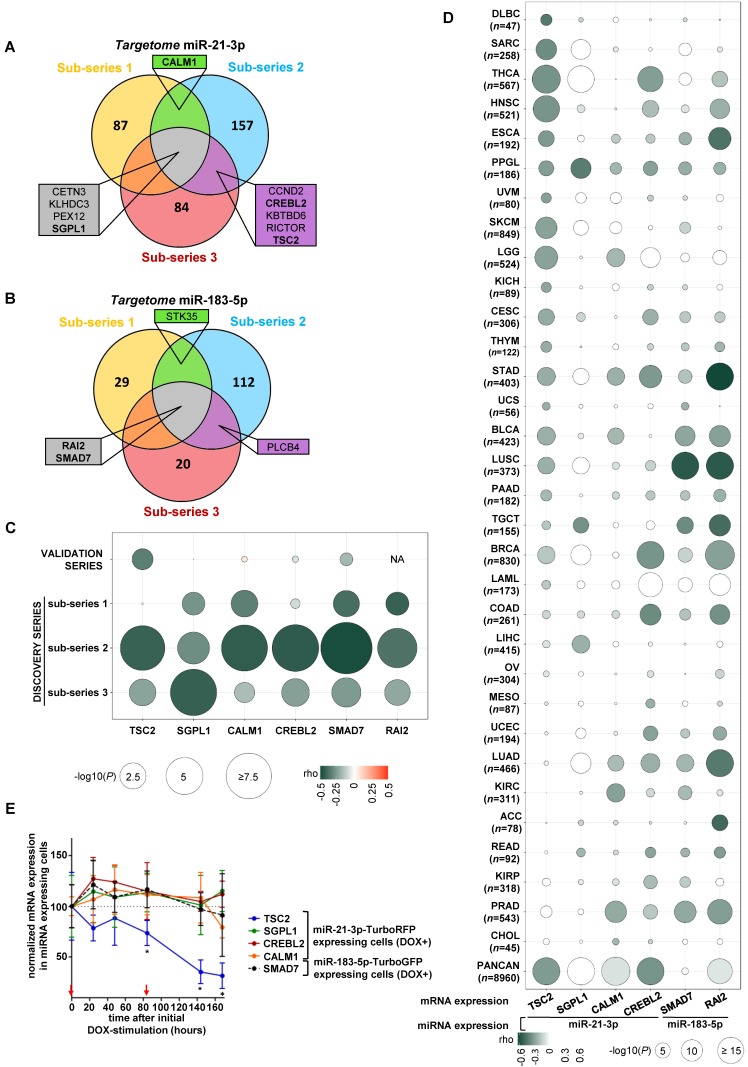
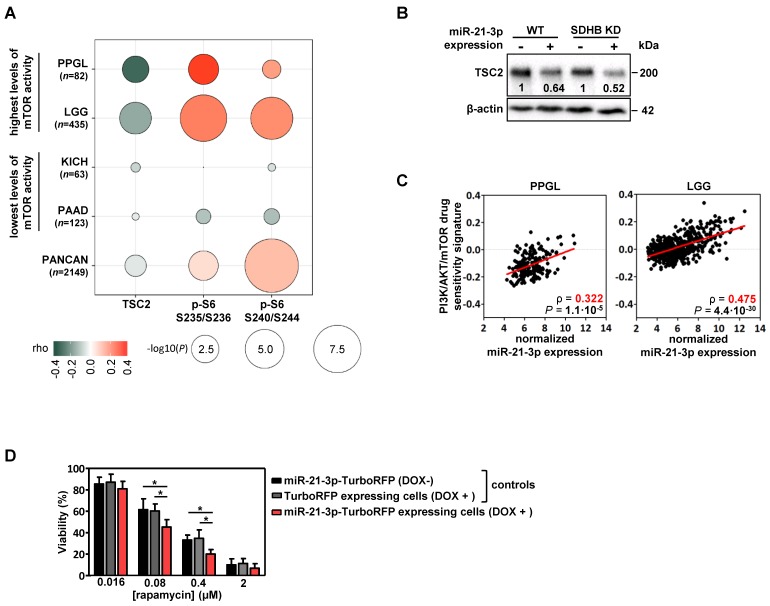
: Pheochromocytomas and paragangliomas (PPGLs) are rare neuroendocrine tumors that present variable outcomes. To date, no effective therapies or reliable prognostic markers are available for patients who develop metastatic PPGL (mPPGL). Our aim was to discover robust prognostic markers validated through models, and define specific therapeutic options according to tumor genomic features. : We analyzed three PPGL miRNome datasets (n=443), validated candidate markers and assessed them in serum samples (n=36) to find a metastatic miRNA signature. An integrative study of miRNome, transcriptome and proteome was performed to find miRNA targets, which were further characterized . : A signature of six miRNAs (miR-21-3p, miR-183-5p, miR-182-5p, miR-96-5p, miR-551b-3p, and miR-202-5p) was associated with metastatic risk and time to progression. A higher expression of five of these miRNAs was also detected in PPGL patients' liquid biopsies compared with controls. The combined expression of miR-21-3p/miR-183-5p showed the best power to predict metastasis (AUC=0.804, =4.67·10), and was found associated with pro-metastatic features, such as neuroendocrine-mesenchymal transition phenotype, and increased cell migration rate. A pan-cancer multi-omic integrative study correlated miR-21-3p levels with TSC2 expression, mTOR pathway activation, and a predictive signature for mTOR inhibitor-sensitivity in PPGLs and other cancers. Likewise, we demonstrated a repression and an enhanced rapamycin sensitivity upon miR-21-3p expression. : Our findings support the assessment of miR-21-3p/miR-183-5p, in tumors and liquid biopsies, as biomarkers for risk stratification to improve the PPGL patients' management. We propose miR-21-3p to select mPPGL patients who may benefit from mTOR inhibitors.
嗜铬细胞瘤和副神经节瘤(PPGL)是罕见的神经内分泌肿瘤,其表现结果多样。迄今为止,对于发生转移性 PPGL(mPPGL)的患者,尚无有效的治疗方法或可靠的预后标志物。我们的目的是发现通过模型验证的稳健预后标志物,并根据肿瘤基因组特征定义特定的治疗选择。
我们分析了三个 PPGL miRNA 组数据集(n=443),验证了候选标志物,并在血清样本(n=36)中进行了评估,以找到转移性 miRNA 特征。对 miRNA 组、转录组和蛋白质组进行了综合研究,以找到 miRNA 靶标,并进一步对其进行了特征描述。
一个由六个 miRNA(miR-21-3p、miR-183-5p、miR-182-5p、miR-96-5p、miR-551b-3p 和 miR-202-5p)组成的特征与转移风险和进展时间相关。与对照组相比,PPGL 患者的液体活检中也检测到其中五个 miRNA 的表达较高。miR-21-3p/miR-183-5p 的联合表达显示出预测转移的最佳能力(AUC=0.804,=4.67·10),并且与神经内分泌-间充质转化表型和增加的细胞迁移率等促转移特征相关。一项泛癌多组学综合研究将 miR-21-3p 水平与 TSC2 表达、mTOR 通路激活以及用于预测 PPGL 和其他癌症中 mTOR 抑制剂敏感性的预测特征相关联。同样,我们证明了 miR-21-3p 表达的抑制作用和增强的雷帕霉素敏感性。
我们的研究结果支持在肿瘤和液体活检中评估 miR-21-3p/miR-183-5p 作为风险分层的生物标志物,以改善 PPGL 患者的管理。我们建议使用 miR-21-3p 来选择可能受益于 mTOR 抑制剂的 mPPGL 患者。