Geladi Ilke, De León Luis Fernando, Torchin Mark E, Hendry Andrew P, González Rigoberto, Sharpe Diana M T
Redpath Museum and Department of Biology McGill University Montreal Quebec Canada.
Department of Biology University of Massachusetts Boston Boston Massachusetts.
Evol Appl. 2019 Feb 27;12(7):1385-1401. doi: 10.1111/eva.12763. eCollection 2019 Aug.
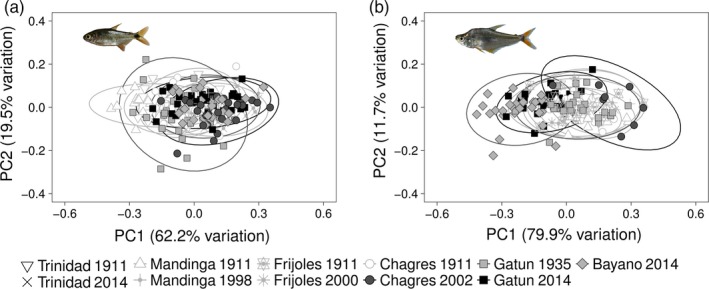
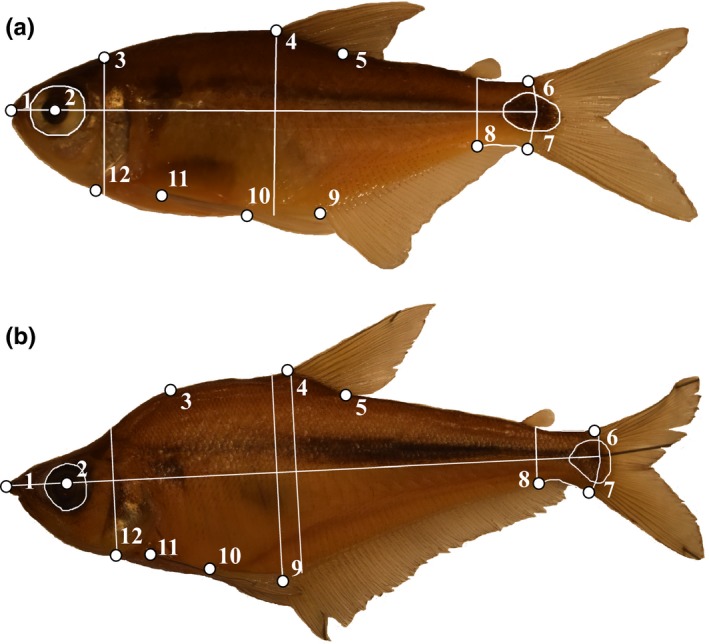
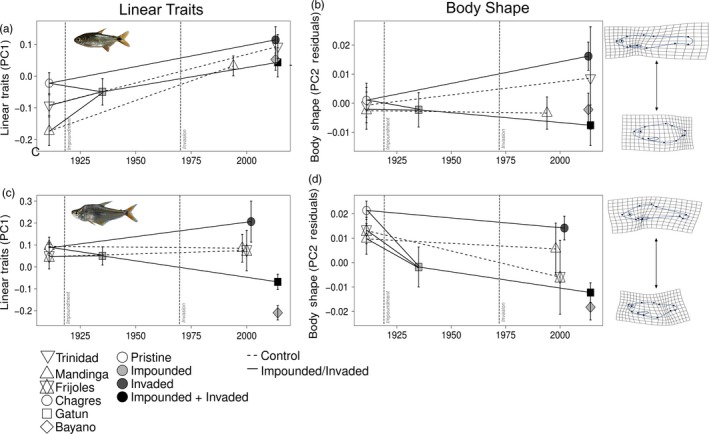
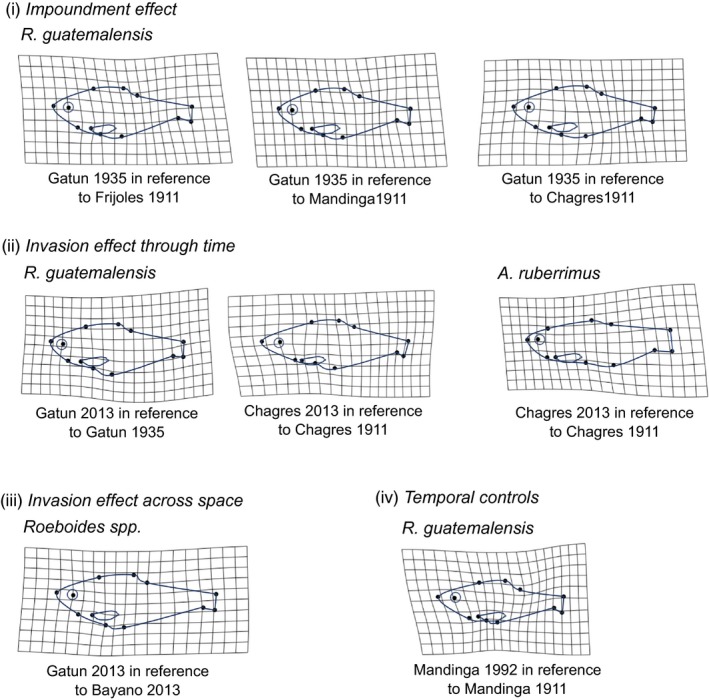
Human activities are dramatically altering ecosystems worldwide, often resulting in shifts in selection regimes. In response, natural populations sometimes undergo rapid phenotypic changes, which, if adaptive, can increase their probability of persistence. However, in many instances, populations fail to undergo any phenotypic change, which might indicate a variety of possibilities, including maladaptation. In freshwater ecosystems, the impoundment of rivers and the introduction of exotic species are among the leading threats to native fishes. We examined how the construction of the Panama Canal, which formed Lake Gatun, and the subsequent invasion of the predatory influenced the morphology of two native fishes: and spp. Using a 100-year time series, we studied variation in overall body shape over time (before vs. after impoundment and invasion) as well as across space (between an invaded and an uninvaded reservoir). In addition, we examined variation in linear morphological traits associated with swim performance and predator detection/avoidance. Notwithstanding a few significant changes in particular traits in particular comparisons, we found only limited evidence for morphological change associated with these two stressors. Most observed changes were subtle, and tended to be site- and species-specific. The lack of a strong morphological response to these stressors, coupled with dramatic population declines in both species, suggests they may be maladapted to the anthropogenically perturbed environment of Lake Gatun, but direct measures of fitness would be needed to test this. In general, our results suggest that morphological responses to anthropogenic disturbances can be very limited and, when they do occur, are often complex and context-dependent.
人类活动正在极大地改变全球生态系统,常常导致选择机制的转变。作为回应,自然种群有时会经历快速的表型变化,如果这种变化具有适应性,就能增加它们持续生存的概率。然而,在许多情况下,种群并未发生任何表型变化,这可能暗示着多种可能性,包括适应不良。在淡水生态系统中,河流筑坝和外来物种的引入是本地鱼类面临的主要威胁。我们研究了形成加通湖的巴拿马运河的建设以及随后掠食性鱼类的入侵如何影响两种本地鱼类的形态: 和 属。利用一个长达100年的时间序列,我们研究了随时间(蓄水和入侵前后)以及空间(在一个被入侵和一个未被入侵的水库之间)整体体型的变化。此外,我们还研究了与游泳性能以及捕食者探测/躲避相关的线性形态特征的变化。尽管在特定比较中某些特定特征有一些显著变化,但我们仅发现了有限的证据表明与这两种压力源相关的形态变化。大多数观察到的变化很细微,并且往往是特定地点和特定物种的。对这些压力源缺乏强烈的形态学响应,再加上这两个物种的种群数量都急剧下降,这表明它们可能无法适应加通湖人为干扰的环境,但需要直接的适应性测量来验证这一点。总体而言,我们的结果表明,对人为干扰的形态学响应可能非常有限,而且当它们确实发生时,往往是复杂且依赖于具体情境的。