Liu Xiaoliang, Meng Qingyu, Wang Weiping, Zhou Ziqi, Zhang Fuquan, Hu Ke
Department of Radiation Oncology, Peking Union Medical College Hospital, Chinese Academy of Medical Sciences & Peking Union Medical College, Beijing, People's Republic of China.
J Cancer. 2019 Jul 5;10(17):3967-3974. doi: 10.7150/jca.31538. eCollection 2019.
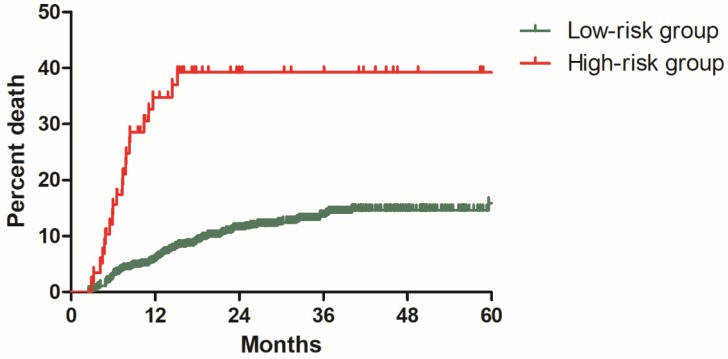
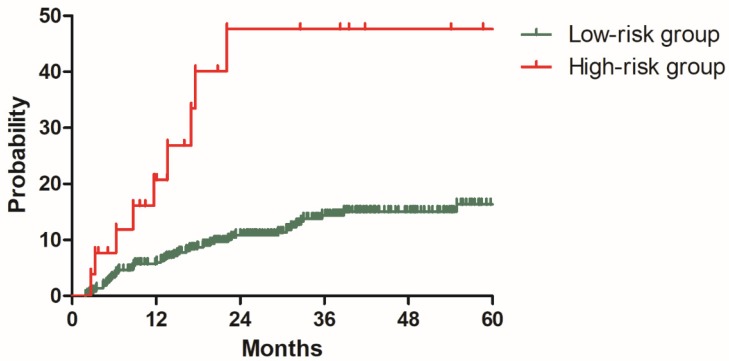
To identify the predictors of distant metastasis in patients with cervical cancer treated with definitive radiotherapy and develop a model for predicting distant metastasis. We reviewed the clinical records of patients with cervical cancer treated with definitive radiotherapy (IMRT) at Peking Union Medical College Hospital between January 2011 and December 2015. Eligible patients were randomly assigned into model development cohort and validation cohort in a 2:1 ratio. Distant metastasis rate (DMR) was calculated with Kaplan-Meier method. Univariate and multivariate analyses using cox proportional hazard model was performed to identify the risk factors of distant relapse. Based on the identified risk factors for distant metastasis, a model for predicting distant metastasis was developed and validated. A two-side P<0.05 was defined as statistically significant. A total of 1193 patients were eligible for this analysis including 797 patients in the model development cohort and 396 patients in the validation cohort. The median follow-up durations of the model development cohort and the validation cohort were 28.7 months (range: 2.5-83.9 months) and 30.9 months (1.9-83.5 months). The 2-year distant metastasis rates (DMR) for patients in the model development cohort and validation cohort were 13.3% and 12.8%. Non-squamous cell carcinoma (non-Scc), common iliac lymph nodes metastasis (LNM) and bilateral pelvic LNM (PLNM) were identified as risk factors for distant metastasis. In the model development cohort, significant difference between high-risk group (with 2-3 risk factors) and low-risk group (with 0-1 risk factor) regarding DMR was observed (39.3% vs 19.3%, P<0.001). Similar conclusions were observed in the validation cohort (high-risk group vs low-risk group, 47.6% vs 10.9%, P<0.001) We successfully developed a model for predicting distant metastasis in patients with cervical cancer receiving definitive radiotherapy based on the three identified risk factors for distant metastasis. This model would help us distinguish patients with high risk of distant relapse from others.
确定接受根治性放疗的宫颈癌患者远处转移的预测因素,并建立一个预测远处转移的模型。我们回顾了2011年1月至2015年12月在北京协和医院接受根治性放疗(调强放疗)的宫颈癌患者的临床记录。符合条件的患者以2:1的比例随机分为模型开发队列和验证队列。采用Kaplan-Meier法计算远处转移率(DMR)。使用Cox比例风险模型进行单因素和多因素分析,以确定远处复发的危险因素。基于确定的远处转移危险因素,建立并验证了一个预测远处转移的模型。双侧P<0.05被定义为具有统计学意义。共有1193例患者符合本分析条件,其中模型开发队列797例,验证队列396例。模型开发队列和验证队列的中位随访时间分别为28.7个月(范围:2.5 - 83.9个月)和30.9个月(1.9 - 83.5个月)。模型开发队列和验证队列患者的2年远处转移率(DMR)分别为13.3%和12.8%。非鳞状细胞癌(非Scc)、髂总淋巴结转移(LNM)和双侧盆腔LNM被确定为远处转移的危险因素。在模型开发队列中,观察到高危组(有2 - 3个危险因素)和低危组(有0 - 1个危险因素)在DMR方面存在显著差异(39.3%对19.3%,P<0.001)。在验证队列中也观察到类似结论(高危组对低危组,47.6%对10.9%,P<0.001)。我们基于确定的三个远处转移危险因素,成功建立了一个预测接受根治性放疗的宫颈癌患者远处转移的模型。该模型将有助于我们区分远处复发高危患者和其他患者。