Ma Xiaolong, Zhou Jiaqi, Mo Hongyan, Ying Ying
Department of Respiration, The First Hospital of Jiaxing, Jiaxing, Zhejiang 314000, P.R. China.
Department of Cardiothoracic Surgery, The First Hospital of Jiaxing, Jiaxing, Zhejiang 314000, P.R. China.
Oncol Lett. 2019 Aug;18(2):1318-1322. doi: 10.3892/ol.2019.10393. Epub 2019 May 22.
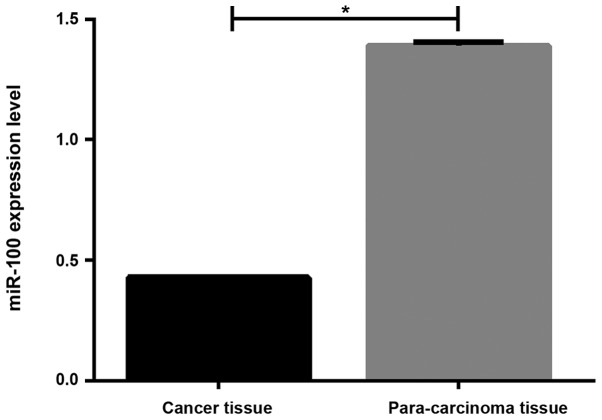
The expression of microRNA (miR)-100 in non-small cell lung cancer (NSCLC) and its association with clinicopathological features and poor prognosis were investigated. A total of 283 patients with NSCLC were enrolled in The First Hospital of Jiaxing from February 2013 to April 2015. Total RNA was extracted from cancer tissues and corresponding adjacent normal tissues. The expression of miR-100 was detected by RT-qPCR. Association between the expression level of miR-100 with clinicopathological features and prognosis of NSCLC were analyzed. The expression level of miR-100 in NSCLC tissues was lower than that in the normal tissues (P<0.05). According to the median expression level of miR-100 in cancer tissue, patients were divided into the high expression and low expression groups. Cross-tabulation analysis showed that the expression level of miR-100 was significantly associated with patients' age, TNM stage, metastasis and histological type (P<0.05), but not with sex (P>0.05). The proportion of patients with low miR-100 expression was higher in patients who died than in those who survived (P<0.05). Univariate prognostic analysis showed that miR-100 expression, age, TNM staging, and metastasis may be risk factors for poor prognosis in patients with NSCLC. Cox multivariate regression analysis showed that the downregulated miR-100 expression, advanced TNM stage, and metastasis were independent risk factors for poor prognosis of NSCLC. The relatively low expression level of miR-100 in NSCLC is associated with poor prognosis of patients. Therefore, miR-100 shows potential as a prognostic marker for NSCLC.
研究了微小RNA(miR)-100在非小细胞肺癌(NSCLC)中的表达及其与临床病理特征和不良预后的关系。2013年2月至2015年4月,嘉兴市第一医院共纳入283例NSCLC患者。从癌组织和相应的癌旁正常组织中提取总RNA。采用RT-qPCR检测miR-100的表达。分析miR-100表达水平与NSCLC临床病理特征及预后的关系。NSCLC组织中miR-100的表达水平低于正常组织(P<0.05)。根据癌组织中miR-100的中位表达水平,将患者分为高表达组和低表达组。交叉表分析显示,miR-100的表达水平与患者年龄、TNM分期、转移及组织学类型显著相关(P<0.05),但与性别无关(P>0.05)。miR-100低表达患者的死亡比例高于存活患者(P<0.05)。单因素预后分析显示,miR-100表达、年龄、TNM分期和转移可能是NSCLC患者预后不良的危险因素。Cox多因素回归分析显示,miR-100表达下调、TNM分期晚期和转移是NSCLC预后不良的独立危险因素。NSCLC中miR-100相对较低的表达水平与患者的不良预后相关。因此,miR-100显示出作为NSCLC预后标志物的潜力。