Grassi Sara, Mauri Laura, Prioni Simona, Cabitta Livia, Sonnino Sandro, Prinetti Alessandro, Giussani Paola
Department of Medical Biotechnology and Translational Medicine, University of Milan, Milan, Italy.
Front Pharmacol. 2019 Jul 23;10:807. doi: 10.3389/fphar.2019.00807. eCollection 2019.
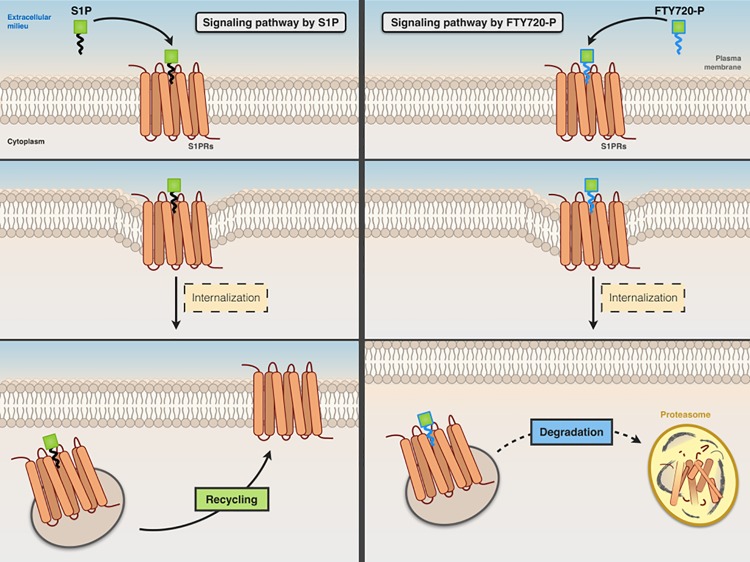
The central nervous system is characterized by a high content of sphingolipids and by a high diversity in terms of different structures. Stage- and cell-specific sphingolipid metabolism and expression are crucial for brain development and maintenance toward adult age. On the other hand, deep dysregulation of sphingolipid metabolism, leading to altered sphingolipid pattern, is associated with the majority of neurological and neurodegenerative diseases, even those totally lacking a common etiological background. Thus, sphingolipid metabolism has always been regarded as a promising pharmacological target for the treatment of brain disorders. However, any therapeutic hypothesis applied to complex amphipathic sphingolipids, components of cellular membranes, has so far failed probably because of the high regional complexity and specificity of the different biological roles of these structures. Simpler sphingosine-based lipids, including ceramide and sphingosine 1-phosphate, are important regulators of brain homeostasis, and, thanks to the relative simplicity of their metabolic network, they seem a feasible druggable target for the treatment of brain diseases. The enzymes involved in the control of the levels of bioactive sphingoids, as well as the receptors engaged by these molecules, have increasingly allured pharmacologists and clinicians, and eventually fingolimod, a functional antagonist of sphingosine 1-phosphate receptors with immunomodulatory properties, was approved for the therapy of relapsing-remitting multiple sclerosis. Considering the importance of neuroinflammation in many other brain diseases, we would expect an extension of the use of such analogs for the treatment of other ailments in the future. Nevertheless, many aspects other than neuroinflammation are regulated by bioactive sphingoids in healthy brain and dysregulated in brain disease. In this review, we are addressing the multifaceted possibility to address the metabolism and biology of bioactive sphingosine 1-phosphate as novel targets for the development of therapeutic paradigms and the discovery of new drugs.
中枢神经系统的特点是鞘脂含量高且结构多样。特定阶段和细胞的鞘脂代谢及表达对于大脑发育和成年后的维持至关重要。另一方面,鞘脂代谢的严重失调会导致鞘脂模式改变,这与大多数神经和神经退行性疾病相关,甚至包括那些完全缺乏共同病因背景的疾病。因此,鞘脂代谢一直被视为治疗脑部疾病的一个有前景的药理学靶点。然而,迄今为止,任何应用于复杂两亲性鞘脂(细胞膜成分)的治疗假说都可能失败,这可能是因为这些结构的不同生物学作用具有高度的区域复杂性和特异性。基于鞘氨醇的更简单脂质,包括神经酰胺和1 -磷酸鞘氨醇,是脑内稳态的重要调节因子,并且由于其代谢网络相对简单,它们似乎是治疗脑部疾病的一个可行的可药物作用靶点。参与控制生物活性鞘氨醇水平的酶以及这些分子所作用的受体越来越吸引药理学家和临床医生,最终,具有免疫调节特性的1 -磷酸鞘氨醇受体功能拮抗剂芬戈莫德被批准用于治疗复发缓解型多发性硬化症。考虑到神经炎症在许多其他脑部疾病中的重要性,我们预计未来这类类似物的使用会扩展到治疗其他疾病。然而,除了神经炎症之外,许多其他方面在健康大脑中由生物活性鞘氨醇调节,而在脑部疾病中失调。在这篇综述中,我们探讨了将生物活性1 -磷酸鞘氨醇的代谢和生物学作为治疗模式开发和新药发现的新靶点的多方面可能性。