Tran Thi Thom, Mathieu Calypso, Torres Magali, Loriod Béatrice, Lê Linh Thuy, Nguyen Catherine, Bernard Monique, Leone Marc, Lalevée Nathalie
Aix-Marseille Univ, INSERM UMR 1090, TAGC, Campus de Luminy, Case 928, 13288, Marseille Cedex 9, France.
Aix Marseille Univ, Service d'anesthésie et de réanimation, Hôpital Nord, Assistance Publique Hôpitaux de Marseille, Chemin des Bourrely, 13015, Marseille, France.
Intensive Care Med Exp. 2019 Aug 19;7(1):50. doi: 10.1186/s40635-019-0263-0.
The aims of this study are to better understand phenotypic differences between male and female rats during sepsis, to characterise the contribution of the beta1-adrenergic blocker landiolol to septic cardiomyopathy and to determine why landiolol induces divergent effects in males and females.
The myocardial transcriptional profiles in male and female Wistar rats were assessed after the induction of sepsis by cecal ligation and puncture and addition of landiolol.
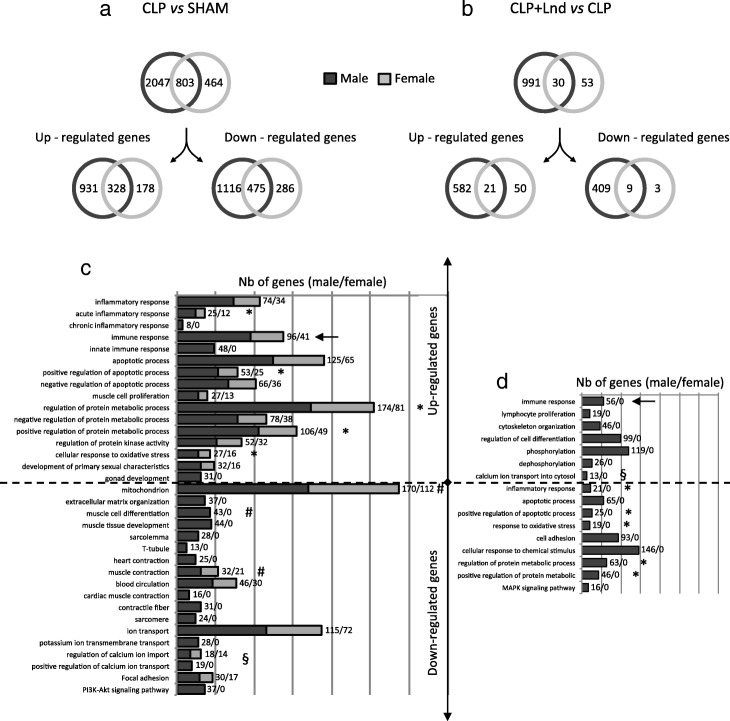
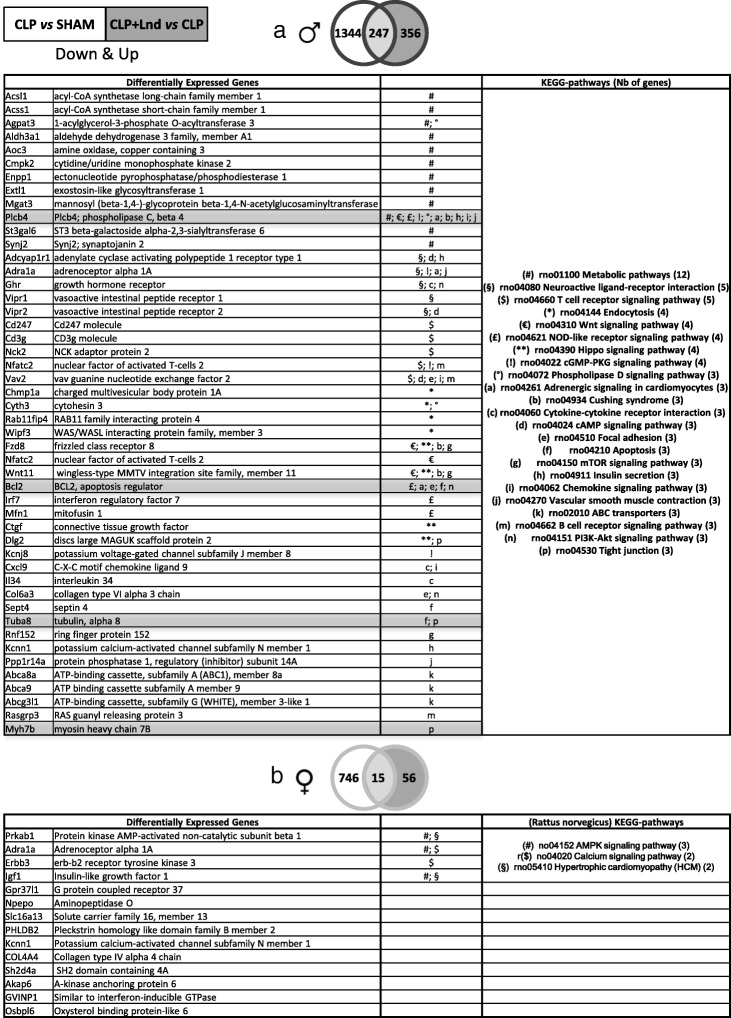
Our results showed major differences in the biological processes activated during sepsis in male and female rats. In particular, a significant decrease in processes related to cell organisation, contractile function, ionic transport and phosphoinositide-3-kinase/AKT (PI3K/AKT) signalling was observed only in males. The transcript of ATPase sarcoplasmic/endoplasmic reticulum Ca transporting 3 (SERCA3) was sex-differently regulated. In males, landiolol reversed several signalling pathways dysregulated during sepsis. The expression level of genes encoding tubulin alpha 8 (TUBA8) and myosin heavy chain 7B (MYH7) contractile proteins, phosphatase 2 catalytic subunit alpha (PPP2CA), G protein-coupled receptor kinase 5 (GRK5) and A-kinase anchoring protein 6 (AKAP6) returned to their basal levels. In contrast, in females, landiolol had limited effects.
In males, landiolol reversed the expression of many genes that were deregulated in sepsis. Conversely, sepsis-induced deregulation of gene expression was less pronounced in females than in males, and was maintained in the landiolol-treated females. These findings highlight important sex-related differences and confirm previous observations on the important benefit of landiolol intake on cardiac function in male rats.
本研究旨在更好地了解脓毒症期间雄性和雌性大鼠的表型差异,明确β1肾上腺素能阻滞剂兰地洛尔对脓毒症性心肌病的作用,并确定兰地洛尔在雄性和雌性大鼠中产生不同作用的原因。
通过盲肠结扎和穿刺诱导脓毒症并添加兰地洛尔后,评估雄性和雌性Wistar大鼠的心肌转录谱。
我们的结果显示,雄性和雌性大鼠在脓毒症期间激活的生物学过程存在重大差异。特别是,仅在雄性大鼠中观察到与细胞组织、收缩功能、离子转运和磷酸肌醇-3-激酶/蛋白激酶B(PI3K/AKT)信号传导相关的过程显著减少。ATP酶肌浆网/内质网钙转运3(SERCA3)的转录本受到性别差异调节。在雄性大鼠中,兰地洛尔逆转了脓毒症期间失调的几种信号通路。编码微管蛋白α8(TUBA8)和肌球蛋白重链7B(MYH7)收缩蛋白、蛋白磷酸酶2催化亚基α(PPP2CA)、G蛋白偶联受体激酶5(GRK5)和A激酶锚定蛋白6(AKAP6)的基因表达水平恢复到基础水平。相比之下,在雌性大鼠中,兰地洛尔的作用有限。
在雄性大鼠中,兰地洛尔逆转了脓毒症中许多失调基因的表达。相反,脓毒症诱导的基因表达失调在雌性大鼠中不如雄性大鼠明显,并且在接受兰地洛尔治疗的雌性大鼠中持续存在。这些发现突出了重要的性别相关差异,并证实了先前关于摄入兰地洛尔对雄性大鼠心脏功能有重要益处的观察结果。