Unit for Population-Based Dermatology Research, St John's Institute of Dermatology, King's College London and Guy's and St Thomas' NHS Foundation Trust, London, UK.
Women's Health, King's College London, London, UK.
BMJ Open. 2019 Aug 20;9(8):e027168. doi: 10.1136/bmjopen-2018-027168.
Atopic eczema affects 20% of UK children, and environmental factors are important in its aetiology. Several observational studies suggest an increased risk of atopic eczema in children living in hard water areas. The Softened Water for Eczema Prevention pilot trial tests the feasibility of installing domestic ion-exchange water softeners around the time of birth to reduce the risk of atopic eczema in children with a family history of atopy. A further aim is to explore the pathophysiological mechanisms for this in an embedded mechanistic study.
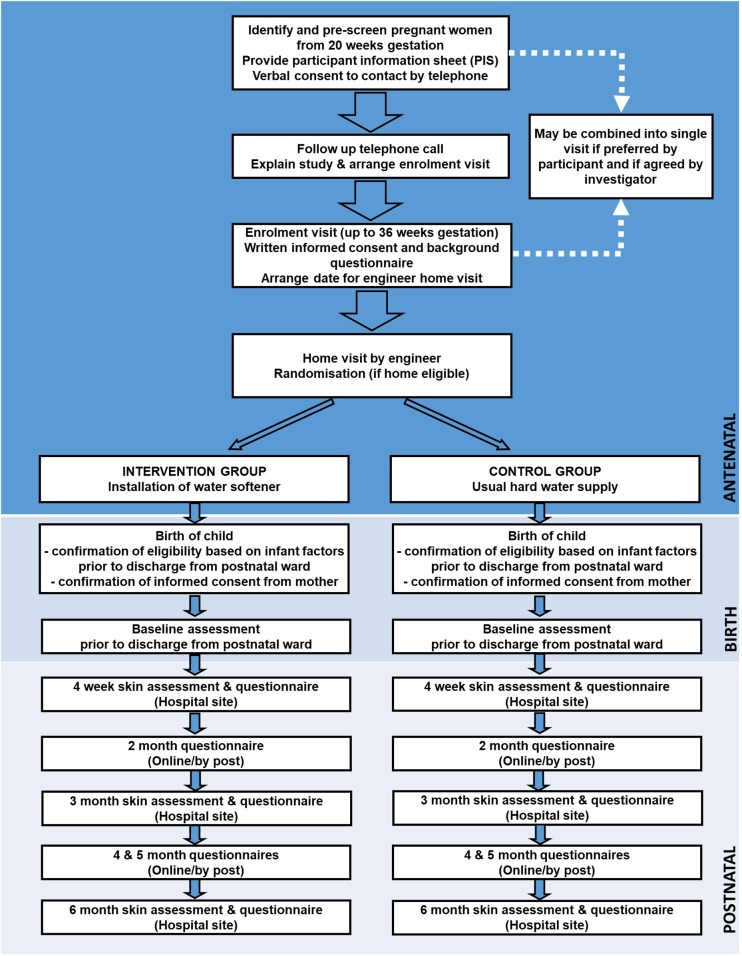
Multicentre parallel group assessor-blinded randomised controlled pilot trial. Participants are newborn babies (n=80) living in a hard water (>250 mg/L calcium carbonate) area at risk of developing atopic eczema because of a family history of atopy. Participants will be randomised prior to birth in a 1:1 ratio. The intervention group will have an ion-exchange water softener installed prior to birth. The control group will receive their usual domestic hard water supply. Follow-up will be until 6 months of age. Data will be collected at birth (baseline), 1, 3 and 6 months of age. The main outcome is the proportion of eligible families screened who are willing and able to be randomised. Several secondary feasibility and clinical endpoints will also be evaluated, alongside mechanistic outcomes. Data will be analysed on an intention-to-treat basis. There will be no hypothesis testing for the clinical outcomes. Study acceptability will be evaluated through semistructured interviews.
This study has been reviewed and given a favourable opinion by the North West-Liverpool East Research Ethics Committee (Ref: 17/NW/0661). The results of the study will be reported at international conferences and in peer-reviewed scientific journals. We will send participating families a summary of the pilot trial results.
NCT03270566.
特应性皮炎影响了英国 20%的儿童,环境因素在其发病机制中起着重要作用。几项观察性研究表明,生活在硬水区的儿童患特应性皮炎的风险增加。“预防特应性皮炎软化水”试点试验旨在测试在出生前后安装家用离子交换水软化器以降低特应性家族史儿童特应性皮炎风险的可行性。其进一步目的是在一项嵌入式机制研究中探索这种方法的病理生理学机制。
多中心平行组评估员盲法随机对照试点试验。参与者为居住在硬水(>250mg/L 碳酸钙)地区的新生儿(n=80),他们有特应性家族史,因此有发展特应性皮炎的风险。参与者将在出生前按 1:1 的比例随机分组。干预组将在出生前安装离子交换水软化器。对照组将接受其常规家用硬水供应。随访至 6 个月龄。数据将在出生时(基线)、1 个月、3 个月和 6 个月龄收集。主要结局是筛查出有资格的家庭中愿意和能够进行随机分组的比例。还将评估几个次要的可行性和临床终点,以及机制终点。将按意向治疗进行数据分析。对于临床结局,将不会进行假设检验。通过半结构化访谈评估研究的可接受性。
本研究已通过西北-利物浦东研究伦理委员会审查并给予有利意见(Ref: 17/NW/0661)。该研究的结果将在国际会议上和同行评议的科学期刊上报告。我们将向参与家庭发送试点试验结果的摘要。
NCT03270566。