Matsumoto Mitsuyoshi, Miyagi Masayuki, Saito Wataru, Imura Takayuki, Inoue Gen, Nakazawa Toshiyuki, Shirasawa Eiki, Uchida Kentaro, Akazawa Tsutomu, Takahira Naonobu, Takaso Masashi
Department of Orthopaedic Surgery, School of Medicine, Kitasato University, Sagamihara, Japan.
Department of Orthopaedic Surgery, St. Marianna University School of Medicine, Kawasaki, Japan.
Spine Surg Relat Res. 2018 Apr 7;2(4):278-282. doi: 10.22603/ssrr.2017-0075. eCollection 2018 Oct 26.
Patients with neuromuscular disorders sometimes show progressive spinal scoliosis. The surgery for neuromuscular scoliosis (NMS) has high rates of complications. In this study, we elucidated the perioperative complications in patients with NMS.
We included 83 patients with NMS (58 boys and 25 girls; 61 with muscular dystrophy, 18 with spinal muscular atrophy, and 4 others) who had undergone posterior fusion surgery for scoliosis. We evaluated the perioperative complications (within 3 months), age at time of surgery, operative time, blood loss, preoperative %VC and FEV (%) for pulmonary function, and preoperative ejection fraction (EF) for cardiac function.
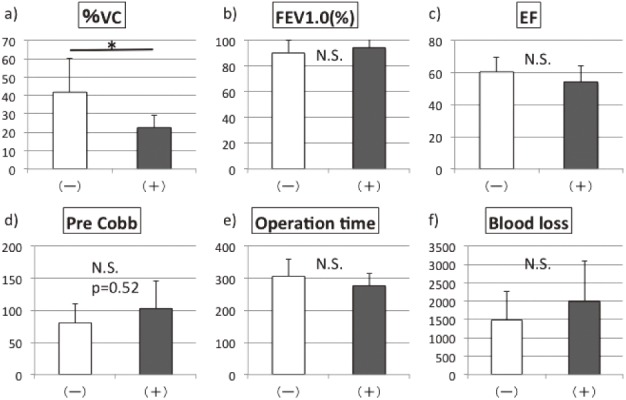
There were 5 (6%) major complications, including pneumonia and a cardiovascular complication requiring intensive care unit (ICU) care, and 15 (18%) minor complications including viral enteritis and a urinary tract infection. Overall, there were 20 (24%) complications. Three of the 5 major complications were pulmonary. The mean age at the time of surgery was 13.7 y, operative time was 304 min, and blood loss was 1530 ml. The mean preoperative %VC was 41%, FEV was 91%, and EF was 60%. When we separated the patients into a group with major complications (n = 5) and a group without major complications (n = 78), the preoperative %VC in the group with major complications (23%) was significantly lower than that in the group without (42%) ( < 0.05). However, operative time, blood loss, preoperative FEV (%) and EF between the two groups were not significantly different ( > 0.05).
Compared with the previous findings of the perioperative complication rate (45%-74%) for NMS, the complication rate was remarkably low in this case series. Because of advances in medical skills, including anesthesia and surgical instruments, surgery for NMS appears to be safe. However, patients with NMS with complications demonstrated severe restrictive ventilatory impairment preoperatively. Therefore, we should be vigilant for perioperative pulmonary complications especially in patients with NMS and preoperative severe restrictive ventilatory impairment.
神经肌肉疾病患者有时会出现进行性脊柱侧弯。神经肌肉性脊柱侧弯(NMS)手术的并发症发生率很高。在本研究中,我们阐明了NMS患者的围手术期并发症。
我们纳入了83例接受脊柱侧弯后路融合手术的NMS患者(58例男性和25例女性;61例患有肌肉萎缩症,18例患有脊髓性肌萎缩症,4例为其他疾病)。我们评估了围手术期并发症(3个月内)、手术时的年龄、手术时间、失血量、术前肺功能的%VC和FEV(%)以及术前心功能的射血分数(EF)。
有5例(6%)主要并发症,包括肺炎和需要重症监护病房(ICU)护理的心血管并发症,以及15例(18%)次要并发症,包括病毒性肠炎和尿路感染。总体而言,有20例(24%)并发症。5例主要并发症中有3例是肺部并发症。手术时的平均年龄为13.7岁,手术时间为304分钟,失血量为1530毫升。术前平均%VC为41%,FEV为91%,EF为60%。当我们将患者分为有主要并发症组(n = 5)和无主要并发症组(n = 78)时,有主要并发症组的术前%VC(23%)显著低于无主要并发症组(42%)(<0.05)。然而,两组之间的手术时间、失血量、术前FEV(%)和EF没有显著差异(>0.05)。
与之前报道的NMS围手术期并发症发生率(45%-74%)相比,本病例系列中的并发症发生率显著较低。由于包括麻醉和手术器械在内的医疗技术的进步,NMS手术似乎是安全的。然而,有并发症的NMS患者术前表现出严重的限制性通气功能障碍。因此,我们应该对围手术期肺部并发症保持警惕,尤其是在NMS患者和术前有严重限制性通气功能障碍的患者中。