Department of Medicine - Gastroenterology and Hepatology, Stanford University School of Medicine, Palo Alto, California, United States of America.
Center for Observational and Real-World Evidence (CORE), Merck & Co., Inc., Kenilworth, New Jersey, United States of America.
PLoS One. 2019 Aug 22;14(8):e0218759. doi: 10.1371/journal.pone.0218759. eCollection 2019.
Data on initiation and utilization of direct-acting antiviral therapies for hepatitis C virus infection in the United States are limited. This study evaluated treatment initiation, time to treatment, and real-world effectiveness of direct-acting antiviral therapy in individuals with hepatitis C virus infection treated during the first 2 years of availability of all-oral direct-acting antiviral therapies.
A retrospective cohort analysis was undertaken using electronic medical records and chart review abstraction of hepatitis C virus-infected individuals aged >18 years diagnosed with chronic hepatitis C virus infection between January 1, 2014, and December 31, 2015 from the Indiana University Health database.
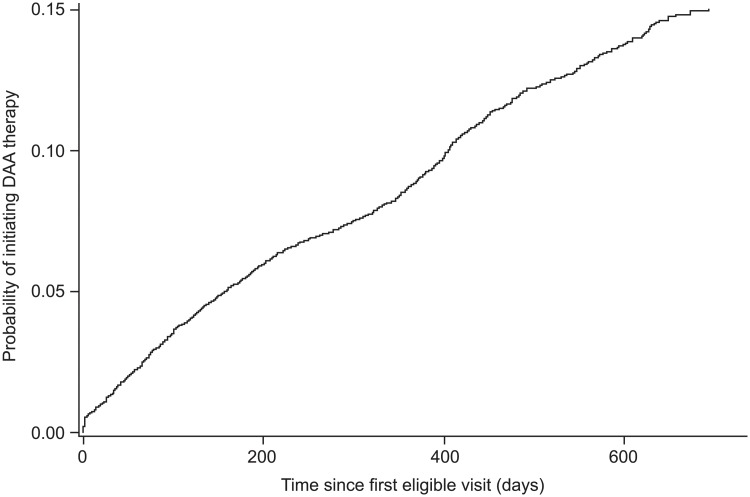
Eight hundred thirty people initiated direct-acting antiviral therapy during the 2-year observation window. The estimated incidence of treatment initiation was 8.8%±0.34% at the end of year 1 and 15.0%±0.5% at the end of year 2. Median time to initiating therapy was 300 days. Using a Cox regression analysis, positive predictors of treatment initiation included age (hazard ratio, 1.008), prior hepatitis C virus treatment (1.74), cirrhosis (2.64), and history of liver transplant (1.5). History of drug abuse (0.43), high baseline alanine aminotransferase levels (0.79), hepatitis B virus infection (0.41), and self-pay (0.39) were negatively associated with treatment initiation. In the evaluable population (n = 423), 83.9% (95% confidence interval, 80.1-87.3%) of people achieved sustained virologic response.
In the early years of the direct-acting antiviral era, <10% of people diagnosed with chronic hepatitis C virus infection received direct-acting antiviral treatment; median time to treatment initiation was 300 days. Future analyses should evaluate time to treatment initiation among those with less advanced fibrosis.
美国有关丙型肝炎病毒感染直接作用抗病毒治疗启动和应用的数据有限。本研究评估了在直接作用抗病毒治疗问世的最初 2 年内,所有口服直接作用抗病毒药物治疗时,丙型肝炎病毒感染者接受治疗的启动、治疗时间和真实世界疗效。
采用回顾性队列分析,从印第安纳大学健康数据库中提取 2014 年 1 月 1 日至 2015 年 12 月 31 日期间诊断为慢性丙型肝炎病毒感染且年龄>18 岁的丙型肝炎病毒感染者的电子病历和图表记录进行分析。
在 2 年观察窗口期间,830 人启动了直接作用抗病毒治疗。在第 1 年末,治疗启动的估计发生率为 8.8%±0.34%,在第 2 年末为 15.0%±0.5%。中位启动治疗时间为 300 天。采用 Cox 回归分析,治疗启动的阳性预测因素包括年龄(风险比,1.008)、既往丙型肝炎病毒治疗(1.74)、肝硬化(2.64)和肝移植史(1.5)。药物滥用史(0.43)、基线丙氨酸氨基转移酶水平较高(0.79)、乙型肝炎病毒感染(0.41)和自费(0.39)与治疗启动呈负相关。在可评估人群(n=423)中,83.9%(95%置信区间,80.1-87.3%)的人获得持续病毒学应答。
在直接作用抗病毒治疗时代的早期,<10%的慢性丙型肝炎病毒感染者接受了直接作用抗病毒治疗;中位治疗启动时间为 300 天。未来的分析应评估纤维化程度较低者的治疗启动时间。