Department of Pharmaceutics, School of Pharmacy, Guangdong Pharmaceutical University, Guangzhou 510006, People's Republic of China.
Department of Pharmacy of Chinese Materia Medica, School of Traditional Chinese Medicine, Guangdong Pharmaceutical University, Guangzhou 510006, People's Republic of China.
Int J Nanomedicine. 2019 Jul 23;14:5623-5636. doi: 10.2147/IJN.S203911. eCollection 2019.
The objective of this study was to compare the in vitro Fick's first law, in vitro lipolysis, and in vivo rat assays for oral absorption of Biopharmaceutical Classification Systems Class II (BCS II) drugs in self-nanoemulsifying drug delivery system (SNEDDS), and studied drugs and oils properties effects on the absorption.
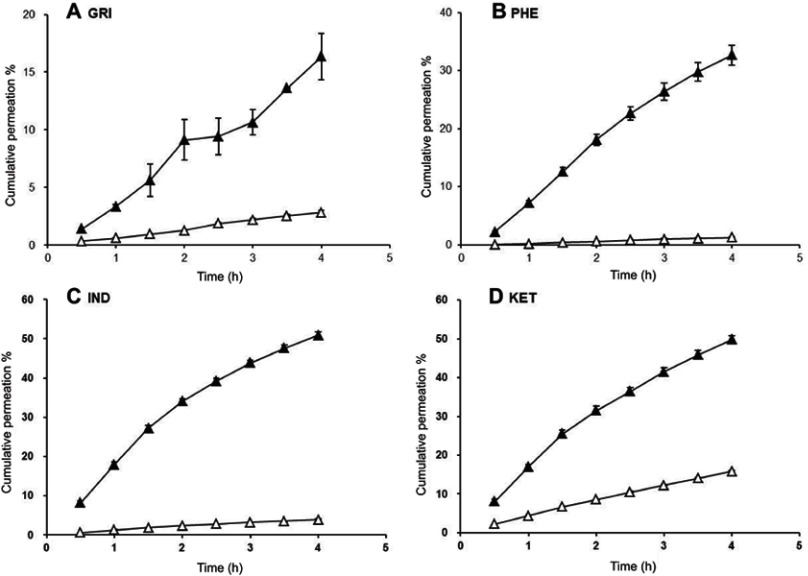
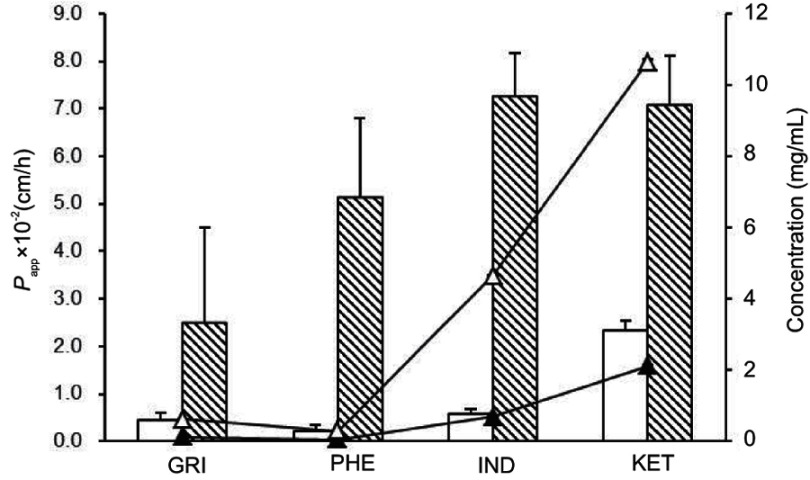
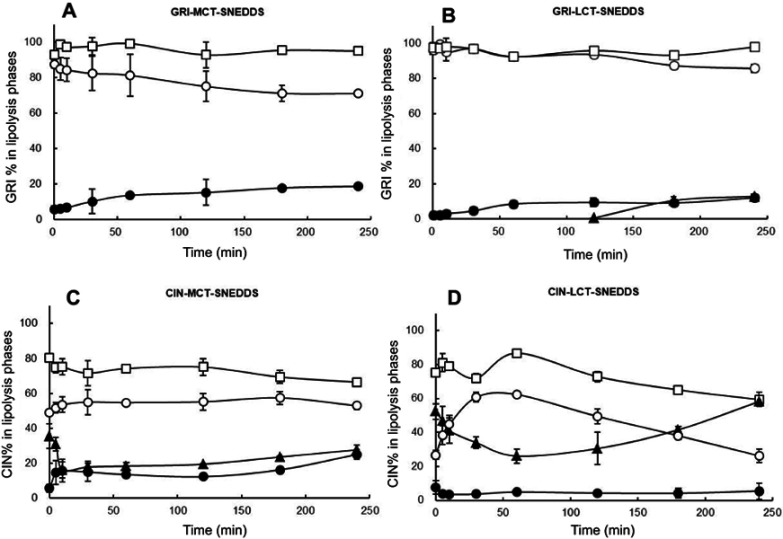
The transport abilities of griseofulvin (GRI), phenytoin (PHE), indomethacin (IND), and ketoprofen (KET) in saturated water solutions and SNEDDS were investigated using the in vitro Madin-Darby canine kidney cell model. GRI and cinnarizine (CIN) in medium-chain triglycerides (MCT)-SNEDDS and long-chain triglycerides (LCT)-SNEDDS were administered in the in vivo SD rat and in vitro lipolysis models to compare the oral absorption and the distribution behaviors in GIT and build an in vitro-in vivo correlation (IVIVC).
In the cell model, the solubility of GRI, PHE, IND, and KET increased 6-8 fold by SNEDDS, but their permeability were only 18%, 4%, 8%, and 33% of those of their saturated water solutions, respectively. However, in vivo absorption of GRI-SNEDDS was twice that of the GRI suspension and those of CIN-SNEDDS were 15-21 fold those of the CIN suspension. In the lipolysis model, the GRI% in aqueous and pellet phases of MCT were similar to that in LCT. In contrast, the CIN% in the aqueous and pellet phases were decreased but that of the lipid phase increased. In addition, an IVIVC was found between the CIN% in the lipid phase and in vivo relative oral bioavailability ( ).
The in vitro cell model was still a suitable tool to study drug properties effects on biofilm transport and SNEDDS absorption mechanisms. The in vitro lipolysis model provided superior oral absorption simulation of SNEDDS and helped to build correlation with in vivo rats. The oral drug absorption was affected by drug and oil properties in SNEDDS.
本研究旨在比较体外菲克第一定律、体外脂肪分解和体内大鼠试验,以评估生物药剂学分类系统(BCS)Ⅱ类药物在自微乳给药系统(SNEDDS)中的口服吸收情况,并研究药物和油类性质对吸收的影响。
采用体外马-达比犬肾细胞模型,研究灰黄霉素(GRI)、苯妥英(PHE)、吲哚美辛(IND)和酮洛芬(KET)在饱和水溶液和 SNEDDS 中的转运能力。将 GRI 和肉桂嗪(CIN)分别置于中链甘油三酯(MCT)-SNEDDS 和长链甘油三酯(LCT)-SNEDDS 中,通过体内 SD 大鼠和体外脂肪分解模型进行给药,比较口服吸收和在胃肠道中的分布行为,并建立体外-体内相关性(IVIVC)。
在细胞模型中,GRI、PHE、IND 和 KET 的溶解度通过 SNEDDS 分别提高了 6-8 倍,但它们的通透性仅为其饱和水溶液的 18%、4%、8%和 33%。然而,GRI-SNEDDS 的体内吸收是 GRI 混悬液的两倍,CIN-SNEDDS 的吸收是 CIN 混悬液的 15-21 倍。在脂肪分解模型中,MCT 中的 GRI 在水相和颗粒相的比例与 LCT 相似。相比之下,CIN 在水相和颗粒相的比例降低,但在脂质相的比例增加。此外,还发现 CIN 在脂质相的比例与体内相对口服生物利用度()之间存在 IVIVC。
体外细胞模型仍然是研究药物性质对生物膜转运和 SNEDDS 吸收机制影响的合适工具。体外脂肪分解模型为 SNEDDS 的口服吸收提供了更优越的模拟,并有助于与体内大鼠建立相关性。SNEDDS 中的药物和油类性质影响药物的口服吸收。