Laboratory for the Study of Upper Airway Dysfunction, Teachers College, Columbia University, New York, NY, 10027, USA.
NYU Swallowing Research Lab, Steinhardt, School of Culture, Education, and Human Development, New York University, New York, NY, 10012, USA.
Dysphagia. 2020 Apr;35(2):389-398. doi: 10.1007/s00455-019-10052-7. Epub 2019 Aug 24.
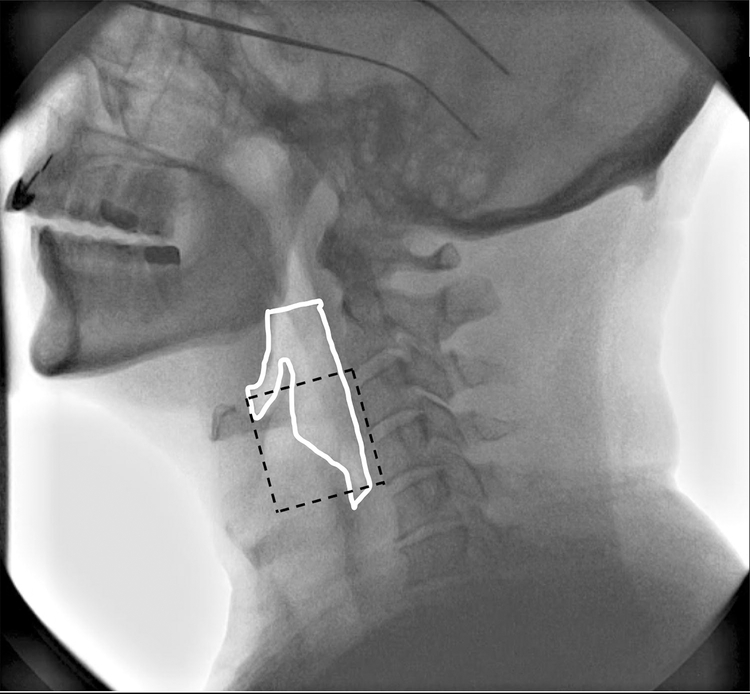
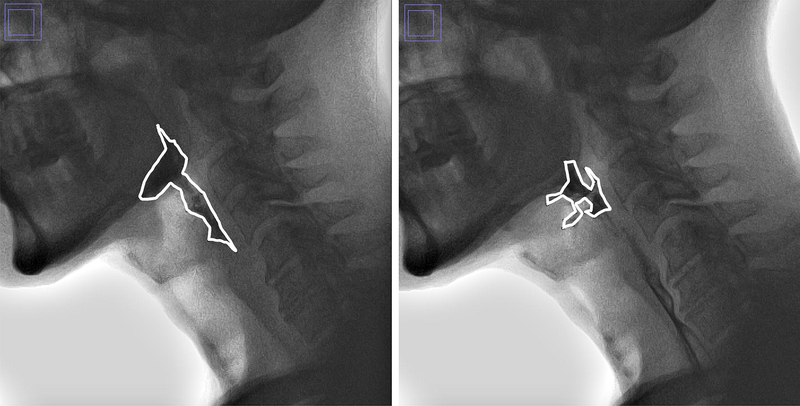
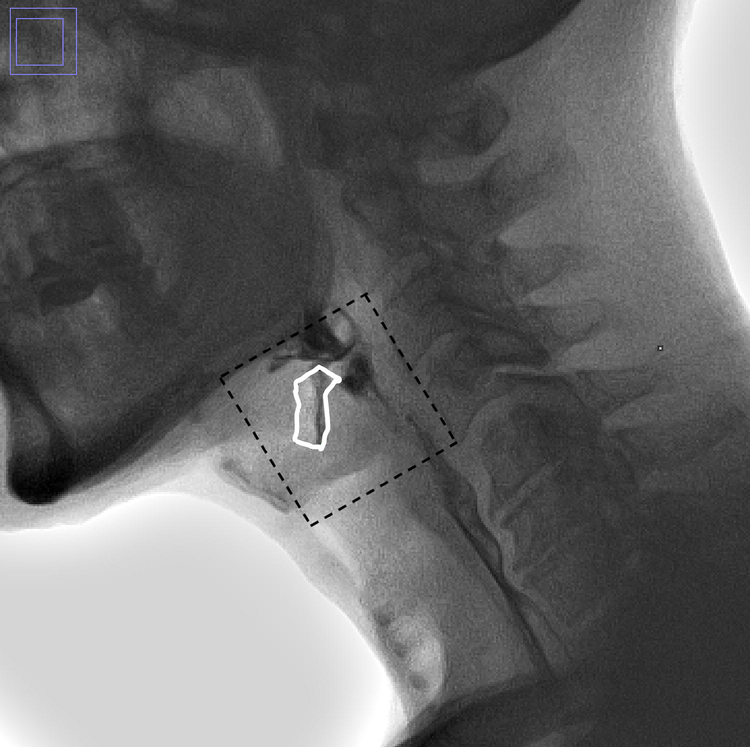
Pharyngeal area can increase as a function of normal healthy aging and muscle atrophy. These increases in pharyngeal area can negatively affect swallowing function in healthy older adults (HOA). However, the presence of pharyngeal area changes and their effects on swallowing function in Parkinson's disease (PD) remain unknown. Therefore, we compared the pharyngeal area of people with PD to HOA to determine if pharyngeal area changes were present in PD above and beyond what is seen in HOA. Within PD, we also evaluated if and how an increase in pharyngeal area affects swallowing kinematics, swallowing safety, and swallowing efficiency. A secondary analysis of videofluoroscopic swallow studies was completed comparing 41 HOA and 40 people with PD. Measures of pharyngeal area, swallowing kinematics, swallowing safety (penetration/aspiration), and swallowing efficiency (residue) were analyzed. An analysis of covariance (ANCOVA) was used to determine if pharyngeal area was significantly different between the HOA and PD groups while controlling for age, sex, and height. Regression analyses were used to examine if and how pharyngeal area influenced swallowing kinematics, swallowing safety, and swallowing efficiency in PD. Pharyngeal areas were significantly larger for people with PD when compared to HOA (p = .008). An increase in pharyngeal area was associated with less pharyngeal constriction (p = .022), shorter duration of airway closure (p = .017), worse swallowing safety (p < .0005), and worse swallowing efficiency (p = .037). This study revealed that pharyngeal areas are larger in people with PD when compared to HOA, and that this increase in pharyngeal area is associated with maladaptive changes to swallowing kinematics, residue, and penetration/aspiration. These findings support the notion that pharyngeal muscle atrophy may be exacerbated in PD above and beyond what is seen in normal, healthy aging group. Results from this study highlight the need to consider pharyngeal muscle atrophy as a source for swallowing dysfunction in PD, and as a potential treatment target for swallowing rehabilitation.
咽区会随着正常健康衰老和肌肉萎缩而增大。这些咽区的增加会对健康老年人(HOA)的吞咽功能产生负面影响。然而,帕金森病(PD)患者咽区变化及其对吞咽功能的影响尚不清楚。因此,我们比较了 PD 患者与 HOA 患者的咽区,以确定 PD 患者的咽区变化是否超过了 HOA 患者。在 PD 患者中,我们还评估了咽区增加是否以及如何影响吞咽运动学、吞咽安全性和吞咽效率。通过比较 41 名 HOA 和 40 名 PD 患者的视频透视吞咽研究进行了二次分析。分析了咽区、吞咽运动学、吞咽安全性(渗透/吸入)和吞咽效率(残留)的测量值。使用协方差分析(ANCOVA)来确定在控制年龄、性别和身高的情况下,HOA 和 PD 组之间咽区是否有显著差异。回归分析用于检查 PD 患者中咽区如何影响吞咽运动学、吞咽安全性和吞咽效率。与 HOA 相比,PD 患者的咽区明显更大(p=0.008)。咽区增加与咽缩肌收缩减少(p=0.022)、气道关闭持续时间缩短(p=0.017)、吞咽安全性恶化(p<0.0005)和吞咽效率恶化(p=0.037)相关。这项研究表明,与 HOA 相比,PD 患者的咽区更大,并且咽区的增加与吞咽运动学、残留和渗透/吸入的适应性变化相关。这些发现支持这样一种观点,即咽肌萎缩在 PD 中可能比在正常健康衰老组中更为严重。本研究的结果强调了需要将咽肌萎缩视为 PD 吞咽功能障碍的一个来源,并将其作为吞咽康复的潜在治疗靶点。