• 文献检索
  • 文档翻译
  • 深度研究
  • 学术资讯
  • Suppr Zotero 插件Zotero 插件
  • 邀请有礼
  • 套餐&价格
  • 历史记录
应用&插件
Suppr Zotero 插件Zotero 插件浏览器插件Mac 客户端Windows 客户端微信小程序
定价
高级版会员购买积分包购买API积分包
服务
文献检索文档翻译深度研究API 文档MCP 服务
关于我们
关于 Suppr公司介绍联系我们用户协议隐私条款
关注我们

Suppr 超能文献

核心技术专利:CN118964589B侵权必究
粤ICP备2023148730 号-1Suppr @ 2026

文献检索

告别复杂PubMed语法,用中文像聊天一样搜索,搜遍4000万医学文献。AI智能推荐,让科研检索更轻松。

立即免费搜索

文件翻译

保留排版,准确专业,支持PDF/Word/PPT等文件格式,支持 12+语言互译。

免费翻译文档

深度研究

AI帮你快速写综述,25分钟生成高质量综述,智能提取关键信息,辅助科研写作。

立即免费体验

新生儿败血症的流行病学及相关因素:埃塞俄比亚东南部阿尔西大学教学与转诊医院新生儿重症监护病房的观察性研究

Epidemiology of Neonatal Sepsis and Associated Factors Implicated: Observational Study at Neonatal Intensive Care Unit of Arsi University Teaching and Referral Hospital, South East Ethiopia.

作者信息

Sorsa Abebe

机构信息

Department of pediatrics and child health Arsi University College of Health Science, Asella, Ethiopia.

出版信息

Ethiop J Health Sci. 2019 May;29(3):333-342. doi: 10.4314/ejhs.v29i3.5.

DOI:10.4314/ejhs.v29i3.5
PMID:31447501
原文链接:https://pmc.ncbi.nlm.nih.gov/articles/PMC6689722/
Abstract

BACKGROUND

Globally, sepsis remains one of the major causes of morbidity and mortality in neonates, in spite of recent advances in health care units. The major burden of the problem occurs in the developing world while most evidence is derived from developed countries. The objective of this study was to evaluate the epidemiology of neonatal sepsis and associated factors among neonates admitted to Neonatal Intensive Care Unit (NICU).

METHODS

Hospital based prospective cross-sectional study was conducted from April 2016 to May 2017. Neonates with clinical sepsis were included into the study. Data were analyzed using SPSS version 20. Frequencies, proportion and summary statistics were used to describe the study population in relation to relevant variables. Multivariate logistic regressions were used to assess factors associated with neonatal sepsis. p-values of < 0.05 were considered statistically significant.

RESULTS

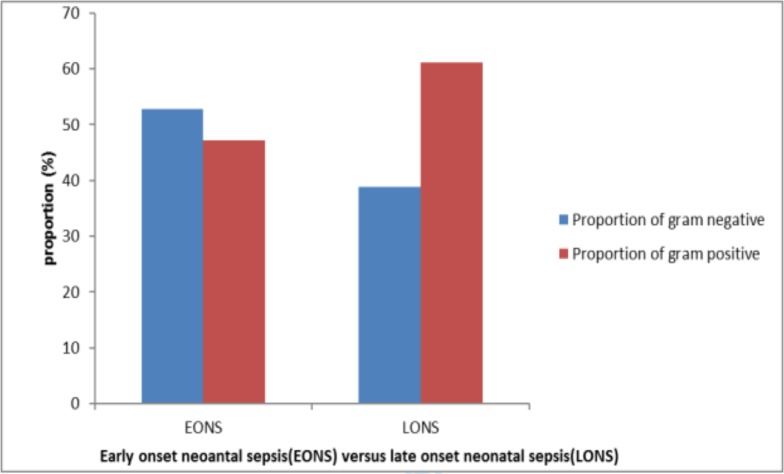
A total of 901neonates were admitted to NICU of which 303 neonates were admitted with diagnosis of clinical sepsis making the prevalence of neonatal sepsis to be 34%. Bacteremia were confirmed in 88/303(29.3%) of clinical sepsis, and gram-positive bacteria constituted 47/88(53.4%). Of all positive blood cultures, 52/88(59.1%) were reported from late onset sepsis. Coagulase negative staphylococcus (CoNS) accounted for 22/88(25%) followed by E. coli and S. aureus, each contributing 18/88(20.3%) and 16/88(18.2%) respectively. Prolonged PROM, low fifth Apgar score, prematurity and low birth weight were strongly associated with increased risk of neonatal sepsis. Neonates born to mothers who received antibiotics during labor and delivery were at significantly lower risk of acquiring neonatal sepsis.

CONCLUSION

The prevalence of neonatal sepsis was high, and most causes of neonatal sepsis were gram positive bacteria and most bacteria isolates were from late onset sepsis. Obstetric factors were strongly associated with development of neonatal sepsis. Intrapartal antibiotic administration significantly reduces neonatal sepsis.

摘要

背景

在全球范围内,尽管医疗保健单位最近取得了进展,但败血症仍然是新生儿发病和死亡的主要原因之一。该问题的主要负担发生在发展中世界,而大多数证据来自发达国家。本研究的目的是评估新生儿重症监护病房(NICU)收治的新生儿败血症的流行病学及相关因素。

方法

于2016年4月至2017年5月进行了一项基于医院的前瞻性横断面研究。纳入有临床败血症的新生儿。使用SPSS 20版进行数据分析。频率、比例和汇总统计用于描述研究人群与相关变量的关系。多变量逻辑回归用于评估与新生儿败血症相关的因素。p值<0.05被认为具有统计学意义。

结果

共有901名新生儿入住NICU,其中303名新生儿被诊断为临床败血症,新生儿败血症的患病率为34%。88/303(29.3%)的临床败血症病例确诊为菌血症,革兰氏阳性菌占47/88(53.4%)。在所有阳性血培养中,52/88(59.1%)报告自晚发性败血症。凝固酶阴性葡萄球菌(CoNS)占22/88(25%),其次是大肠杆菌和金黄色葡萄球菌,各占18/88(20.3%)和16/88(18.2%)。胎膜早破时间延长、阿氏评分低、早产和低出生体重与新生儿败血症风险增加密切相关。在分娩期间接受抗生素治疗的母亲所生的新生儿患新生儿败血症的风险显著降低。

结论

新生儿败血症的患病率很高,新生儿败血症的大多数病因是革兰氏阳性菌,大多数细菌分离株来自晚发性败血症。产科因素与新生儿败血症的发生密切相关。产时抗生素给药可显著降低新生儿败血症。
https://cdn.ncbi.nlm.nih.gov/pmc/blobs/0901/6689722/153c043fff25/EJHS2903-0333Fig1.jpg

相似文献

1
Epidemiology of Neonatal Sepsis and Associated Factors Implicated: Observational Study at Neonatal Intensive Care Unit of Arsi University Teaching and Referral Hospital, South East Ethiopia.新生儿败血症的流行病学及相关因素:埃塞俄比亚东南部阿尔西大学教学与转诊医院新生儿重症监护病房的观察性研究
Ethiop J Health Sci. 2019 May;29(3):333-342. doi: 10.4314/ejhs.v29i3.5.
2
Blood culture result profile and antimicrobial resistance pattern: a report from neonatal intensive care unit (NICU), Asella teaching and referral hospital, Asella, south East Ethiopia.血培养结果特征和抗菌药物耐药模式:来自埃塞俄比亚东南阿斯马拉教学和转诊医院新生儿重症监护病房(NICU)的报告。
Antimicrob Resist Infect Control. 2019 Feb 20;8:42. doi: 10.1186/s13756-019-0486-6. eCollection 2019.
3
Magnitude of neonatal sepsis and its associated factors among neonates admitted to the neonatal intensive care unit in Hawassa Comprehensive Specialized Hospital, Sidama Regional State, Ethiopia, 2020.2020 年,在埃塞俄比亚锡达马州哈瓦萨综合专科医院新生儿重症监护病房住院的新生儿中,新生儿败血症的严重程度及其相关因素。
BMC Pregnancy Childbirth. 2024 May 22;24(1):383. doi: 10.1186/s12884-024-06583-z.
4
Bacteriological profile and antibiotic susceptibility of neonatal sepsis in neonatal intensive care unit of a tertiary hospital in Nepal.尼泊尔一家三级医院新生儿重症监护病房新生儿败血症的细菌学特征及抗生素敏感性
BMC Pediatr. 2018 Jun 27;18(1):208. doi: 10.1186/s12887-018-1176-x.
5
Magnitude of Neonatal Sepsis and Factors Associated with It among Neonates Admitted to the Intensive Care Units of Neonate in the Primary Hospital of Hawzen, Tigray, Ethiopia, 2020.2020 年,在埃塞俄比亚提格雷的 Hawzen 地区初级医院新生儿重症监护病房住院的新生儿中,新生儿败血症的严重程度及其相关因素。
Glob Health Epidemiol Genom. 2024 Aug 22;2024:7393056. doi: 10.1155/2024/7393056. eCollection 2024.
6
Treatment outcome of neonatal sepsis and associated factors among neonates admitted to neonatal intensive care unit in public hospitals, Addis Ababa, Ethiopia, 2021. Multi-center cross-sectional study.2021 年,埃塞俄比亚亚的斯亚贝巴公立医院新生儿重症监护病房新生儿败血症的治疗结果及相关因素。多中心横断面研究。
PLoS One. 2023 May 30;18(5):e0284983. doi: 10.1371/journal.pone.0284983. eCollection 2023.
7
Prevalence and antibiotic resistance pattern of bacteria from sepsis suspected neonates at St. Paul's Hospital Millennium Medical College, Addis Ababa, Ethiopia.埃塞俄比亚亚的斯亚贝巴圣保罗医院千年医药学院疑似败血症新生儿的细菌流行情况和抗生素耐药模式。
BMC Pediatr. 2023 Nov 18;23(1):575. doi: 10.1186/s12887-023-04399-y.
8
Etiology of early onset neonatal sepsis in neonatal intensive care unit - Mansoura, Egypt.埃及曼苏拉新生儿重症监护病房早发型新生儿败血症的病因
J Neonatal Perinatal Med. 2018;11(3):323-330. doi: 10.3233/NPM-17128.
9
Neonatal mortality and associated factors among neonates admitted to neonatal intensive care unit at public hospitals of Somali Regional State, Eastern Ethiopia: A multicenter retrospective analysis.在埃塞俄比亚东部索马里州公立医院新生儿重症监护病房住院的新生儿的死亡率及其相关因素:一项多中心回顾性分析。
PLoS One. 2022 May 26;17(5):e0268648. doi: 10.1371/journal.pone.0268648. eCollection 2022.
10
Phenotypic bacterial epidemiology and antimicrobial resistance profiles in neonatal sepsis at Jimma medical center, Ethiopia: Insights from prospective study.埃塞俄比亚吉马医疗中心新生儿败血症的表型细菌流行病学和抗菌药物耐药性概况:前瞻性研究的见解
PLoS One. 2024 Sep 16;19(9):e0310376. doi: 10.1371/journal.pone.0310376. eCollection 2024.

引用本文的文献

1
Statin utilization and its predictors for the primary prevention of cardiovascular disease among type 2 diabetic patients in a resource-limited setting.资源有限环境下2型糖尿病患者中他汀类药物的使用情况及其用于心血管疾病一级预防的预测因素
Front Endocrinol (Lausanne). 2025 Jul 4;16:1472300. doi: 10.3389/fendo.2025.1472300. eCollection 2025.
2
The burden of neonatal sepsis and its risk factors in Africa. a systematic review and meta-analysis.非洲新生儿败血症的负担及其危险因素。一项系统评价和荟萃分析。
BMC Public Health. 2025 Mar 3;25(1):847. doi: 10.1186/s12889-025-22076-w.
3
Trends of neonatal sepsis and its etiology at Hawassa, Ethiopia: a five year retrospective cross-sectional study.

本文引用的文献

1
Bacterial etiologic agents causing neonatal sepsis and associated risk factors in Gondar, Northwest Ethiopia.埃塞俄比亚西北部贡德尔地区引起新生儿败血症的细菌病原体及相关危险因素
BMC Pediatr. 2017 Jun 6;17(1):137. doi: 10.1186/s12887-017-0892-y.
2
Antimicrobial resistance pattern: a report of microbiological cultures at a tertiary hospital in Tanzania.抗菌药物耐药模式:坦桑尼亚一家三级医院的微生物培养报告
BMC Infect Dis. 2016 Dec 13;16(1):756. doi: 10.1186/s12879-016-2082-1.
3
Neonatal bloodstream infections in a Ghanaian Tertiary Hospital: Are the current antibiotic recommendations adequate?
埃塞俄比亚哈瓦萨新生儿败血症及其病因的趋势:一项五年回顾性横断面研究。
BMC Pediatr. 2025 Feb 28;25(1):152. doi: 10.1186/s12887-025-05515-w.
4
Prevalence and pathogen profiles of bacteremia in neonates hospitalized for clinical Sepsis in Ethiopia: a systematic review and meta-analysis.埃塞俄比亚因临床脓毒症住院新生儿的菌血症患病率及病原体谱:一项系统评价和荟萃分析
BMC Infect Dis. 2024 Dec 18;24(1):1424. doi: 10.1186/s12879-024-10312-4.
5
Early onset neonatal sepsis and its associatited factors: a cross sectional study.早发型新生儿败血症及其相关因素:一项横断面研究。
BMC Pregnancy Childbirth. 2024 Sep 28;24(1):617. doi: 10.1186/s12884-024-06820-5.
6
Magnitude of neonatal sepsis and its associated factors among neonates admitted to the neonatal intensive care unit in Hawassa Comprehensive Specialized Hospital, Sidama Regional State, Ethiopia, 2020.2020 年,在埃塞俄比亚锡达马州哈瓦萨综合专科医院新生儿重症监护病房住院的新生儿中,新生儿败血症的严重程度及其相关因素。
BMC Pregnancy Childbirth. 2024 May 22;24(1):383. doi: 10.1186/s12884-024-06583-z.
7
Determinants and Magnitude of Neonatal Sepsis at Hiwot Fana Comprehensive Specialized University Hospital, in Eastern Ethiopia: A Cross-Sectional Study.埃塞俄比亚东部希沃特·法纳综合专科医院新生儿败血症的决定因素及严重程度:一项横断面研究
Clin Med Insights Pediatr. 2024 Mar 28;18:11795565241242656. doi: 10.1177/11795565241242656. eCollection 2024.
8
Time to recovery from neonatal sepsis and its determinants among neonates admitted in Woldia comprehensive specialized hospital, Northeast Ethiopia: a retrospective cohort study.埃塞俄比亚东北部沃尔迪亚综合专科医院收治的新生儿从新生儿败血症中恢复所需时间及其决定因素:一项回顾性队列研究
Front Pediatr. 2024 Jan 25;11:1289593. doi: 10.3389/fped.2023.1289593. eCollection 2023.
9
Prevalence and factors associated with maternal and neonatal sepsis in sub-Saharan Africa: a systematic review and meta-analysis.撒哈拉以南非洲地区孕产妇和新生儿败血症的流行情况及相关因素:系统评价和荟萃分析。
Front Public Health. 2024 Jan 24;12:1272193. doi: 10.3389/fpubh.2024.1272193. eCollection 2024.
10
Determinants of Neonatal Sepsis among Neonates Admitted in a Neonatal Intensive Care Unit at Injibara General Hospital, Awi Zone, and Amhara Regional State, Ethiopia.埃塞俄比亚阿姆哈拉州阿维地区因吉巴拉综合医院新生儿重症监护病房收治的新生儿中新生儿败血症的决定因素。
Glob Pediatr Health. 2024 Jan 31;11:2333794X241228062. doi: 10.1177/2333794X241228062. eCollection 2024.
加纳一家三级医院的新生儿血流感染:当前的抗生素推荐是否足够?
BMC Infect Dis. 2016 Oct 24;16(1):598. doi: 10.1186/s12879-016-1913-4.
4
Early and Late Infections in Newborns: Where Do We Stand? A Review.新生儿的早期和晚期感染:我们目前的状况如何?一篇综述。
Pediatr Neonatol. 2016 Aug;57(4):265-73. doi: 10.1016/j.pedneo.2015.09.007. Epub 2015 Dec 2.
5
Epidemiology of Neonatal Sepsis and Implicated Pathogens: A Study from Egypt.新生儿败血症的流行病学及相关病原体:来自埃及的一项研究。
Biomed Res Int. 2015;2015:509484. doi: 10.1155/2015/509484. Epub 2015 Jun 4.
6
Burden of bacterial resistance among neonatal infections in low income countries: how convincing is the epidemiological evidence?低收入国家新生儿感染中的细菌耐药负担:流行病学证据有多令人信服?
BMC Infect Dis. 2015 Mar 15;15:127. doi: 10.1186/s12879-015-0843-x.
7
Empiric treatment of neonatal sepsis in developing countries.发展中国家新生儿败血症的经验性治疗。
Pediatr Infect Dis J. 2015 Jun;34(6):659-61. doi: 10.1097/INF.0000000000000692.
8
Utility of qualitative C- reactive protein assay and white blood cells counts in the diagnosis of neonatal septicaemia at Bugando Medical Centre, Tanzania.定性C反应蛋白检测和白细胞计数在坦桑尼亚布甘多医疗中心新生儿败血症诊断中的应用
BMC Pediatr. 2014 Oct 3;14:248. doi: 10.1186/1471-2431-14-248.
9
Neonatal sepsis: an old problem with new insights.新生儿败血症:一个具有新见解的老问题。
Virulence. 2014 Jan 1;5(1):170-8. doi: 10.4161/viru.26906. Epub 2013 Nov 1.
10
Trends in incidence of neonatal sepsis and antibiotic susceptibility of causative agents in two neonatal intensive care units in tehran, I.R iran.伊朗德黑兰两个新生儿重症监护病房新生儿败血症发病率及病原体抗生素敏感性趋势
J Clin Neonatol. 2012 Jul;1(3):124-30. doi: 10.4103/2249-4847.101692.