Péterfalvi Ágnes, Németh Nándor, Herczeg Róbert, Tényi Tamás, Miseta Attila, Czéh Boldizsár, Simon Maria
Neurobiology of Stress Research Group, Szentágothai Research Centre, University of Pécs, Pécs, Hungary.
Department of Laboratory Medicine, Medical School, University of Pécs, Pécs, Hungary.
Front Psychol. 2019 Aug 6;10:1798. doi: 10.3389/fpsyg.2019.01798. eCollection 2019.
Early childhood adversity is a strong predictor of the development of major depressive disorder (MDD), but not all depressed patients experience early life stress (ELS). Cardio-metabolic diseases and cognitive deficits often coincide in MDD and worsen its course and outcome. Adverse childhood experiences have been associated with elevated risk for cardiovascular disease (CVD), but little is known on the impact of ELS on cardiovascular risk factors in MDD. Here, we examined MDD patients with and without ELS to explore the effects of ELS on serum lipid and lipoprotein levels and on cognitive performances of the patients.
Participants with a mean age of 35 years (18-55 years) were recruited from the university mental health clinic and general community. Three groups, matched in age, gender and lifestyle were examined: MDD patients with ELS ( = 21), MDD patients without ELS ( = 21), and healthy controls ( = 20). The following CVD risk factors were assessed: serum lipids (total cholesterol, triglycerides, high- and low-density lipoproteins), body mass index and exercise in a typical week. MDD severity was measured by the Beck Depression Inventory. Childhood Trauma Questionnaire was used to assess early life adversities. Executive functions and attentional processes were assessed by the Wisconsin Card Sorting and Conners' Continuous Performance tests.
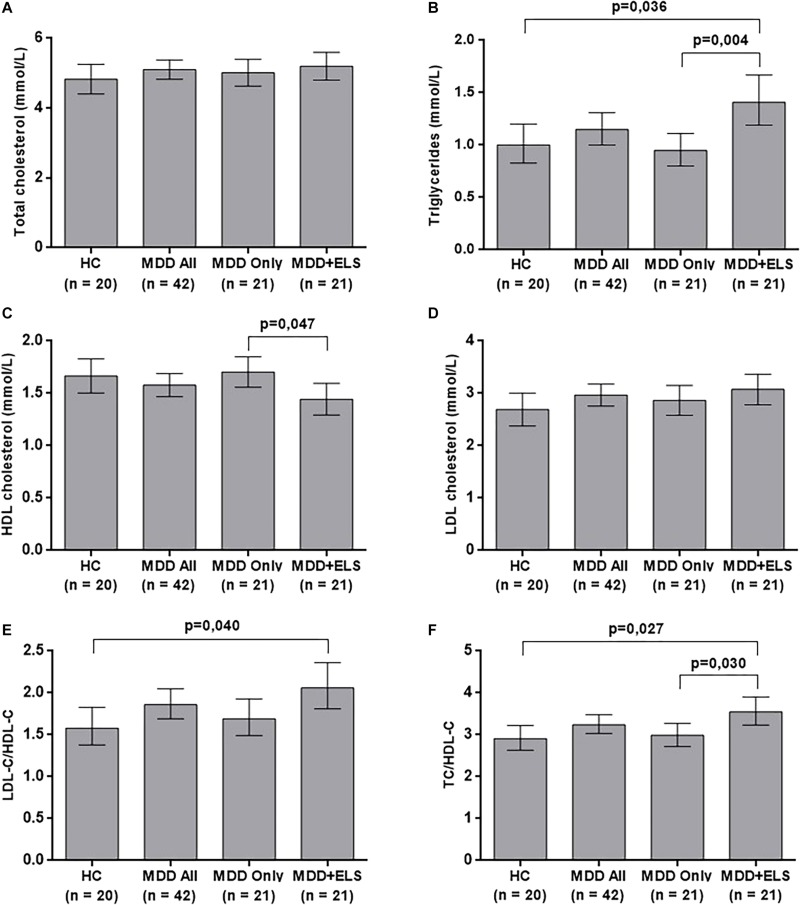
Major depressive disorder patients with ELS had higher serum triglyceride and lower HDL-cholesterol concentrations compared to MDD patients without ELS. Linear regression analysis revealed that the severity of ELS had a significant negative association with HDL-cholesterol levels and significant positive associations with the serum levels of TG and TC/HDL-cholesterol index. We also found significant associations between some specific trauma types and lipid profiles. Finally, we could detect significant associations between depression severity and specific domains of the cognitive tests as well as between lipid profiles and certain domains of the Wisconsin Card Sorting Test. However, we could not detect any association between the severity of ELS and cognitive performance.
After controlling for depressive symptom severity and lifestyle variables, ELS was found to be a strong predictor of serum lipid alterations. Several, inter-correlated pathways may mediate the undesirable effects of ELS on the course and outcome of MDD.
童年早期逆境是重度抑郁症(MDD)发病的一个有力预测因素,但并非所有抑郁症患者都经历过早期生活应激(ELS)。心脏代谢疾病和认知缺陷在MDD中常常同时出现,并会使病情及其病程和预后恶化。童年不良经历与心血管疾病(CVD)风险升高有关,但关于ELS对MDD患者心血管危险因素的影响却知之甚少。在此,我们对有和没有ELS的MDD患者进行了研究,以探讨ELS对患者血清脂质和脂蛋白水平以及认知表现的影响。
从大学心理健康诊所和普通社区招募了平均年龄为35岁(18 - 55岁)的参与者。对年龄、性别和生活方式相匹配的三组人群进行了检查:有ELS的MDD患者(n = 21)、无ELS的MDD患者(n = 21)和健康对照者(n = 20)。评估了以下CVD危险因素:血清脂质(总胆固醇、甘油三酯、高密度和低密度脂蛋白)、体重指数以及典型一周内的运动量。用贝克抑郁量表测量MDD的严重程度。用儿童创伤问卷评估早期生活逆境。通过威斯康星卡片分类测验和康纳斯连续操作测验评估执行功能和注意力过程。
与无ELS的MDD患者相比,有ELS的重度抑郁症患者血清甘油三酯水平较高,高密度脂蛋白胆固醇浓度较低。线性回归分析显示,ELS的严重程度与高密度脂蛋白胆固醇水平呈显著负相关,与甘油三酯血清水平和总胆固醇/高密度脂蛋白胆固醇指数呈显著正相关。我们还发现某些特定创伤类型与血脂谱之间存在显著关联。最后,我们能够检测到抑郁严重程度与认知测试的特定领域之间以及血脂谱与威斯康星卡片分类测验的某些领域之间存在显著关联。然而,我们未检测到ELS严重程度与认知表现之间存在任何关联。
在控制了抑郁症状严重程度和生活方式变量后,发现ELS是血清脂质改变的一个有力预测因素。几条相互关联的途径可能介导了ELS对MDD病程和预后的不良影响。