Institute of Structural and Molecular Biology, Birkbeck, University of London, London, UK.
Medical Research Council Laboratory of Molecular Biology, Division of Structural Studies, Cambridge, UK.
Nat Struct Mol Biol. 2019 Sep;26(9):823-829. doi: 10.1038/s41594-019-0286-y. Epub 2019 Aug 26.
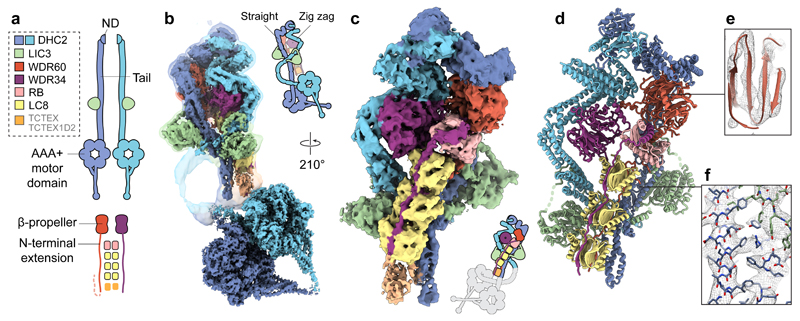
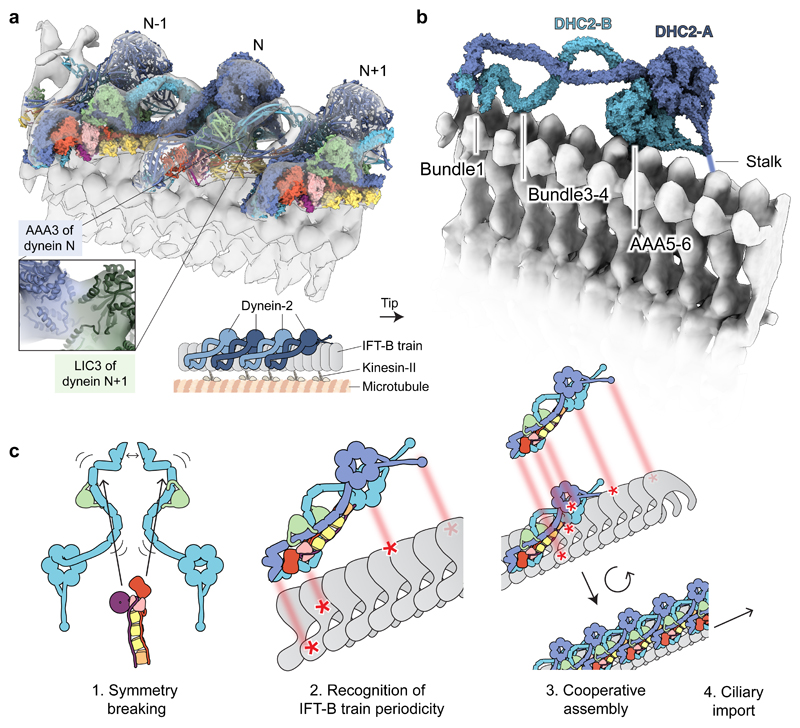
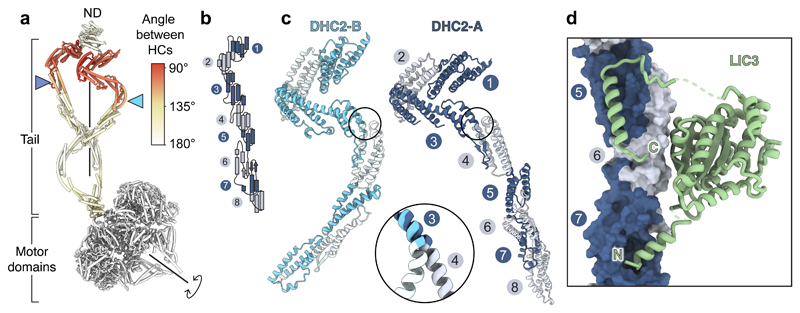
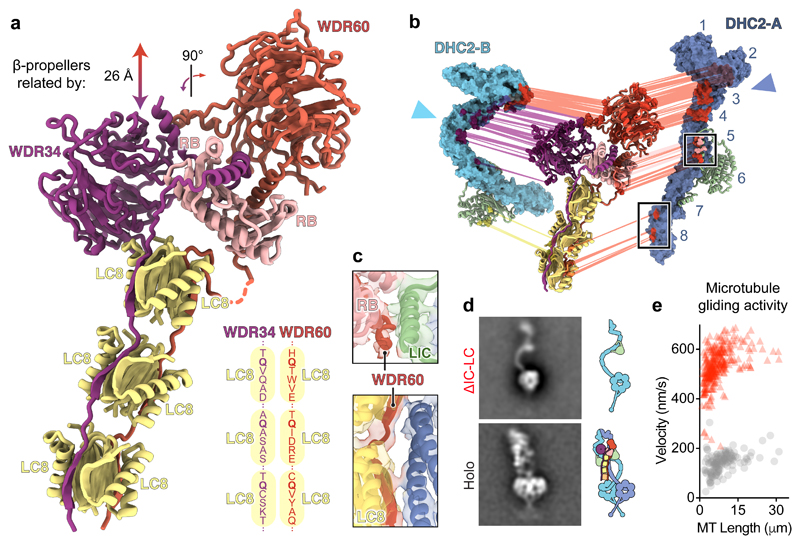
Dynein-2 assembles with polymeric intraflagellar transport (IFT) trains to form a transport machinery that is crucial for cilia biogenesis and signaling. Here we recombinantly expressed the ~1.4-MDa human dynein-2 complex and solved its cryo-EM structure to near-atomic resolution. The two identical copies of the dynein-2 heavy chain are contorted into different conformations by a WDR60-WDR34 heterodimer and a block of two RB and six LC8 light chains. One heavy chain is steered into a zig-zag conformation, which matches the periodicity of the anterograde IFT-B train. Contacts between adjacent dyneins along the train indicate a cooperative mode of assembly. Removal of the WDR60-WDR34-light chain subcomplex renders dynein-2 monomeric and relieves autoinhibition of its motility. Our results converge on a model in which an unusual stoichiometry of non-motor subunits controls dynein-2 assembly, asymmetry, and activity, giving mechanistic insight into the interaction of dynein-2 with IFT trains and the origin of diverse functions in the dynein family.
动力蛋白-2与聚合的内鞭毛运输(IFT)列车组装在一起,形成一种运输机制,对于纤毛发生和信号转导至关重要。在这里,我们重组表达了约 1.4MDa 的人源动力蛋白-2 复合物,并解析了其冷冻电镜结构,达到了近原子分辨率。动力蛋白-2 重链的两个相同拷贝通过 WDR60-WDR34 异二聚体和两个 RB 和六个 LC8 轻链块扭曲成不同的构象。一条重链被引导成锯齿状构象,与向前 IFT-B 列车的周期性相匹配。列车上相邻动力蛋白之间的接触表明组装的协作模式。去除 WDR60-WDR34-轻链亚基复合物使动力蛋白-2 单体化,并解除其运动的自动抑制。我们的结果收敛于一个模型,其中非马达亚基的不寻常比例控制动力蛋白-2 的组装、不对称性和活性,为动力蛋白-2 与 IFT 列车的相互作用以及动力蛋白家族中不同功能的起源提供了机制见解。