Department of Surgery, Division of General Surgery, Medical University of Vienna, Waehringer Guertel 18-20, 1090, Vienna, Austria.
Department of Anesthesia, General Intensive Care and Pain Management, Medical University of Vienna, Waehringer Guertel 18-20, 1090, Vienna, Austria.
Langenbecks Arch Surg. 2019 Sep;404(6):681-691. doi: 10.1007/s00423-019-01815-9. Epub 2019 Aug 26.
After successful surgery for primary hyperparathyroidism, bone mineral density (BMD) does not improve equally in all patients. As no trial has so far aimed to influence normalization of BMD, it was the goal of this investigation to determine whether pharmacological treatment is effective in improving regain of BMD after successful parathyroidectomy in patients with preoperatively diagnosed osteoporosis or osteopenia and to evaluate when treatment may be indicated.
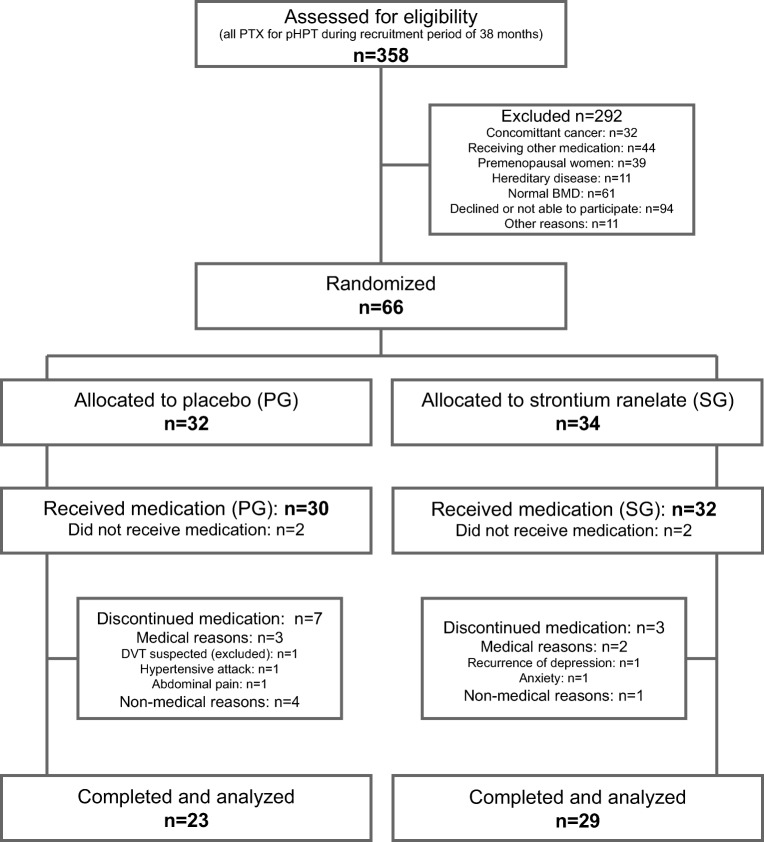
In this randomized, placebo-controlled, double-blind trial, 52 patients were treated with strontium ranelate 2 g daily + 1000 mg calcium + 800 IU vitamin D (strontium group; SG) or with 1000 mg calcium + 800 IU vitamin D alone (placebo group; PG) for 1 year. The main outcome measures were BMD (lumbar spine, femoral neck, radius) and bone turnover markers.
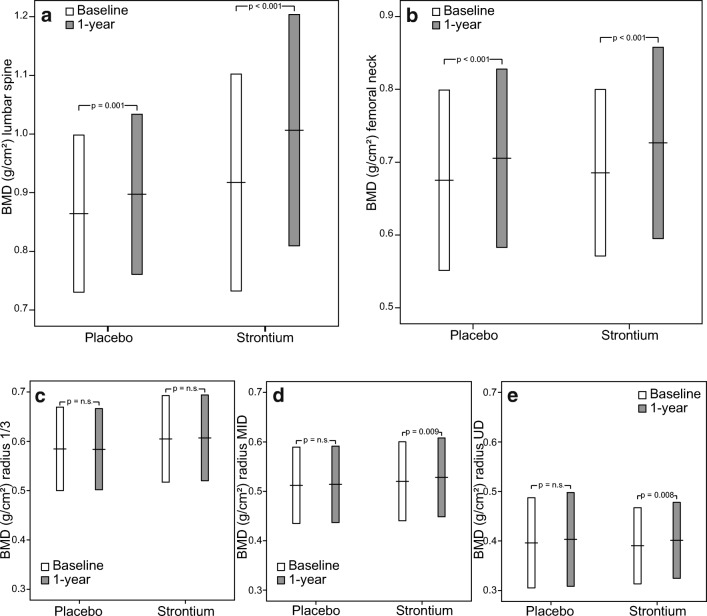
The baseline characteristics were similar in both groups. Absolute BMD (1.007 ± 0.197 vs. 0.897 ± 0.137 g/cm; p = 0.024) and both relative (9.94 vs. 3.94%; p < 0.001) and absolute (0.09 ± 0.06 vs. 0.03 ± 0.04 g/cm; p < 0.001) changes in lumbar-spine BMD were significantly higher in the SG than in the PG. Compared to baseline, BMD significantly increased in both groups at the lumbar spine (p < 0.001 and p = 0.001, respectively) and femoral neck (both p < 0.001), whereas radius BMD only changed significantly in the SG. However, the proportion of patients with osteoporosis/osteopenia significantly declined only at the lumbar spine in the SG (from 69.0 to 37.9%; p = 0.034), whereas no decrease was found in the PG. No severe adverse events occurred.
Postoperative anti-osteoporotic treatment can positively influence regain of BMD mainly in the lumbar spine and should be considered. Without treatment, most patients and especially those with low preoperative markers of bone turnover remained osteoporotic/osteopenic 1 year after surgery.
甲状旁腺功能亢进症手术后,并非所有患者的骨密度(BMD)都能得到同等改善。由于迄今为止尚无试验旨在影响 BMD 的正常化,因此本研究的目的是确定在术前诊断为骨质疏松症或骨量减少的患者中,手术后应用药物治疗是否能有效改善 BMD 的恢复,并评估何时需要进行治疗。
在这项随机、安慰剂对照、双盲试验中,52 名患者接受雷奈酸锶 2g 每日+1000mg 钙+800IU 维生素 D(锶组;SG)或仅接受 1000mg 钙+800IU 维生素 D(安慰剂组;PG)治疗 1 年。主要观察指标为 BMD(腰椎、股骨颈、桡骨)和骨转换标志物。
两组的基线特征相似。SG 的腰椎 BMD 的绝对值(1.007±0.197 比 0.897±0.137g/cm;p=0.024)和相对值(9.94 比 3.94%;p<0.001)以及绝对值(0.09±0.06 比 0.03±0.04g/cm;p<0.001)的变化均明显高于 PG。与基线相比,两组的腰椎 BMD 均显著增加(p<0.001 和 p=0.001),股骨颈 BMD 也显著增加(均 p<0.001),而桡骨 BMD 仅在 SG 中显著增加。然而,只有 SG 组的骨质疏松/骨量减少的患者比例显著下降(从 69.0%降至 37.9%;p=0.034),而 PG 组则没有下降。未发生严重不良事件。
术后抗骨质疏松治疗可积极影响 BMD 的恢复,主要是在腰椎,并应予以考虑。不进行治疗,大多数患者,尤其是那些术前骨转换标志物较低的患者,在手术后 1 年仍为骨质疏松/骨量减少。