• 文献检索
  • 文档翻译
  • 深度研究
  • 学术资讯
  • Suppr Zotero 插件Zotero 插件
  • 邀请有礼
  • 套餐&价格
  • 历史记录
应用&插件
Suppr Zotero 插件Zotero 插件浏览器插件Mac 客户端Windows 客户端微信小程序
定价
高级版会员购买积分包购买API积分包
服务
文献检索文档翻译深度研究API 文档MCP 服务
关于我们
关于 Suppr公司介绍联系我们用户协议隐私条款
关注我们

Suppr 超能文献

核心技术专利:CN118964589B侵权必究
粤ICP备2023148730 号-1Suppr @ 2026

文献检索

告别复杂PubMed语法,用中文像聊天一样搜索,搜遍4000万医学文献。AI智能推荐,让科研检索更轻松。

立即免费搜索

文件翻译

保留排版,准确专业,支持PDF/Word/PPT等文件格式,支持 12+语言互译。

免费翻译文档

深度研究

AI帮你快速写综述,25分钟生成高质量综述,智能提取关键信息,辅助科研写作。

立即免费体验

马拉维艾滋病毒综合知识方面的社会经济不平等

Socio-economic Inequality in Comprehensive Knowledge about HIV in Malawi.

作者信息

Chirwa Gowokani Chijere, Sithole Lonjezo, Jamu Edister

机构信息

University of Malawi, Chancellor College, Economics Department, P.O. Box 280, Zomba.

Centre for Health Economics, University of York, Heslington, York, United Kingdom, YO10 5DD.

出版信息

Malawi Med J. 2019 Jun;31(2):104-111. doi: 10.4314/mmj.v31i2.1.

DOI:10.4314/mmj.v31i2.1
PMID:31452842
原文链接:https://pmc.ncbi.nlm.nih.gov/articles/PMC6698630/
Abstract

BACKGROUND

Having comprehensive knowledge about HIV is crucial in the fight against HIV and AIDS, and in achieving the global aspiration of ending AIDS as a public health threat by 2030. Low comprehensive knowledge about HIV can undercut efforts to halt the spread of the epidemic. It is important, however, to also determine if socioeconomic inequality is a factor in having a comprehensive knowledge about HIV in order to ensure that socioeconomic considerations are embedded in interventions. In this paper, the objective is to assess trends, as well as socioeconomic related inequality in comprehensive knowledge about HIV in Malawi.

METHODS

The current study uses a non-parametric approach and the concentration index. It draws upon secondary data from three rounds of the Malawi Demographic and Health Survey (MDHS) of 2004, 2010 and 2016.

RESULTS

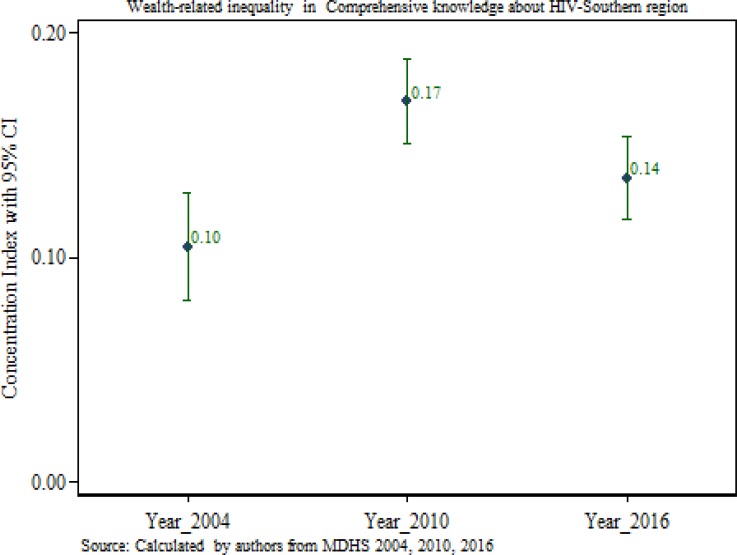
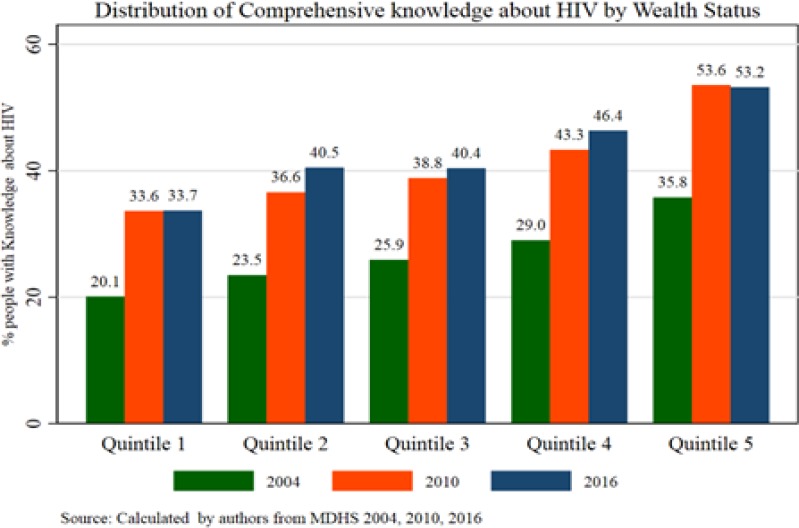
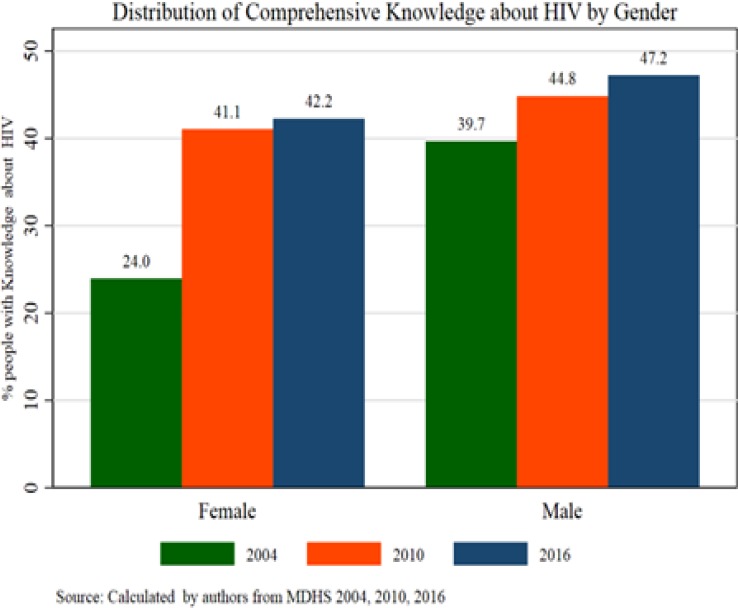
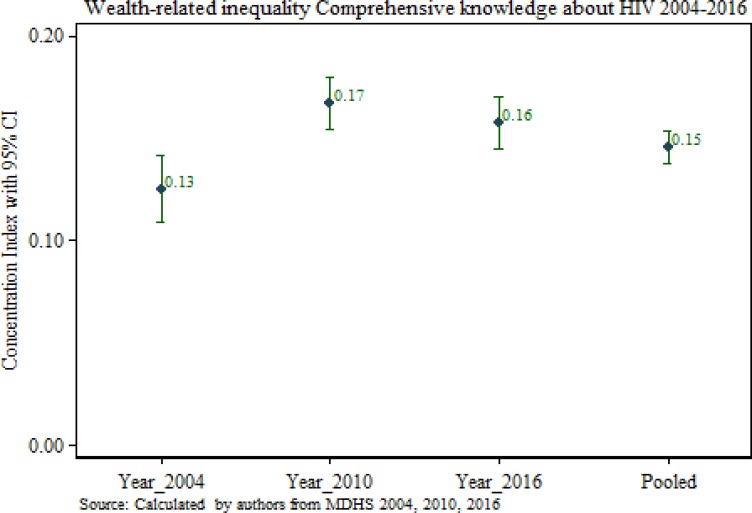
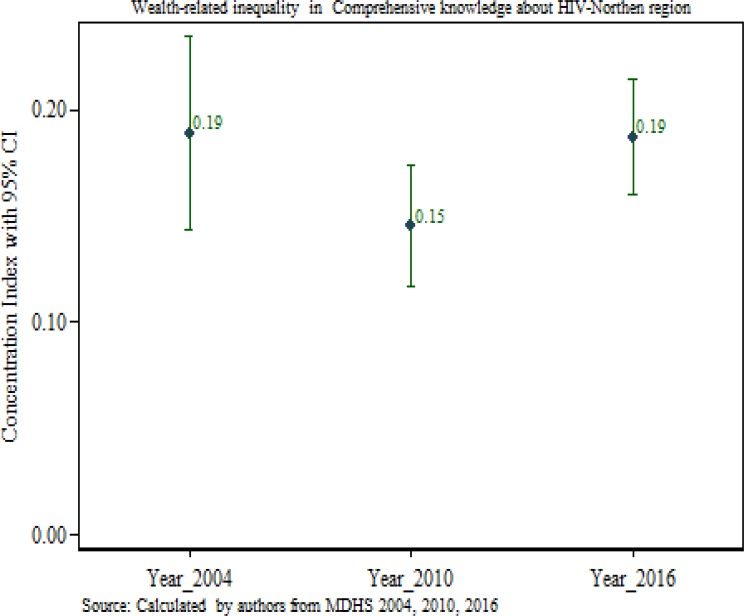
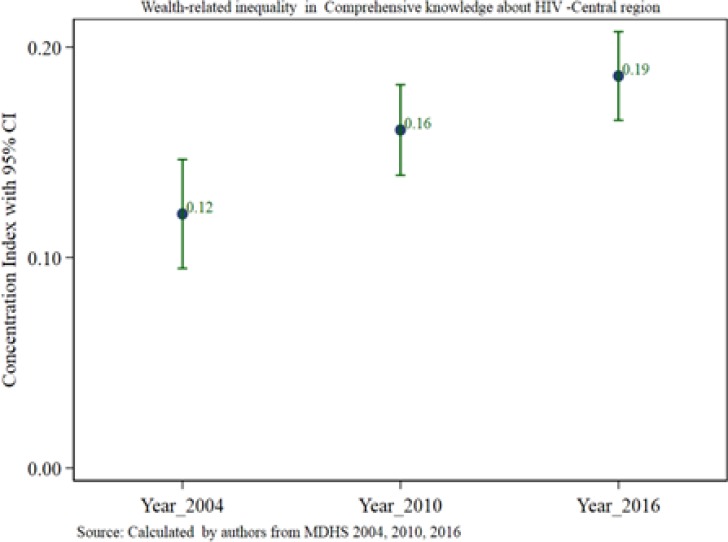
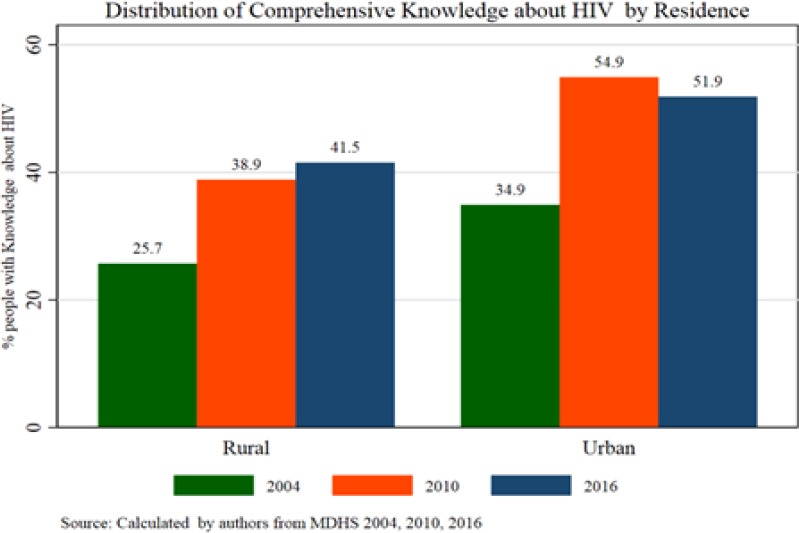
Our results point to an increase in comprehensive knowledge about HIV over the 12-year period, from 28% in 2004 to around 44% in 2016. However, upon using the Erreygers concentration index, a wealth related inequality in comprehensive knowledge about HIV is uncovered. The poorer are less informed and the richer are better informed: comprehensive knowledge about HIV is concentrated among the rich. Furthermore, inequality in comprehensive knowledge about HIV has worsened over this period. Across gender, there is greater inequality among men than women. However, the rural-urban difference in wealth-related inequality in comprehensive knowledge about HIV dropped in 2016.

CONCLUSION

The results show that comprehensive knowledge about HIV has increased. Furthermore, it is established that comprehensive knowledge about HIV is concentrated among the wealthier in the 2004 -2016 period. Our results suggest that there should be a targeted approach in messaging and disseminating information regarding HIV and AIDS, using methods that are pro-poor.

摘要

背景

全面了解艾滋病毒对于抗击艾滋病毒和艾滋病、实现到2030年消除艾滋病作为公共卫生威胁的全球目标至关重要。对艾滋病毒的全面了解不足会削弱阻止疫情传播的努力。然而,确定社会经济不平等是否是影响艾滋病毒全面了解的一个因素也很重要,以便确保社会经济因素纳入干预措施。本文的目的是评估马拉维艾滋病毒全面了解的趋势以及与社会经济相关的不平等情况。

方法

本研究采用非参数方法和集中指数。它借鉴了2004年、2010年和2016年三轮马拉维人口与健康调查(MDHS)的二手数据。

结果

我们的结果表明,在这12年期间,对艾滋病毒的全面了解有所增加,从2004年的28%增至2016年的约44%。然而,使用埃雷格斯集中指数后,发现了与财富相关的艾滋病毒全面了解方面的不平等。较贫穷者了解较少,较富裕者了解较多:对艾滋病毒的全面了解集中在富人中。此外,在此期间,艾滋病毒全面了解方面的不平等有所加剧。在性别方面,男性中的不平等比女性更大。然而,2016年艾滋病毒全面了解方面与财富相关的不平等在城乡之间的差异有所下降。

结论

结果表明对艾滋病毒的全面了解有所增加。此外,已确定在2004 - 2016年期间,对艾滋病毒的全面了解集中在较富裕者中。我们的结果表明,在宣传和传播有关艾滋病毒和艾滋病的信息时,应采用有利于穷人的方法,采取有针对性的方式。
https://cdn.ncbi.nlm.nih.gov/pmc/blobs/0cbc/6698630/5a64365c13f3/MMJ3102-0104Fig7.jpg
https://cdn.ncbi.nlm.nih.gov/pmc/blobs/0cbc/6698630/c0d1b4c7e920/MMJ3102-0104Fig1.jpg
https://cdn.ncbi.nlm.nih.gov/pmc/blobs/0cbc/6698630/d6a3d52ee8a7/MMJ3102-0104Fig2.jpg
https://cdn.ncbi.nlm.nih.gov/pmc/blobs/0cbc/6698630/f9824cae3fca/MMJ3102-0104Fig3.jpg
https://cdn.ncbi.nlm.nih.gov/pmc/blobs/0cbc/6698630/8f4474a1ad5c/MMJ3102-0104Fig4.jpg
https://cdn.ncbi.nlm.nih.gov/pmc/blobs/0cbc/6698630/b6c343c0684a/MMJ3102-0104Fig5.jpg
https://cdn.ncbi.nlm.nih.gov/pmc/blobs/0cbc/6698630/bfcc9555aaaf/MMJ3102-0104Fig6.jpg
https://cdn.ncbi.nlm.nih.gov/pmc/blobs/0cbc/6698630/5a64365c13f3/MMJ3102-0104Fig7.jpg
https://cdn.ncbi.nlm.nih.gov/pmc/blobs/0cbc/6698630/c0d1b4c7e920/MMJ3102-0104Fig1.jpg
https://cdn.ncbi.nlm.nih.gov/pmc/blobs/0cbc/6698630/d6a3d52ee8a7/MMJ3102-0104Fig2.jpg
https://cdn.ncbi.nlm.nih.gov/pmc/blobs/0cbc/6698630/f9824cae3fca/MMJ3102-0104Fig3.jpg
https://cdn.ncbi.nlm.nih.gov/pmc/blobs/0cbc/6698630/8f4474a1ad5c/MMJ3102-0104Fig4.jpg
https://cdn.ncbi.nlm.nih.gov/pmc/blobs/0cbc/6698630/b6c343c0684a/MMJ3102-0104Fig5.jpg
https://cdn.ncbi.nlm.nih.gov/pmc/blobs/0cbc/6698630/bfcc9555aaaf/MMJ3102-0104Fig6.jpg
https://cdn.ncbi.nlm.nih.gov/pmc/blobs/0cbc/6698630/5a64365c13f3/MMJ3102-0104Fig7.jpg

相似文献

1
Socio-economic Inequality in Comprehensive Knowledge about HIV in Malawi.马拉维艾滋病毒综合知识方面的社会经济不平等
Malawi Med J. 2019 Jun;31(2):104-111. doi: 10.4314/mmj.v31i2.1.
2
Explaining socioeconomic inequality in cervical cancer screening uptake in Malawi.解释马拉维宫颈癌筛查参与度的社会经济不平等现象。
BMC Public Health. 2022 Jul 18;22(1):1376. doi: 10.1186/s12889-022-13750-4.
3
Socioeconomic inequalities in HIV/AIDS prevalence in sub-Saharan African countries: evidence from the Demographic Health Surveys.撒哈拉以南非洲国家艾滋病毒/艾滋病流行中的社会经济不平等:来自人口健康调查的证据。
Int J Equity Health. 2014 Feb 18;13:18. doi: 10.1186/1475-9276-13-18.
4
Socioeconomic inequality in knowledge about HIV/AIDS over time in Ethiopia: A population-based study.埃塞俄比亚不同时期艾滋病病毒/艾滋病知识方面的社会经济不平等:一项基于人群的研究。
PLOS Glob Public Health. 2023 Oct 31;3(10):e0002484. doi: 10.1371/journal.pgph.0002484. eCollection 2023.
5
What explains gender inequalities in HIV/AIDS prevalence in sub-Saharan Africa? Evidence from the demographic and health surveys.如何解释撒哈拉以南非洲地区艾滋病毒/艾滋病流行情况中的性别不平等现象?来自人口与健康调查的证据。
BMC Public Health. 2016 Nov 3;16(1):1136. doi: 10.1186/s12889-016-3783-5.
6
Prevalence and correlates of comprehensive HIV/AIDS knowledge among adolescent girls and young women aged 15-24 years in Malawi: evidence from the 2015-16 Malawi demographic and health survey. Malawi 2015-16 年人口与健康调查:15-24 岁未成年少女和年轻女性综合艾滋病毒/艾滋病知识的流行情况及其相关因素分析。
BMC Public Health. 2021 Aug 4;21(1):1508. doi: 10.1186/s12889-021-11564-4.
7
Socioeconomic inequality in adults undertaking HIV testing over time in Ethiopia based on data from demographic and health surveys.基于人口与健康调查数据,探讨埃塞俄比亚成年人在不同时间进行 HIV 检测的社会经济不平等状况。
PLoS One. 2024 Feb 14;19(2):e0296869. doi: 10.1371/journal.pone.0296869. eCollection 2024.
8
Women in Chinsapo, Malawi: vulnerability and risk to HIV/AIDS.马拉维钦萨波的女性:感染艾滋病毒/艾滋病的脆弱性与风险
SAHARA J. 2005 Nov;2(3):320-32. doi: 10.1080/17290376.2005.9724857.
9
Socioeconomic inequality and contributors in accepting attitudes toward people living with HIV among adults in Ethiopia from 2005 to 2016: a population-based cross-sectional study.2005 年至 2016 年埃塞俄比亚成年人对艾滋病毒感染者接受态度的社会经济不平等及其影响因素:一项基于人群的横断面研究。
BMJ Open. 2023 Dec 1;13(12):e074694. doi: 10.1136/bmjopen-2023-074694.
10
Socio-economic inequity in HIV testing in Malawi.马拉维艾滋病毒检测中的社会经济不平等现象。
Glob Health Action. 2016 Oct 26;9:31730. doi: 10.3402/gha.v9.31730. eCollection 2016.

引用本文的文献

1
Engaging Councillors to Address Structural and Social Drivers of HIV Infections in Blantyre City: A Formative Study.促使议员解决布兰太尔市艾滋病毒感染的结构和社会驱动因素:一项形成性研究。
Int J Health Policy Manag. 2025;14:8550. doi: 10.34172/ijhpm.8550. Epub 2025 Jun 9.
2
Assessing HIV transmission knowledge and rapid test history among the general population in Iran.评估伊朗普通人群中的艾滋病毒传播知识和快速检测史。
Sci Rep. 2025 Feb 10;15(1):4944. doi: 10.1038/s41598-025-88844-1.
3
Explaining inequity in knowledge, attitude, and services related to HIV/AIDS: a systematic review.

本文引用的文献

1
Critical perspectives on the 'end of AIDS'.对“艾滋病终结”的批判性观点。
Glob Public Health. 2018 Aug;13(8):957-959. doi: 10.1080/17441692.2018.1464589. Epub 2018 Apr 20.
2
Trends and Determinants of Comprehensive Knowledge of HIV among Adolescents and Young Adults in Nigeria: 2003 - 2013.2003 - 2013年尼日利亚青少年和青年中艾滋病病毒综合知识的趋势与决定因素
Afr J Reprod Health. 2017 Jun;21(2):26-34. doi: 10.29063/ajrh2017/v21i2.4.
3
Health systems and the SDGs: lessons from a joint HIV and sexual and reproductive health and rights response.
解释与艾滋病相关的知识、态度和服务方面的不平等:系统评价。
BMC Public Health. 2024 Jul 8;24(1):1815. doi: 10.1186/s12889-024-19329-5.
4
Equity in HIV/AIDS services requires optimization of mainstreaming sectors in Ethiopia.艾滋病服务中的公平性需要优化埃塞俄比亚的主流部门。
BMC Public Health. 2024 Jun 1;24(1):1477. doi: 10.1186/s12889-024-19016-5.
5
Knowledge, attitude and perception towards COVID-19 among representative educated sub-Saharan Africans: A cross-sectional study during the exponential phase of the pandemic.撒哈拉以南非洲受教育代表人群对 COVID-19 的认知、态度和看法:疫情指数增长阶段的一项横断面研究。
PLoS One. 2024 Feb 1;19(2):e0281342. doi: 10.1371/journal.pone.0281342. eCollection 2024.
6
Socioeconomic inequalities in uptake of HIV testing during antenatal care: evidence from Sub-Saharan Africa.社会经济不平等对产前保健中艾滋病毒检测的影响:来自撒哈拉以南非洲的证据。
Int J Equity Health. 2024 Jan 8;23(1):4. doi: 10.1186/s12939-023-02068-1.
7
Socioeconomic inequality in knowledge about HIV/AIDS over time in Ethiopia: A population-based study.埃塞俄比亚不同时期艾滋病病毒/艾滋病知识方面的社会经济不平等:一项基于人群的研究。
PLOS Glob Public Health. 2023 Oct 31;3(10):e0002484. doi: 10.1371/journal.pgph.0002484. eCollection 2023.
8
Public Anxiety, Attitudes, and Practices towards COVID-19 Infection in the Eastern Province of Saudi Arabia: A Cross-Sectional Study.沙特阿拉伯东部省份公众对新冠病毒感染的焦虑、态度及行为:一项横断面研究
Healthcare (Basel). 2023 Jul 21;11(14):2083. doi: 10.3390/healthcare11142083.
9
Knowledge, attitudes and practices (KAP) on COVID-19 among the general population in most affected districts of Nepal.尼泊尔受影响最严重地区普通民众对新冠病毒病的知识、态度和行为
PLOS Glob Public Health. 2023 Jul 28;3(7):e0001977. doi: 10.1371/journal.pgph.0001977. eCollection 2023.
10
A multiplicative effect of Education and Wealth associated with HIV-related knowledge and attitudes among Ghanaian women.加纳女性的教育和财富与艾滋病毒相关知识和态度呈乘法效应。
BMC Public Health. 2023 Jul 20;23(1):1397. doi: 10.1186/s12889-023-16311-5.
卫生系统与可持续发展目标:来自艾滋病病毒与性健康和生殖健康及权利联合应对行动的经验教训。
Health Policy Plan. 2017 Nov 1;32(suppl_4):iv102-iv107. doi: 10.1093/heapol/czx052.
4
National responses to global health targets: exploring policy transfer in the context of the UNAIDS '90-90-90' treatment targets in Ghana and Uganda.国家对全球卫生目标的应对:在加纳和乌干达UNAIDS“90-90-90”治疗目标的背景下探索政策转移
Health Policy Plan. 2018 Jan 1;33(1):17-33. doi: 10.1093/heapol/czx132.
5
A comprehensive analysis of trends and determinants of HIV/AIDS knowledge among the Bangladeshi women based on Bangladesh Demographic and Health Surveys, 2007-2014.基于2007 - 2014年孟加拉国人口与健康调查对孟加拉国女性艾滋病毒/艾滋病知识的趋势和决定因素进行的综合分析。
Arch Public Health. 2017 Sep 28;75:59. doi: 10.1186/s13690-017-0228-2. eCollection 2017.
6
Trends and determinants of HIV/AIDS knowledge among women in Bangladesh.孟加拉国女性对艾滋病毒/艾滋病的认知趋势及影响因素
BMC Public Health. 2016 Aug 17;16(1):812. doi: 10.1186/s12889-016-3512-0.
7
A general method for decomposing the causes of socioeconomic inequality in health.一种剖析健康领域社会经济不平等成因的通用方法。
J Health Econ. 2016 Jul;48:89-106. doi: 10.1016/j.jhealeco.2016.03.006. Epub 2016 Apr 7.
8
conindex: Estimation of concentration indices.浓度指数:浓度指数的估计。
Stata J. 2016;16(1):112-138.
9
Resource needs and gap analysis in achieving universal access to HIV/AIDS services: a data envelopment analysis of 45 countries.实现普遍获得艾滋病毒/艾滋病服务方面的资源需求与差距分析:对45个国家的数据包络分析
Health Policy Plan. 2016 Jun;31(5):624-33. doi: 10.1093/heapol/czv109. Epub 2015 Nov 9.
10
HIV/AIDS Knowledge, Stigmatizing Attitudes, and Related Behaviors and Factors that Affect Stigmatizing Attitudes against HIV/AIDS among Korean Adolescents.韩国青少年的艾滋病毒/艾滋病知识、污名化态度以及相关行为和影响对艾滋病毒/艾滋病污名化态度的因素
Osong Public Health Res Perspect. 2012 Mar;3(1):24-30. doi: 10.1016/j.phrp.2012.01.004.