Dutta Rupam, Pyne Arghajit, Mondal Dipankar, Sarkar Nilmoni
Department of Chemistry, Indian Institute of Technology, Kharagpur 721302, WB, India.
ACS Omega. 2018 Jan 10;3(1):314-328. doi: 10.1021/acsomega.7b01833. eCollection 2018 Jan 31.
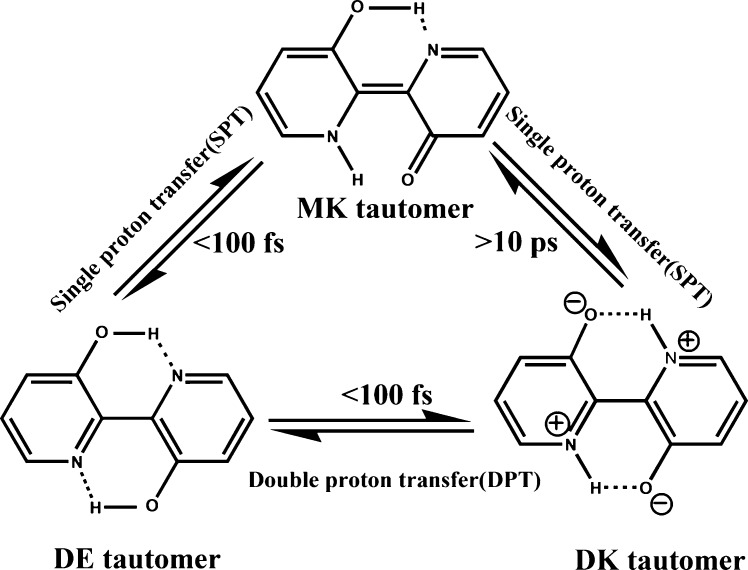
In this article, we have investigated the excited-state intramolecular double proton transfer dynamics of [2,2'-bipyridyl]-3,3'-diol, BP(OH), in three alcohol-water binary mixtures, namely, ethanol (EtOH)-water, -propanol (PrOH)-water, -butyl alcohol (TBA)-water, and dimethyl sulfoxide (DMSO)-water utilizing the femtosecond fluorescence upconversion technique. We have found that in alcohol-water binary mixtures the proton transfer (PT) pathway of BP(OH) is sequential and the anomalous slowdown in PT dynamics is observed in mole fraction (χ) ranges χ = 0.04-0.07, χ = 0.23-0.28, χ = 0.17-0.30, χ = 0.12-0.21, and χ = 0.40-0.46. Our study sheds light on the involvement of water network in the PT dynamics. Reduction in water accessibility due to the involvement of water molecules in cluster formation results in hindered PT dynamics, and this retardation is more for the TBA-water binary mixture compared to that for the other two mixtures. Additionally, we have found two anomalous regions for the DMSO-water binary mixture in ranges χ = 0.12-0.16 and χ = 0.26-0.34. However, most interestingly, beyond χ = 0.40, we do not find any growth component in the femtosecond fluorescence upconversion trace, which may be due to the change in the PT mechanism from a sequential water-mediated pathway to a concerted intramolecular pathway.
在本文中,我们利用飞秒荧光上转换技术研究了[2,2'-联吡啶]-3,3'-二醇(BP(OH))在三种醇 - 水二元混合物,即乙醇(EtOH) - 水、丙醇(PrOH) - 水、丁醇(TBA) - 水和二甲基亚砜(DMSO) - 水中的激发态分子内双质子转移动力学。我们发现,在醇 - 水二元混合物中,BP(OH)的质子转移(PT)途径是连续的,并且在摩尔分数(χ)范围χ = 0.04 - 0.07、χ = 0.23 - 0.28、χ = 0.17 - 0.30、χ = 0.12 - 0.21和χ = 0.40 - 0.46中观察到PT动力学的异常减慢。我们的研究揭示了水网络在PT动力学中的作用。由于水分子参与簇形成导致水可及性降低,从而阻碍了PT动力学,并且与其他两种混合物相比,TBA - 水二元混合物的这种延迟更为明显。此外,我们发现DMSO - 水二元混合物在χ = 0.12 - 0.16和χ = 0.26 - 0.34范围内有两个异常区域。然而,最有趣的是,在χ > 0.40时,我们在飞秒荧光上转换轨迹中未发现任何增长成分,这可能是由于PT机制从连续的水介导途径转变为协同的分子内途径所致。