Olson Andrew S, Jameson Abigail J, Kyasa Shiva K, Evans Boone W, Dussault Patrick H
Department of Chemistry, University of Nebraska-Lincoln, 809 Hamilton Hall, Lincoln, Nebraska 68588-0304, United States.
Department of Natural Sciences, Western New Mexico University, Harlan Hall, Silver City, New Mexico 88062, United States.
ACS Omega. 2018 Oct 25;3(10):14054-14063. doi: 10.1021/acsomega.8b01977. eCollection 2018 Oct 31.
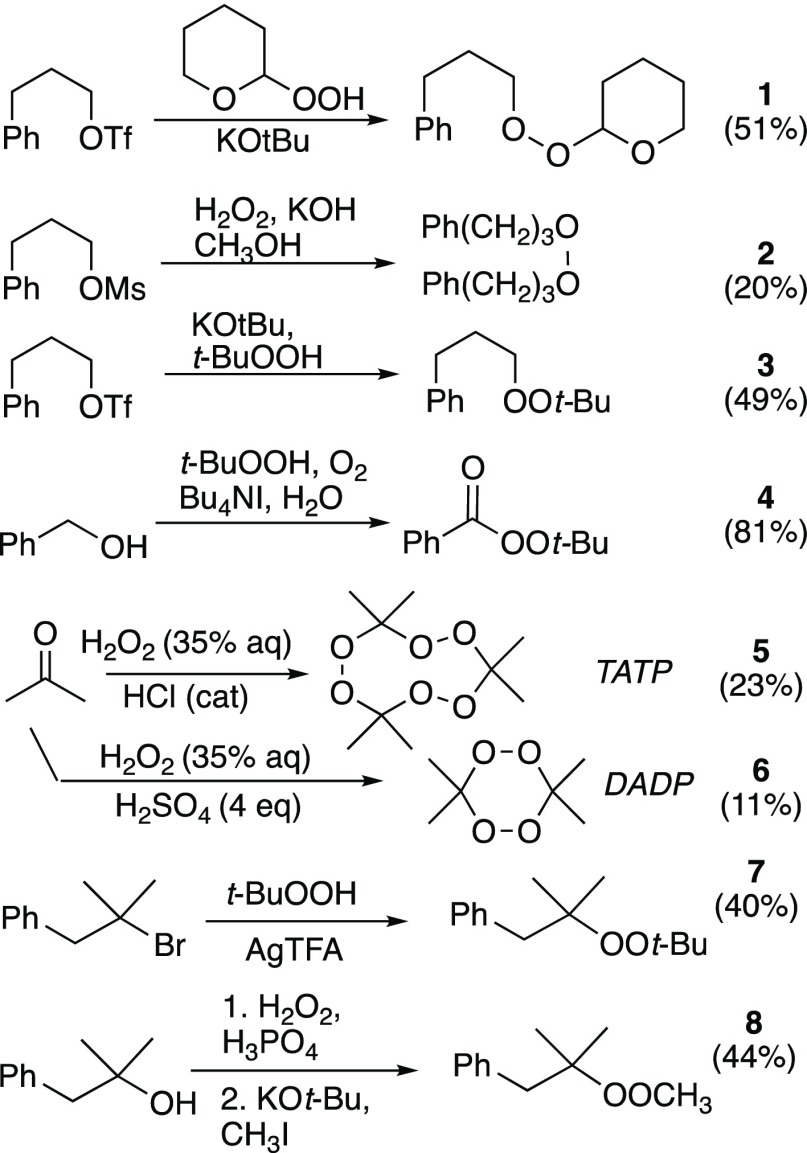
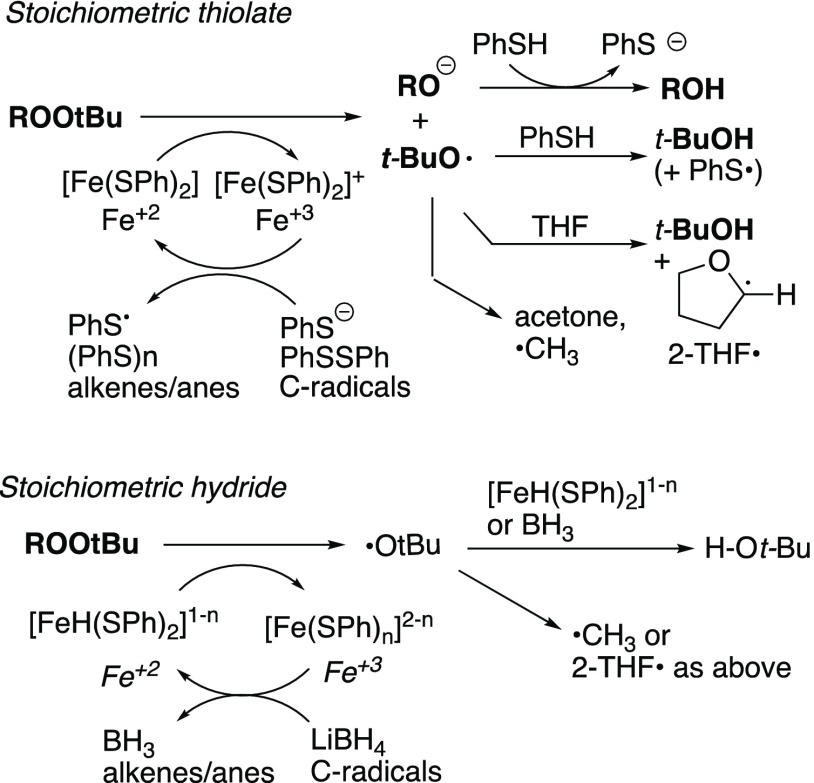
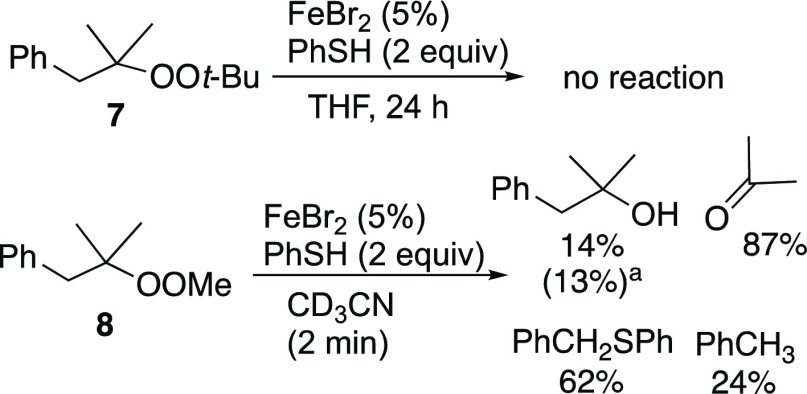
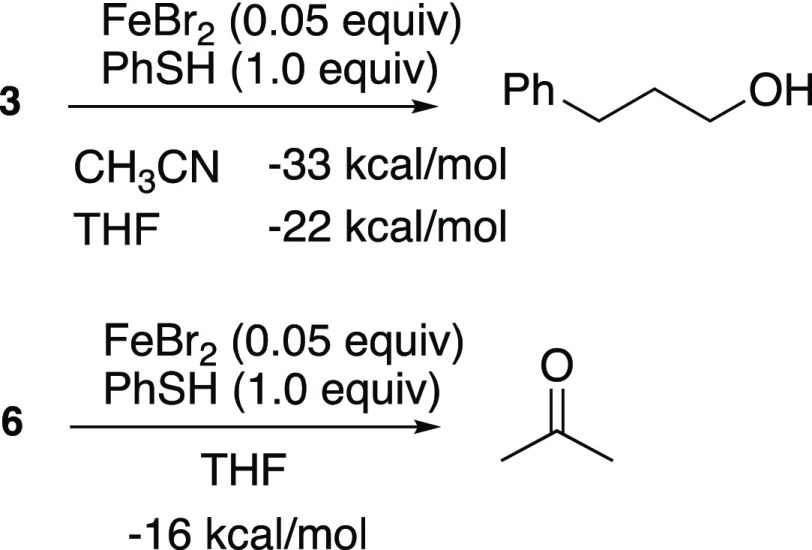
Despite the low bond strength of the oxygen-oxygen bond, organic peroxides are often surprisingly resistant to cleavage by nucleophiles and reductants. As a result, achieving decomposition under mild conditions can be challenging. Herein, we explore the reactivity of a selection of peroxides toward thiolates, phenyl selenide, Fe(II) salts, and iron thiolates. Peroxides activated by conjugation, strain, or stereoelectronics are rapidly cleaved at room temperature by thiolate anions, phenylselenide, or Fe(II) salts. Under the same conditions, unhindered dialkyl peroxides are only marginally reactive; hindered peroxides, including triacetone triperoxide and diacetone diperoxide (DADP), are inert. In contrast, all but the most hindered of peroxides are rapidly (<1 min at concentrations down to ∼40 mM) cleaved by mixtures of thiols and iron salts. Our observations suggest the possible intermediacy of strongly reducing complexes that are readily regenerated in the presence of stoichiometric thiolate or hydride. In the case of DADP, an easily prepared explosive of significant societal concern, catalytic amounts of iron and thiol are capable of promoting rapid and complete disproportionation. The availability of inexpensive and readily available catalysts for the mild reductive degradation of all but the most hindered of peroxides could have significant applications for controlled remediation of explosives or unwanted radical initiators.
尽管氧-氧键的键能较低,但有机过氧化物通常对亲核试剂和还原剂的裂解具有惊人的抗性。因此,在温和条件下实现分解可能具有挑战性。在此,我们研究了一系列过氧化物对硫醇盐、苯硒化物、亚铁盐和硫醇铁的反应活性。通过共轭、应变或立体电子效应活化的过氧化物在室温下会被硫醇盐阴离子、苯硒化物或亚铁盐迅速裂解。在相同条件下,未受阻的二烷基过氧化物反应活性很低;受阻过氧化物,包括三丙酮三过氧化物和二丙酮二过氧化物(DADP),则呈惰性。相比之下,除了受阻程度最高的过氧化物外,所有过氧化物都会被硫醇和铁盐的混合物迅速裂解(在浓度低至约40 mM时,<1分钟)。我们的观察结果表明,可能存在强还原络合物中间体,在化学计量的硫醇盐或氢化物存在下很容易再生。对于DADP这种备受社会关注的易制爆物,催化量的铁和硫醇能够促进其快速完全歧化。对于除受阻程度最高的过氧化物外的所有过氧化物,廉价且易于获得的催化剂可用于温和的还原降解,这对于爆炸物或不需要的自由基引发剂的可控修复可能具有重要应用。