Zhang Yaqin, He Hongyan, Zhang Suojiang, Fan Maohong
Beijing Key Laboratory of Ionic Liquids Clean Process, Key Laboratory of Green Process and Engineering, State Key Laboratory of Multiphase Complex Systems, Institute of Process Engineering, Chinese Academy of Sciences, Beijing 100190, China.
Department of Chemical and Petroleum Engineering, University of Wyoming, Laramie, Wyoming 82071, United States.
ACS Omega. 2018 Feb 12;3(2):1823-1833. doi: 10.1021/acsomega.7b01805. eCollection 2018 Feb 28.
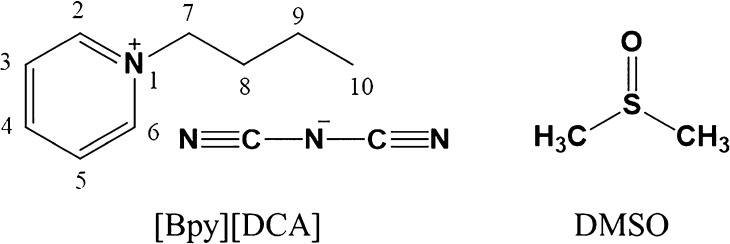
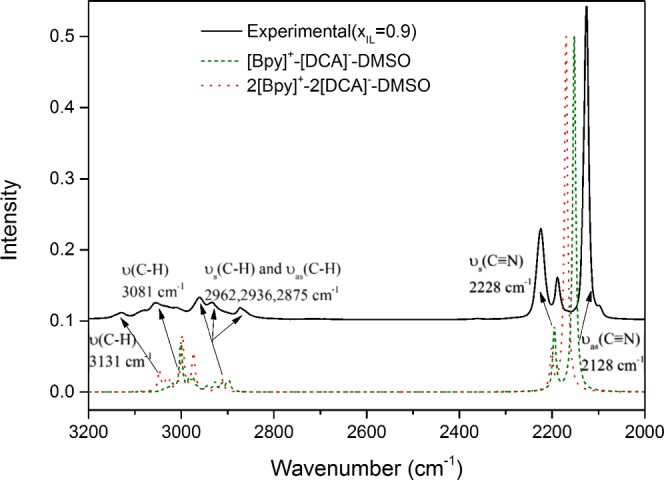
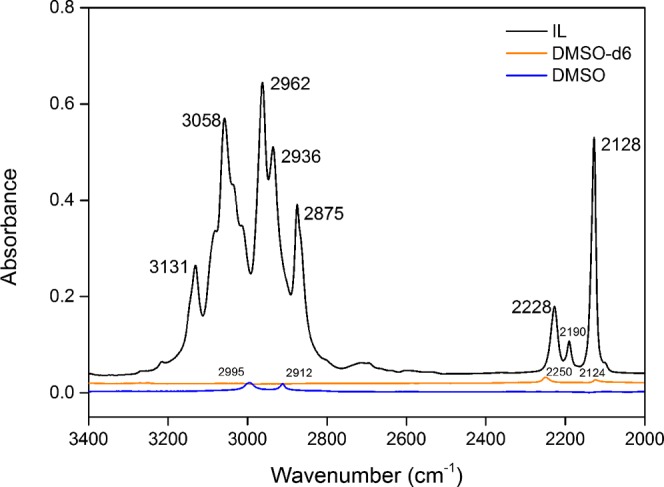
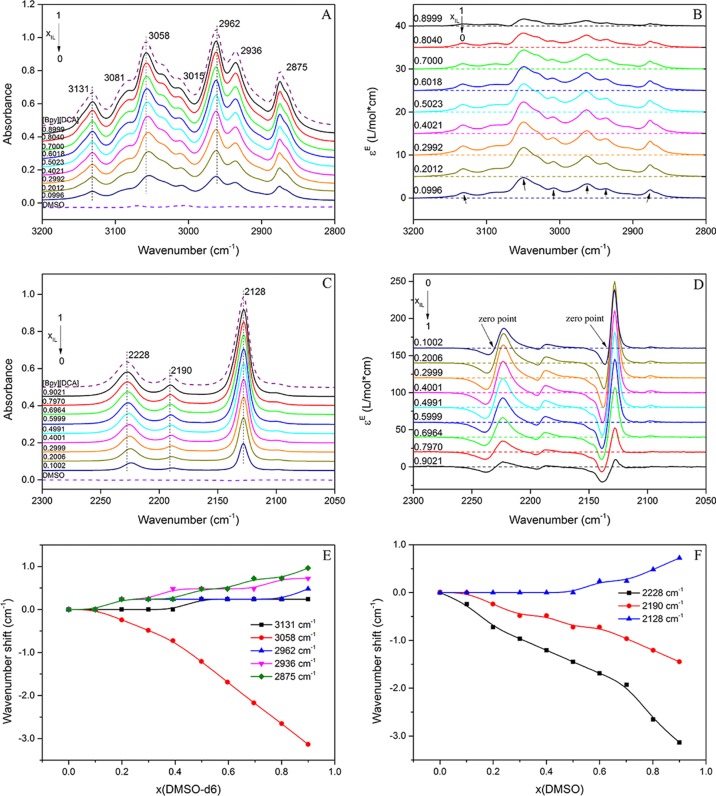
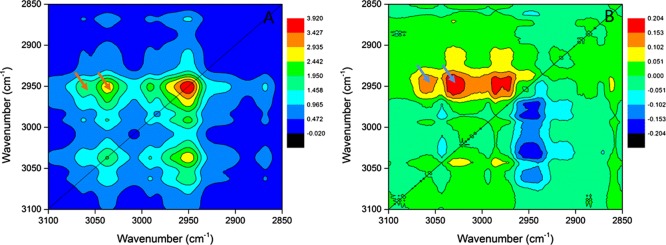
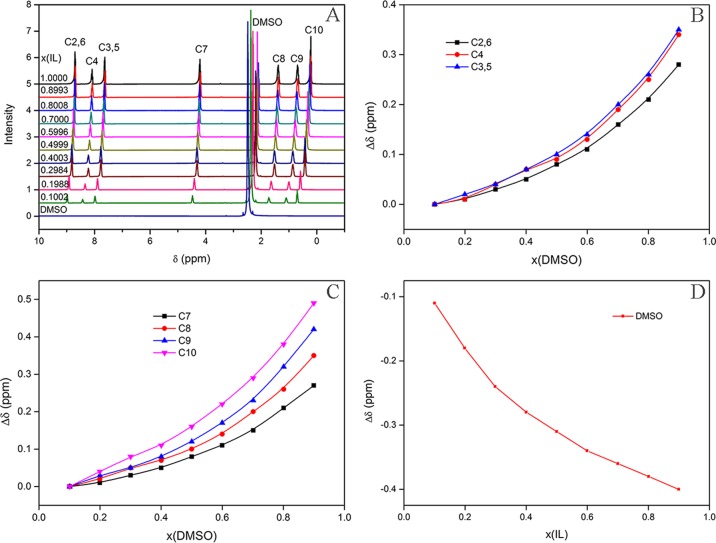
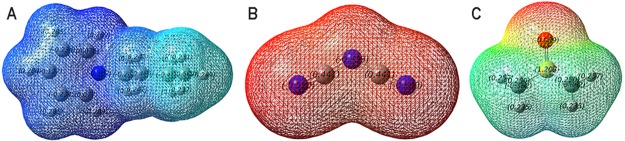
The addition of highly polar and aprotic cosolvents to ionic liquids has proven to considerably decrease the viscosity of the solution and improve mass transfer in many chemical reactions. In this work, the interactions between a representative pyridinium-based ionic liquid, -butylpyridinium dicyanamide ([Bpy][DCA]), and a cosolvent, dimethylsulfoxide (DMSO), were studied in detail by the combined use of attenuated total reflection Fourier transform infrared spectroscopy, hydrogen nuclear magnetic resonance (H NMR), and density functional theory calculations. Several species in the [Bpy][DCA]-DMSO mixtures have been identified, that is, ion clusters can translate into ion pairs during the dilution process. DMSO formed hydrogen bonds (H bonds) simultaneously with [Bpy] cations and [DCA] anions but stronger hydrogen-bonding interactions with the [Bpy] cations than the [DCA] anions, and the intrinsic hydrogen-bond networks of IL were difficult to interrupt at low DMSO concentrations. Interestingly, hydrogen-bonding interactions reach the strongest when the molar fraction of DMSO is 0.4-0.5. Hydrogen-bonding interactions are prominent in the chemical shifts of hydrogen atoms in [Bpy] cations, and anisotropy is the main reason for the upfield shifts of DMSO in the presence of [Bpy][DCA]. The theoretical calculations offer in-depth studies of the structural evolution and NMR calculation.
在离子液体中添加高极性非质子共溶剂已被证明能显著降低溶液的粘度,并改善许多化学反应中的传质过程。在本工作中,通过衰减全反射傅里叶变换红外光谱、氢核磁共振((^{1}H) NMR)和密度泛函理论计算相结合的方法,详细研究了一种代表性的吡啶基离子液体——丁基吡啶二氰胺(([Bpy][DCA]))与共溶剂二甲基亚砜(DMSO)之间的相互作用。已鉴定出([Bpy][DCA])-DMSO混合物中的几种物种,即在稀释过程中离子簇可转化为离子对。DMSO与([Bpy])阳离子和([DCA])阴离子同时形成氢键((H)键),但与([Bpy])阳离子的氢键相互作用比与([DCA])阴离子的更强,且在低DMSO浓度下离子液体的固有氢键网络难以被打断。有趣的是,当DMSO的摩尔分数为(0.4 - 0.5)时,氢键相互作用达到最强。氢键相互作用在([Bpy])阳离子中氢原子的化学位移中很突出,且各向异性是在([Bpy][DCA])存在下DMSO发生高场位移的主要原因。理论计算为结构演变和核磁共振计算提供了深入研究。