Yang Danni, Liu Jie, Wang Zheng-Ming, Kumagai Akio, Endo Takashi, Yin Hua-Qiang, Wei Fu-Sheng
College of Architecture and Environment, Sichuan University, Chengdu 610065, Sichuan, China.
Environmental Management Research Institute, National Institute of Advanced Industrial Science and Technology, 16-1 Onogawa, Tsukuba, Ibaraki 305-8569, Japan.
ACS Omega. 2019 Aug 8;4(8):12995-13004. doi: 10.1021/acsomega.9b00264. eCollection 2019 Aug 20.
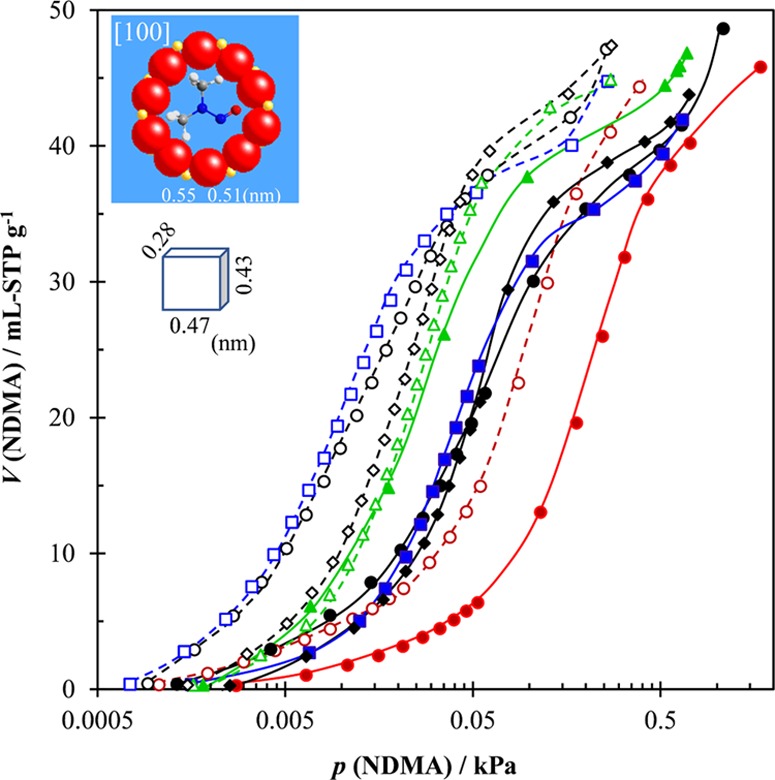
Silicalite-1-type zeolites with unique intracrystal holes or cracks were successfully prepared using a cellulose nanofiber (CNF) as an additional mediating material, and their vapor phase adsorption properties toward methyl -butyl ether (MTBE) and -nitrosodimethylamine (NDMA) were examined. It was found that the mixing protocol of CNF and structure-directing agents (SDAs), the addition amount of CNF, and the CNF/SDAs amount ratio play important roles in forming the holed silicalite-1. The synthesis route that preliminarily mixes CNF with SDAs in a series of controlled conditions is particularly beneficial for the formation of the holed silicalite-1 with mesoporosity and larger pores because the CNF-SDAs composite structure benefits the zeolite growth closely encompassing CNF inside the crystal structure. It also promotes the preferential formation of the orthorhombic phase vicinal to the CNF surface, namely, the surface of the formed internal holes or cracks, with the twin-type crystal size reduced as compared to the non-CNF-templated sample. On the contrary, the synthesis route that mixes CNF with SDAs-silicate composite ions tends to modify the twin-type crystal shape at the same time to form small but uniform well-crystallized particles with less holes or cracks and a dominative monoclinic phase. It was considered that both the inter-subunit structural defect and silanol defect whose content is increased with CNF addition influence the adsorptivity of MTBE and NDMA. Owing to the small twin-type crystal size, the smaller crystal subunits, and the favored short path from the surface of internal holes or cracks, the holed silicalite-1 derived from the CNF and SDA premixture assures the easiest access of adsorbate molecules to the most energetically favored sites and is most appropriate for the adsorption of both MTBE and NDMA among the examined zeolites.
以纤维素纳米纤维(CNF)作为额外的介导材料,成功制备出具有独特晶内孔或裂纹的Silicalite-1型沸石,并研究了它们对甲基叔丁基醚(MTBE)和N-亚硝基二甲胺(NDMA)的气相吸附性能。研究发现,CNF与结构导向剂(SDA)的混合方案、CNF的添加量以及CNF/SDA的量比在形成有孔Silicalite-1中起着重要作用。在一系列受控条件下将CNF与SDA预先混合的合成路线,对于形成具有介孔率和较大孔径的有孔Silicalite-1特别有利,因为CNF-SDA复合结构有利于沸石生长,使CNF紧密包裹在晶体结构内部。它还促进了在CNF表面附近优先形成正交相,即形成的内部孔或裂纹的表面,与无CNF模板的样品相比,孪晶型晶体尺寸减小。相反,将CNF与SDA-硅酸盐复合离子混合的合成路线往往会同时改变孪晶型晶体形状,形成小而均匀的结晶良好的颗粒,孔或裂纹较少,且以单斜相为主。据认为,亚基间结构缺陷和硅醇缺陷(其含量随CNF添加量增加)都会影响MTBE和NDMA的吸附性。由于孪晶型晶体尺寸小、晶体亚基小以及内部孔或裂纹表面的短路径有利,由CNF和SDA预混物衍生的有孔Silicalite-1确保吸附质分子最容易到达能量最有利的位点,在所研究的沸石中最适合吸附MTBE和NDMA。