Guyot Virginie, Jactel Hervé, Imbaud Baptiste, Burnel Laurent, Castagneyrol Bastien, Heinz Wilfried, Deconchat Marc, Vialatte Aude
DYNAFOR, INRA, Université de Toulouse Castanet Tolosan France.
BIOGECO, INRA, Univ. Bordeaux Cestas France.
Ecol Evol. 2019 Jul 18;9(16):9040-9051. doi: 10.1002/ece3.5450. eCollection 2019 Aug.
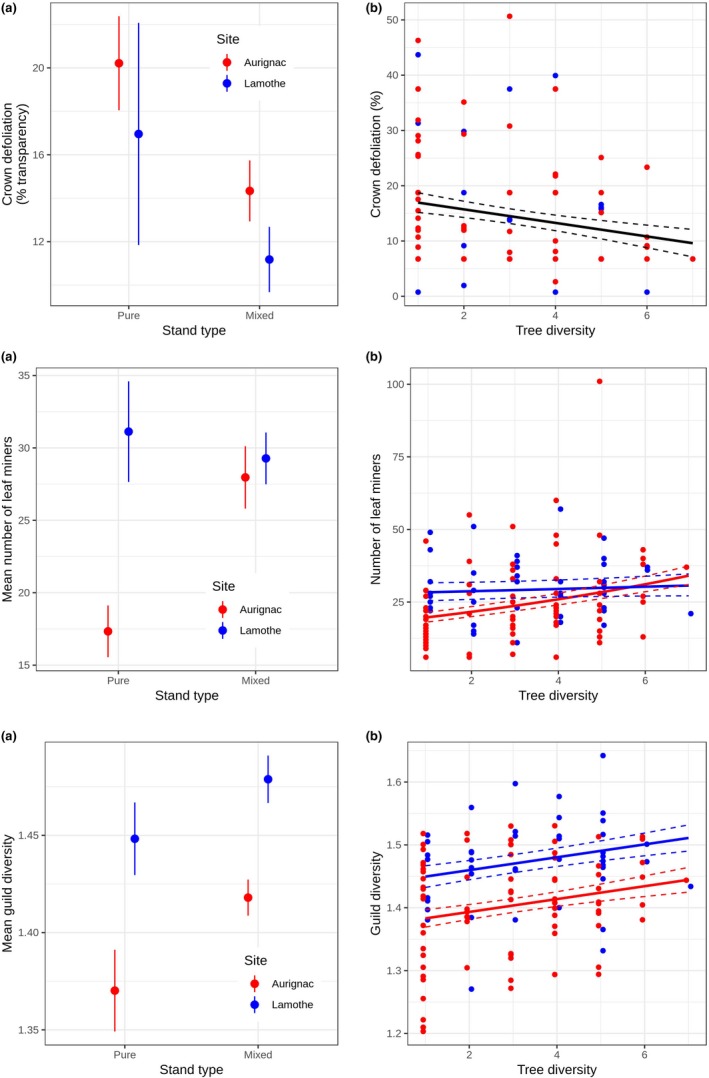
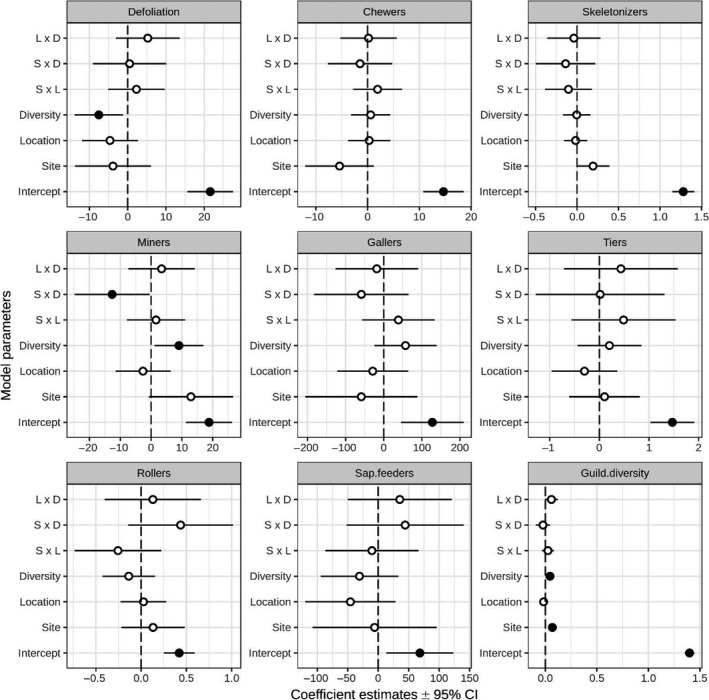
Tree diversity is increasingly acknowledged as an important driver of insect herbivory. However, there is still a debate about the direction of associational effects that can range from associational resistance (i.e., less damage in mixed stands than in monocultures) to the opposite, associational susceptibility. Discrepancies among published studies may be due to the overlooked effect of spatially dependent processes such as tree location within forests. We addressed this issue by measuring crown defoliation and leaf damage made by different guilds of insect herbivores on oaks growing among conspecific versus heterospecific neighbors at forest edges versus interior, in two closed sites in SW France forests. Overall, oaks were significantly less defoliated among heterospecific neighbors (i.e., associational resistance), at both forest edge and interior. At the leaf level, guild diversity and leaf miner herbivory significantly increased with tree diversity regardless of oak location within stands. Other guilds showed no clear response to tree diversity or oak location. We showed that herbivore response to tree diversity varied among insect feeding guilds but not between forest edges and interior, with inconsistent patterns between sites. Importantly, we show that oaks were more defoliated in pure oak plots than in mixed plots at both edge and forest interior and that, on average, defoliation decreased with increasing tree diversity from one to seven species. We conclude that edge conditions could be interacting with tree diversity to regulate insect defoliation, but future investigations are needed to integrate them into the management of temperate forests, notably by better understanding the role of the landscape context.
树木多样性日益被视为昆虫食草作用的一个重要驱动因素。然而,关于关联效应的方向仍存在争议,其范围可以从关联抗性(即混交林比纯林受到的损害更小)到相反的关联易感性。已发表研究之间的差异可能是由于诸如森林中树木位置等空间依赖过程的被忽视的影响。我们通过测量在法国西南部森林的两个封闭地点,森林边缘与内部,与同种或异种邻居生长在一起的橡树上,不同类群的昆虫食草动物造成的树冠落叶和叶片损害,来解决这个问题。总体而言,在森林边缘和内部,与异种邻居在一起时,橡树的落叶明显更少(即关联抗性)。在叶片层面,无论林分内橡树的位置如何,类群多样性和潜叶虫食草作用都随树木多样性显著增加。其他类群对树木多样性或橡树位置没有明显反应。我们表明,食草动物对树木多样性的反应在不同昆虫取食类群之间有所不同,但在森林边缘和内部之间没有差异,不同地点之间的模式不一致。重要的是,我们表明,在边缘和森林内部,纯橡树地块中的橡树比混交地块中的橡树落叶更多,并且平均而言,随着树木多样性从一种增加到七种,落叶减少。我们得出结论,边缘条件可能与树木多样性相互作用以调节昆虫落叶,但未来需要进行调查,以便将它们纳入温带森林的管理,特别是通过更好地理解景观背景的作用。