Lehto Jukka, Puukko Esa, Lindberg Antero, Voutilainen Mikko
Department of Chemistry - Radiochemistry, University of Helsinki, Finland.
Geological Survey of Finland, Espoo, Finland.
Heliyon. 2019 Aug 13;5(8):e02296. doi: 10.1016/j.heliyon.2019.e02296. eCollection 2019 Aug.
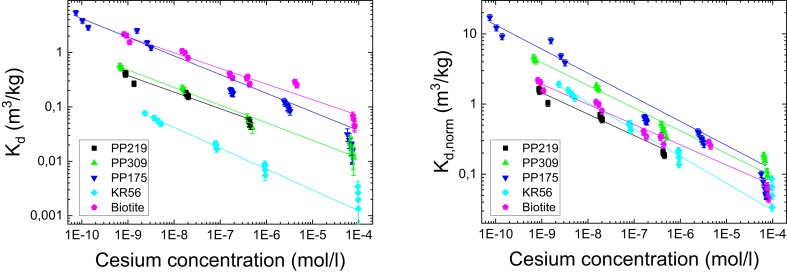
The distribution coefficient (K) of radionuclides on bedrock is one of the key parameters used in the safety analysis of spent nuclear fuel repositories. Typically, distribution coefficients have been determined using crushed rock. However, recent studies have shown that crushing of the rock increases considerably the distribution coefficient compared with the values of intact rock. This study aimed to test if batch sorption experiments using different grain sizes (i.e. mean diameter of grains) can be used to evaluate the K of strontium (Sr) and cesium (Cs) on intact crystalline rock, which would decrease the needed experimental time compared with transport experiments. Here we report the results of the batch sorption experiments with crushed rocks and compare the results with those from a recent study performed using electromigration experiments with intact drill core samples (Puukko et al., 2018). The batch sorption experiments were done for rock samples from Olkiluoto, Finland, as a function of grain size and of Cs and Sr concentration. Furthermore, the specific surface areas of the same rock samples with different grain sizes were determined. It was shown that Cs distribution coefficients correlate with specific surface areas of the studied rocks and biotite, the correlation coefficient being 0.95. The Cs distribution coefficient was highest for biotite at about 0.1 m/kg at 10 M cesium concentration and increased systematically to about 1 m/kg at 10 M. Distribution coefficients for rocks were up to about two orders of magnitude lower, being lowest with the rock with the lowest biotite content (3.3%). The distribution coefficient of Sr varied from 0.04 m/kg to 0.007 m/kg and behaved in a different manner: it remained constant in two out of three studied rocks in the concentration range of 10-10 M and only in the case of one rock a decreasing trend was seen at the higher concentration range. It was also shown that batch sorption experiments overestimate the distribution coefficient in respect to intact rock. The decrease of the distribution coefficient as a function of grain size can be estimated using a power law function. It was also shown that estimation of distribution coefficients of Cs and Sr for intact rock by extrapolation of distribution coefficients determined for different grain sizes is not possible without increasing grain size, but in that case diffusion into the grains would also affect the results. A new method was developed for estimating the fraction of the inner surface area of the total surface area of crushed grains. For the mean grain sizes of 0.25 mm and 0.75 mm the fraction of the inner surface was found to be 35-70% and 60-90%, respectively. The inner specific surface area was highest with biotite at 1.2 m/g and lowest with the rock with lowest biotite content (3.3%) at 0.07 m/g. The surface area analysis revealed that crushing creates and/or allows access to additional inner surface area that is not measured in intact rock. Furthermore, it was demonstrated that sorption of Cs on crushed rock was dominated by mica minerals in multiple concentrations while the effect of mica minerals on the K of Sr was not as straightforward.
放射性核素在基岩上的分配系数(K)是乏核燃料储存库安全分析中使用的关键参数之一。通常,分配系数是使用破碎岩石来确定的。然而,最近的研究表明,与完整岩石的值相比,岩石破碎会使分配系数大幅增加。本研究旨在测试使用不同粒径(即颗粒平均直径)的批量吸附实验是否可用于评估锶(Sr)和铯(Cs)在完整结晶岩石上的K值,这与传输实验相比将减少所需的实验时间。在此,我们报告了破碎岩石的批量吸附实验结果,并将结果与最近使用完整钻孔岩芯样本进行电迁移实验的研究结果(Puukko等人,2018年)进行比较。针对芬兰奥尔基卢奥托的岩石样本进行了批量吸附实验,实验作为粒径以及Cs和Sr浓度的函数。此外,还测定了不同粒径的相同岩石样本的比表面积。结果表明,Cs分配系数与所研究岩石和黑云母的比表面积相关,相关系数为0.95。在10 M铯浓度下,黑云母的Cs分配系数最高,约为0.1 m/kg,在10 M时系统地增加到约1 m/kg。岩石的分配系数低约两个数量级,在黑云母含量最低(3.3%)的岩石中最低。Sr的分配系数在0.04 m/kg至0.007 m/kg之间变化,表现方式不同:在三个研究岩石中的两个中,在10 - 10 M浓度范围内保持恒定,仅在一个岩石的情况下,在较高浓度范围内观察到下降趋势。还表明,批量吸附实验相对于完整岩石高估了分配系数。分配系数随粒径的减小可以使用幂律函数进行估计。还表明,在不增加粒径的情况下,通过外推不同粒径确定的分配系数来估计完整岩石的Cs和Sr分配系数是不可能的,但在那种情况下,扩散到颗粒中也会影响结果。开发了一种新方法来估计破碎颗粒总表面积中内表面积的比例。对于平均粒径为0.25 mm和0.75 mm的情况,内表面积的比例分别为35 - 70%和60 - 90%。内比表面积最高的是黑云母,为1.2 m/g,最低的是黑云母含量最低(3.3%)的岩石,为0.07 m/g。表面积分析表明,破碎会产生和/或允许进入完整岩石中未测量的额外内表面积。此外,还表明在多种浓度下,Cs在破碎岩石上的吸附以云母矿物为主导,而云母矿物对Sr的K值的影响并非如此直接。


