Research School of Population Health, Australian National University, Canberra, Australia.
School of Public Health and Community Medicine, University of New South Wales, Sydney, Australia.
PLoS One. 2019 Aug 29;14(8):e0221480. doi: 10.1371/journal.pone.0221480. eCollection 2019.
Widespread use of antibiotics has led to the development of antibiotic resistance. However, there are limited data describing antibiotic use in the community setting, and examining factors associated with greater use. Our study aimed to quantify antibiotic dispensing in older adults in the community according to socio-demographics and health services use.
Prospective analysis of a population-based cohort study of 239,981 adults aged ≥45 years in Australia (the Sax Institute's 45 and Up Study). Data on socio-demographics and health from a questionnaire, were linked to 2015 antibiotic dispensing data from the Pharmaceutical Benefits Scheme (PBS), as well as other administrative health databases. We estimated the Defined Daily Dose (DDD) of systemic antibiotics dispensed, defined by an Anatomic Therapeutic Classification code beginning with J01, in 2015. We also conducted Poisson regression with robust standard errors to identify factors associated with antibiotic dispensing.
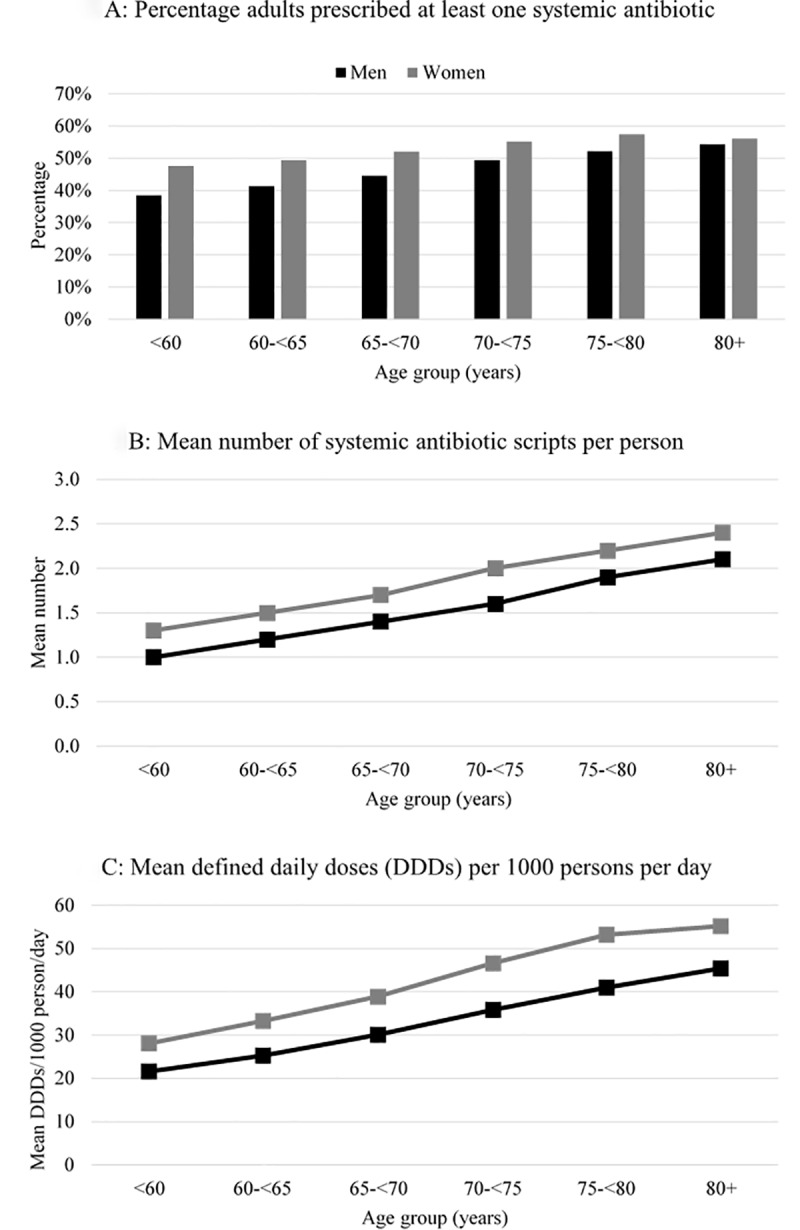
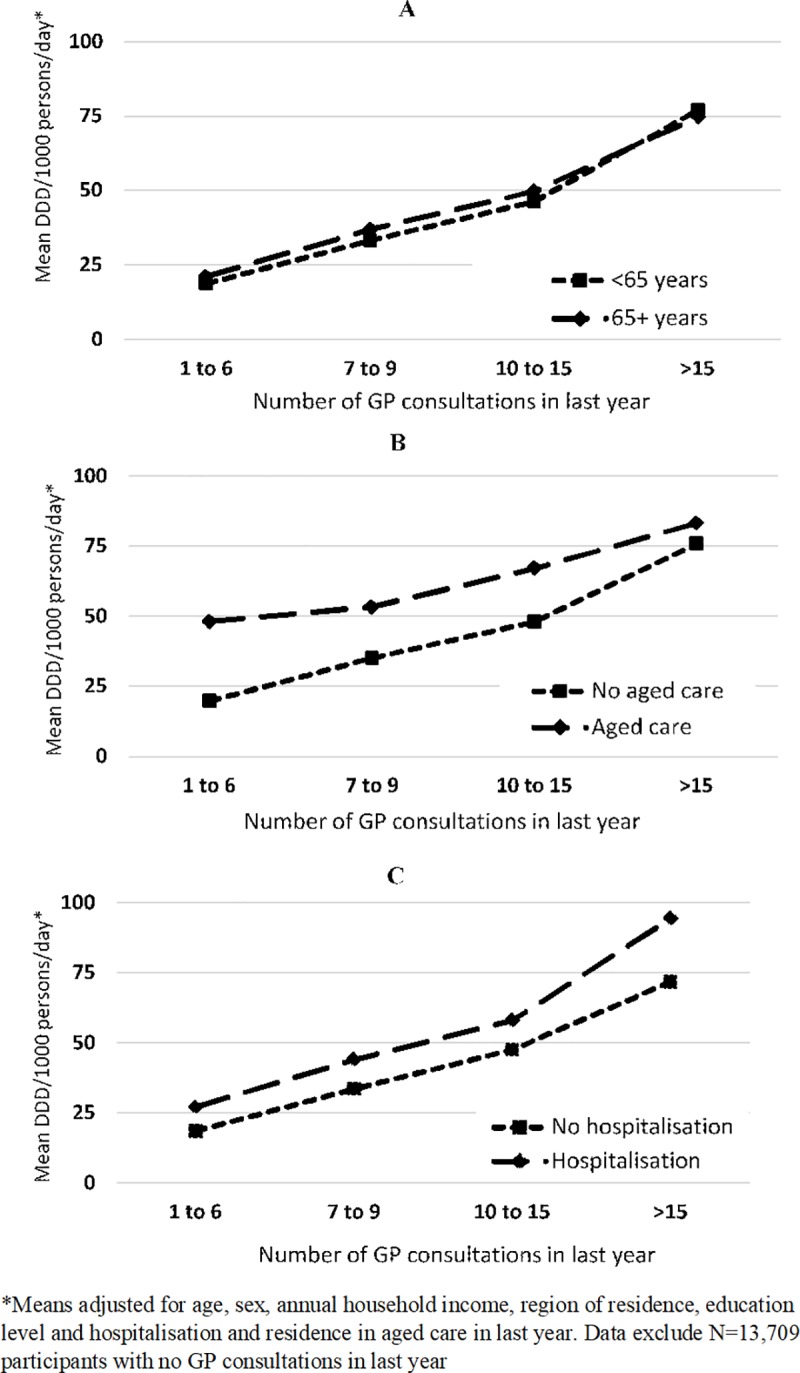
Overall, 49.3% of 45 and Up Study participants had at least one systemic antibiotic dispensed in 2015 with a total of 392,856 prescriptions dispensed and an average of 36.5 DDDs/1000-persons/day in the study population. The quantity of antibiotics dispensed increased with increasing age (25.6 DDDs/1000/day in <60 years old versus 50.4 DDDs/1000/day in 80+ year old) and was higher comparing women to men (39.9 versus 32.4 DDDs/1000/day). Of factors examined, the greatest dispensing of antibiotics was among those who had been resident in an aged care facility and those with >15 general practitioner consultations in the last year (80.5 and 88.3 DDDs/1000/day, respectively). These factors remained strongly associated with greater antibiotic dispensing after adjusting for age, sex, education, income, area of residence and co-morbidities.
Residence in aged care facilities and high GP visits are associated with greater antibiotic dispensing. This study provides important evidence regarding high use groups for antimicrobial stewardship.
抗生素的广泛使用导致了抗生素耐药性的发展。然而,关于社区环境中抗生素使用的描述数据有限,并且检查与更大使用相关的因素。我们的研究旨在根据社会人口统计学和卫生服务使用情况,量化社区中老年人的抗生素配给情况。
对澳大利亚 239981 名年龄≥45 岁的人群进行了基于人群的队列研究(萨克研究所的 45 岁及以上研究)。通过问卷收集社会人口统计学和健康数据,并与 2015 年抗生素配药数据(PBS)以及其他行政健康数据库相关联。我们估计了 2015 年 J01 开始的解剖治疗分类代码系统抗生素的定义日剂量(DDD)。我们还进行了泊松回归分析,以确定与抗生素配药相关的因素。
总体而言,45 岁及以上研究的参与者中有 49.3%在 2015 年至少有一次系统抗生素配药,总共有 392856 张处方配药,研究人群中平均每天每 1000 人 36.5 DDD。抗生素配药数量随年龄增长而增加(<60 岁年龄组为 25.6 DDD/1000 人/天,80 岁以上年龄组为 50.4 DDD/1000 人/天),女性高于男性(39.9 比 32.4 DDD/1000 人/天)。在所检查的因素中,抗生素配药最多的是居住在养老院的人和去年接受超过 15 次全科医生咨询的人(分别为 80.5 和 88.3 DDD/1000 人/天)。这些因素在调整年龄、性别、教育程度、收入、居住地区和合并症后,仍然与更大的抗生素配药密切相关。
居住在养老院和高 GP 就诊与抗生素配药较多有关。这项研究提供了有关抗菌药物管理的高使用群体的重要证据。