Xiao Qing, Zhang Shujun, Yang Cheng, Du Ruoyang, Zhao Jinqiu, Li Jiajun, Xu Yashu, Qin Yuanyuan, Gao Yue, Huang Wenxiang
Chongqing Key Laboratory of Infectious Diseases and Parasitic Diseases, Department of Infectious Diseases, The First Affiliated Hospital of Chongqing Medical University, Chongqing, China.
Department of General Medicine, People's Hospital of Chongqing Bishan District, Chongqing, China.
Int J Endocrinol. 2019 Jul 28;2019:7514802. doi: 10.1155/2019/7514802. eCollection 2019.
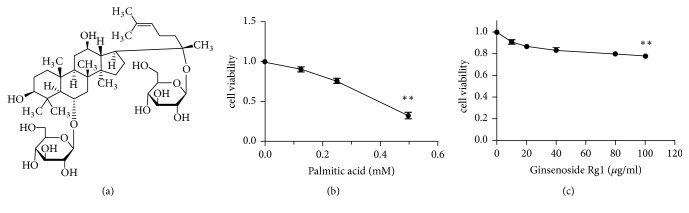
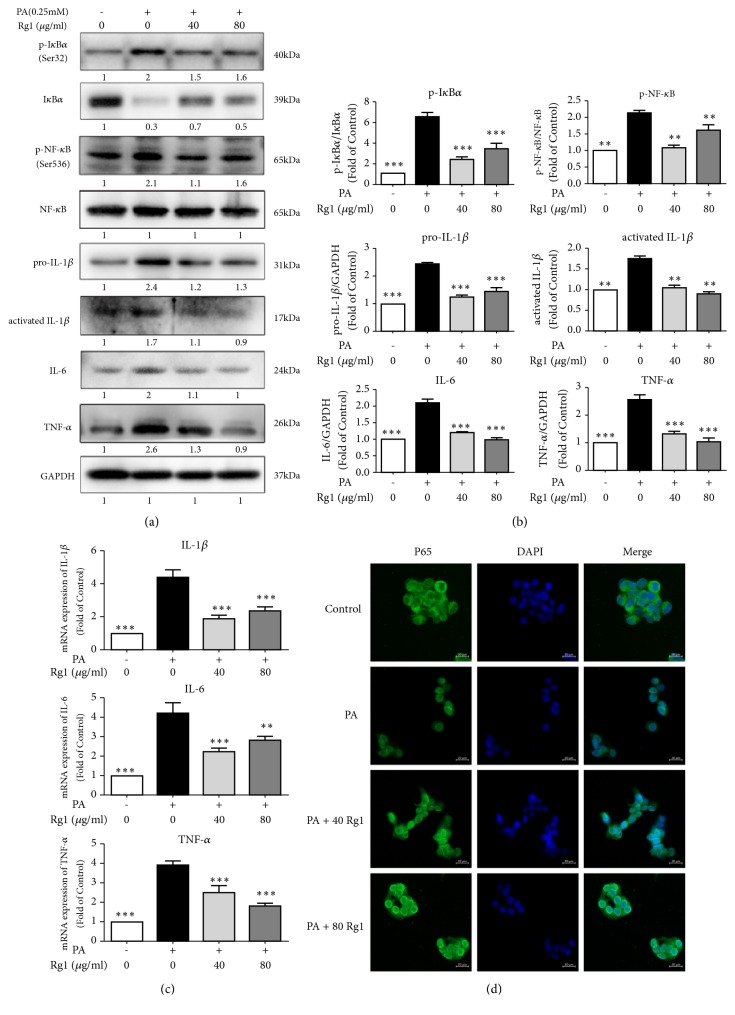
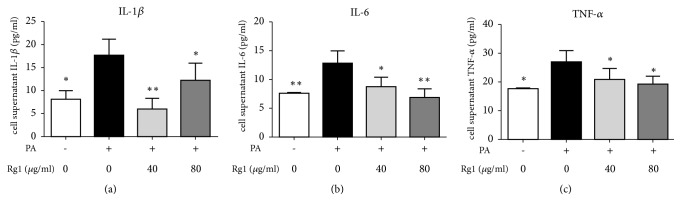
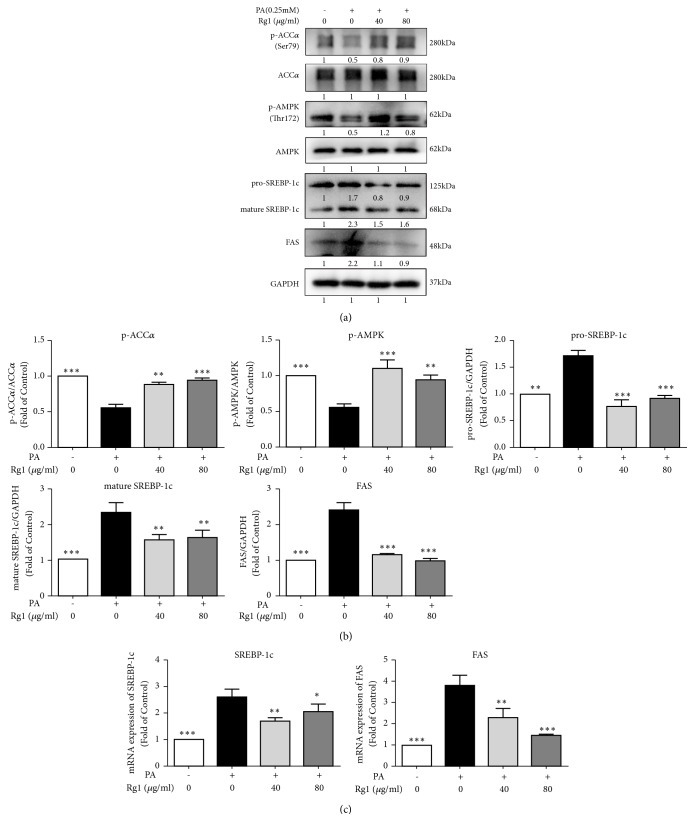
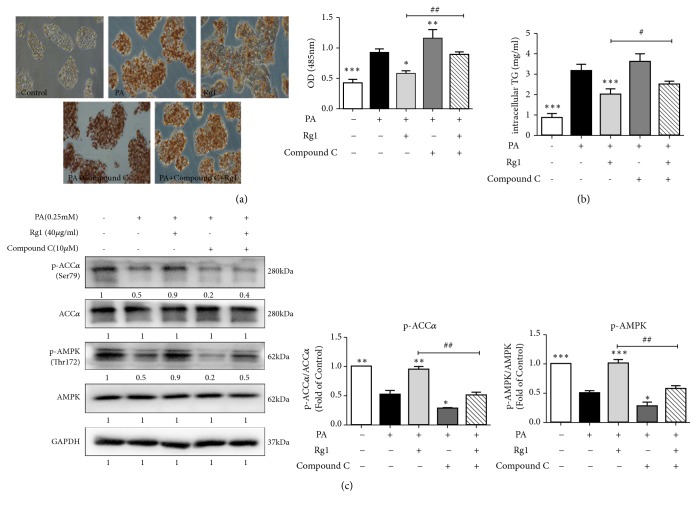
Nonalcoholic fatty liver disease (NAFLD) is one of the common diseases in the world, and it can progress from simple lipid accumulation to sustained inflammation. The present study was designed to investigate the effects and underlying mechanisms of ginsenoside Rg1 (G-Rg1) treatment on NAFLD . HepG2 cells were treated with palmitic acid (PA) to induce steatosis and inflammation and then successively incubated with G-Rg1. Lipids accumulation was analyzed by Oil Red O staining and intracellular triglyceride (TG) quantification. Inflammatory conditions were examined by quantifying the levels of cell supernatant alanine transaminase/aspartate aminotransferase (ALT/AST) and secretory proinflammatory cytokines, including IL-1, IL-6, and TNF- in the cell supernatants. Quantitative RT-PCR and western blotting were used to measure the expressions of genes and proteins associated with lipogenic synthesis and inflammation, including AMP-activated protein kinase (AMPK) and nuclear factor-kappa B (NF-B) pathways. HepG2 cells were pretreated with an AMPK inhibitor; then, Oil Red O staining and TG quantification were performed to study the lipid deposition. Phospho-AMPK (Thr172) (p-AMPK) and phospho-acetyl-CoA carboxylase (Ser79) (p-ACC) were quantified by immunoblotting. Immunofluorescence was performed to demonstrate the nuclear translocation of NF-B P65. The present study showed that PA markedly increased the intracellular lipid droplets accumulation and TG levels, but decreased AMPK phosphorylation and the expressions of its downstream lipogenic genes. However, G-Rg1 alleviated hepatic steatosis and reduced the intracellular TG content; these changes were accompanied by the activation of the AMPK pathway. In addition, blocking AMPK by using the AMPK inhibitor markedly abolished the G-Rg1-mediated protection against PA-induced lipid deposition in HepG2 cells. Furthermore, G-Rg1 reduced the ALT/AST levels and proinflammatory cytokines release, which were all enhanced by PA. These effects were correlated with the inactivation of the NF-B pathway and translocation of P65 from the cytoplasm to the nucleus. Overall, these results suggest that G-Rg1 effectively ameliorates hepatic steatosis and inflammation, which might be associated with the AMPK/NF-B pathway.
非酒精性脂肪性肝病(NAFLD)是全球常见疾病之一,可从单纯脂质蓄积发展为持续性炎症。本研究旨在探讨人参皂苷Rg1(G-Rg1)治疗NAFLD的效果及潜在机制。用棕榈酸(PA)处理HepG2细胞以诱导脂肪变性和炎症,然后依次与G-Rg1孵育。通过油红O染色和细胞内甘油三酯(TG)定量分析脂质蓄积情况。通过定量细胞上清液中的丙氨酸转氨酶/天冬氨酸转氨酶(ALT/AST)水平以及细胞上清液中分泌的促炎细胞因子(包括IL-1、IL-6和TNF-)来检测炎症状态。采用定量逆转录聚合酶链反应(qRT-PCR)和蛋白质印迹法检测与脂肪生成合成和炎症相关的基因和蛋白质表达,包括AMP激活的蛋白激酶(AMPK)和核因子-κB(NF-κB)信号通路。用AMPK抑制剂预处理HepG2细胞;然后进行油红O染色和TG定量分析以研究脂质沉积情况。通过免疫印迹法定量磷酸化AMPK(Thr172)(p-AMPK)和磷酸化乙酰辅酶A羧化酶(Ser79)(p-ACC)。进行免疫荧光检测以证明NF-κB P65的核转位。本研究表明,PA显著增加细胞内脂质滴蓄积和TG水平,但降低AMPK磷酸化及其下游脂肪生成基因的表达。然而,G-Rg1减轻了肝脏脂肪变性并降低了细胞内TG含量;这些变化伴随着AMPK信号通路的激活。此外,使用AMPK抑制剂阻断AMPK可显著消除G-Rg1对PA诱导的HepG2细胞脂质沉积的保护作用。此外,G-Rg1降低了PA所增强的ALT/AST水平和促炎细胞因子释放。这些作用与NF-κB信号通路的失活以及P65从细胞质向细胞核的转位相关。总体而言,这些结果表明G-Rg1可有效改善肝脏脂肪变性和炎症,这可能与AMPK/NF-κB信号通路有关。