Oliver Gretchen D, Friesen Kenzie, Barfield Jeff W, Giordano Kevin, Anz Adam, Dugas Jeff, Andrews James
Sports Medicine & Movement Laboratory, School of Kinesiology, Auburn University, Auburn, Alabama, USA.
Andrews Research & Education Foundation, Gulf Breeze, Florida, USA.
Orthop J Sports Med. 2019 Aug 21;7(8):2325967119865171. doi: 10.1177/2325967119865171. eCollection 2019 Aug.
There is a paucity of research regarding the relationship between fastpitch softball pitching mechanics and reported pain. Thus, understanding the pitching mechanics of athletes pitching with upper extremity pain and those pain free is paramount.
To examine lower extremity pitching mechanics, upper extremity kinetics, and upper extremity pain in National Collegiate Athletic Association (NCAA) Division I female softball pitchers.
Descriptive laboratory study.
A total of 37 NCAA Division I female softball pitchers (mean age, 19.84 ± 1.28 years; mean height, 173.67 ± 7.77 cm; mean weight, 78.98 ± 12.40 kg) from across the United States were recruited to participate. Participants were divided into 2 groups: upper extremity pain (n = 13; mean age, 19.69 ± 1.18 years; mean height, 172.60 ± 11.49 cm; mean weight, 86.75 ± 13.02 kg) and pain free (n = 24; mean age, 19.91 ± 1.35 years; mean height, 174.26 ± 4.96 cm; mean weight, 74.78 ± 9.97 kg). An electromagnetic tracking system was used to obtain kinematic and kinetic data during the riseball softball pitch.
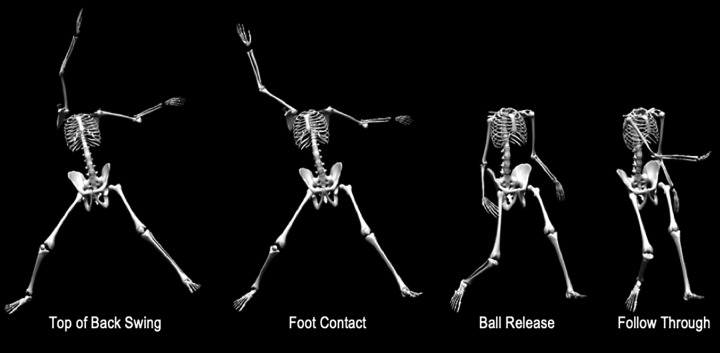
At foot contact ( = 7.01, = .001), backward elimination regression revealed that stride length, trunk rotation, and center of mass (COM) significantly explained about 33% of variance with softball pitchers experiencing upper extremity pain (adjusted = 0.33).
At foot contact, the kinematic variables of increased trunk rotation toward the pitching arm side, increased stride length, and a posteriorly shifted COM were associated with upper extremity pain in collegiate softball pitchers. Variables early in the pitching motion that do not set a working and constructive proximal kinetic chain foundation for the rest of the pitch to follow could be associated with breakdowns more distal in the kinetic chain, possibly increasing the susceptibility to upper extremity pain.
The identification of pitching mechanics associated with pain allows clinicians to develop exercises to avoid such mechanics. Avoiding mechanics associated with pain may help reduce the prevalence of pain in windmill softball pitchers as well as help coaches incorporate quantitative biomechanics into their instruction.
关于快投垒球投球力学与报告的疼痛之间的关系,研究较少。因此,了解上肢疼痛的运动员和无痛运动员的投球力学至关重要。
研究美国国家大学体育协会(NCAA)一级女子垒球投手的下肢投球力学、上肢动力学和上肢疼痛情况。
描述性实验室研究。
招募了来自美国各地的37名NCAA一级女子垒球投手(平均年龄19.84±1.28岁;平均身高173.67±7.77厘米;平均体重78.98±12.40千克)参与研究。参与者被分为两组:上肢疼痛组(n = 13;平均年龄19.69±1.18岁;平均身高172.60±11.49厘米;平均体重86.75±13.02千克)和无痛组(n = 24;平均年龄19.91±1.35岁;平均身高174.26±4.96厘米;平均体重74.78±9.97千克)。在投上升球时,使用电磁跟踪系统获取运动学和动力学数据。
在脚触地时(P = 7.01,P = 0.001),向后逐步回归分析显示,步长、躯干旋转和质心(COM)显著解释了约33%的上肢疼痛垒球投手的方差(调整后R² = 0.33)。
在脚触地时,向投球手臂一侧增加躯干旋转、增加步长和质心后移的运动学变量与大学垒球投手上肢疼痛有关。投球动作早期的变量如果没有为后续投球建立一个有效的、建设性的近端动力链基础,可能与动力链更远处的故障有关,可能会增加上肢疼痛的易感性。
识别与疼痛相关的投球力学,使临床医生能够制定避免此类力学的练习。避免与疼痛相关的力学可能有助于降低风车式垒球投手中疼痛的发生率,也有助于教练将定量生物力学纳入他们的指导中。