Department of Neurology, Children's National Health System, District of Columbia, Washington.
Department of Medical Social Sciences, Northwestern University, Chicago, Illinois.
Ann Clin Transl Neurol. 2019 Sep;6(9):1696-1706. doi: 10.1002/acn3.50867. Epub 2019 Aug 31.
We performed a prospective, cross-sectional cognitive assessment in subjects with Duchenne Muscular Dystrophy (DMD) and their biological mothers.
Thirty subjects with out-of-frame mutations in the dystrophin (DMD) gene, and 25 biological mothers were evaluated using the National Institutes of Health Toolbox Cognition Battery (NIHTB-CB). A parent completed the Behavior Rating Inventory of Executive Functioning (BRIEF), a standardized rating scale of executive functioning, for their child. Mothers completed self-reports of BRIEF and Neuro Quality-of-Life (NeuroQoL) Cognitive Function.
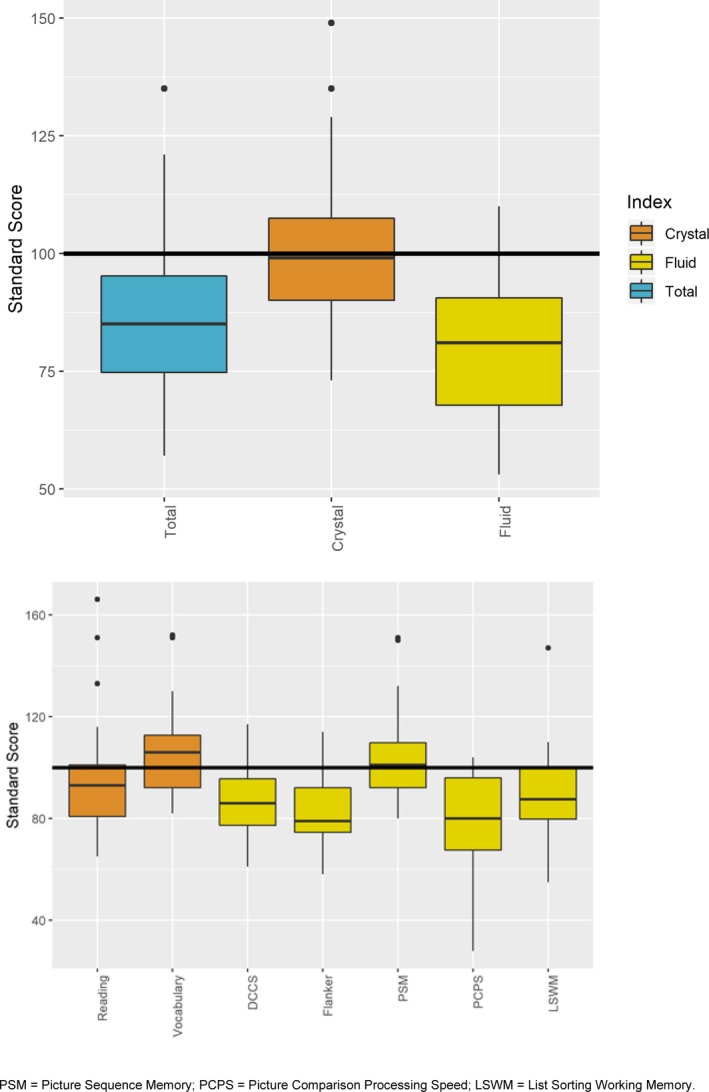
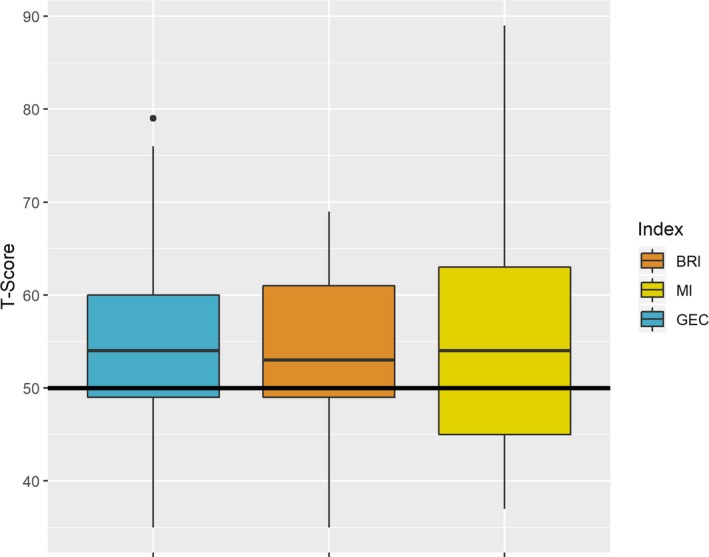
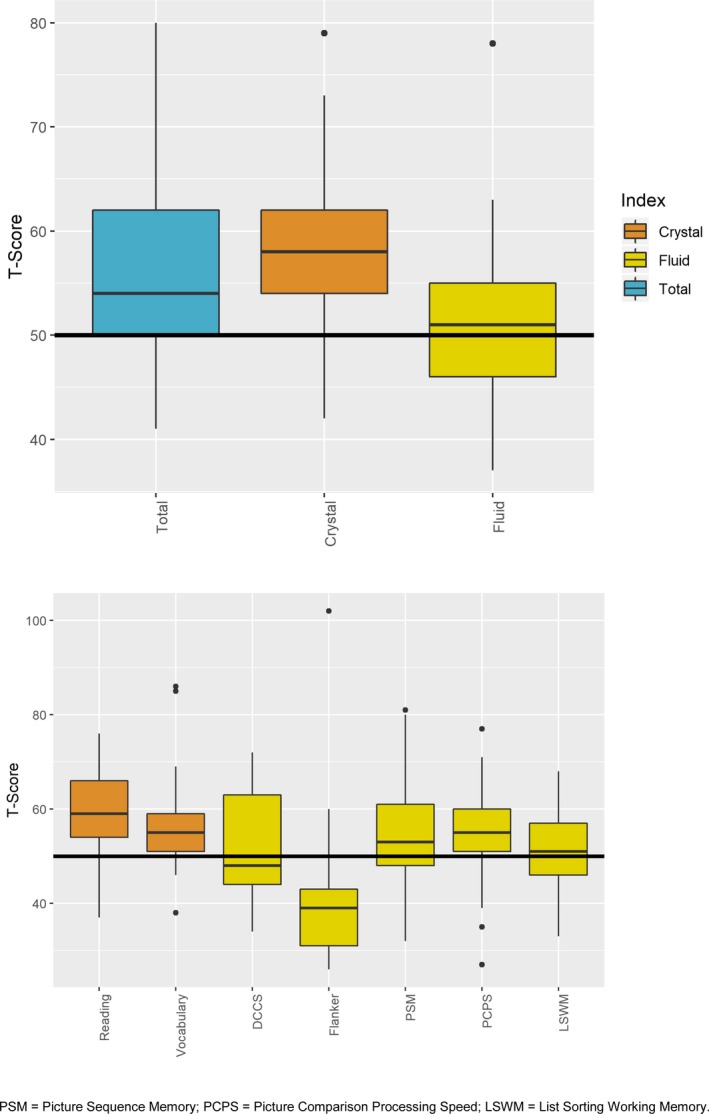
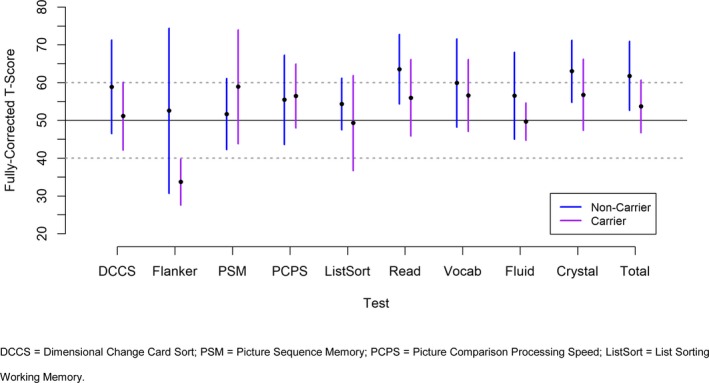
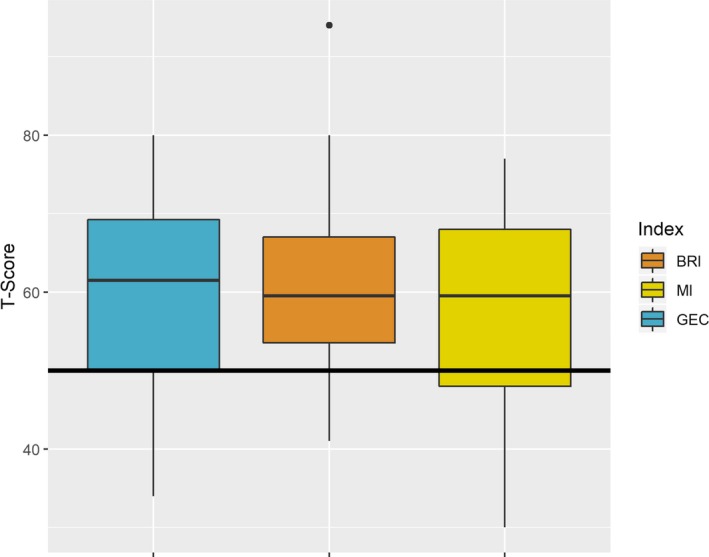
Overall, the subjects with DMD scored approximately one standard deviation (SD) below age-corrected norms on the NIHTB-CB Total Cognition score. They scored 1.5 SD below age-corrected norms in Fluid Cognition, which evaluates the cognitive domains of executive function, working memory, episodic memory, attention, and processing speed. Their performance was consistent with age expectations (i.e., within 1 SD below age-corrected norms) in Crystalized Cognition, which evaluates vocabulary and reading. Subjects with DMD had higher T-scores in several domains of BRIEF, demonstrating greater difficulty in executive functioning. The biological mothers had overall average or above average T-scores on NIHTB-CB. Mothers who were carriers of DMD mutation performed lower overall compared to mothers who were not carriers of DMD mutation (Cohen's d = -1.1). Carrier mothers performed lower than average (1.5 SD) in Executive Function, measured by Flanker Inhibitory Control and Attention. Biological mothers scored within expected score ranges for adults in BRIEF and NeuroQoL.
The NIHTB-CB, combined with standardized self-reported measures, can be a sensitive screening tool for cognitive surveillance in DMD.
我们对患有杜氏肌营养不良症(DMD)的患者及其生物母亲进行了前瞻性、横断面认知评估。
30 名携带肌营养不良蛋白(DMD)基因突变的受试者和 25 名生物母亲使用美国国立卫生研究院工具包认知电池(NIHTB-CB)进行了评估。一位家长为其孩子完成了行为评定量表的执行功能(BRIEF),这是一种执行功能的标准化评定量表。母亲们完成了 BRIEF 和神经生活质量(NeuroQoL)认知功能的自我报告。
总的来说,DMD 患者在 NIHTB-CB 总认知评分上的得分比年龄校正标准低约一个标准差(SD)。他们在流体认知方面的得分比年龄校正标准低 1.5 个 SD,流体认知评估执行功能、工作记忆、情景记忆、注意力和处理速度等认知领域。他们的表现与年龄预期相符(即,比年龄校正标准低 1 个 SD)在晶体认知方面,评估词汇和阅读。DMD 患者在 BRIEF 的几个领域的 T 评分较高,表明在执行功能方面存在更大的困难。生物母亲在 NIHTB-CB 的大多数领域的 T 评分都处于平均或高于平均水平。携带 DMD 基因突变的母亲的整体表现低于未携带 DMD 基因突变的母亲(Cohen's d=-1.1)。携带突变的母亲在执行功能方面的表现低于平均水平(1.5 SD),这一功能通过侧抑制控制和注意力来衡量。生物母亲在 BRIEF 和 NeuroQoL 中的得分在成人预期范围内。
NIHTB-CB 结合标准化的自我报告测量,可作为 DMD 认知监测的敏感筛查工具。