Department of Plant Biotechnology and Cytogenetics, Plant Breeding and Acclimatization Institute-National Research Institute, Radzikow, 05-870, Blonie, Poland.
Department of Robotics and Mechatronics, AGH University of Science and Technology, al. Mickiewicza 30, 30-059, Krakow, Poland.
Plant Cell Rep. 2019 Dec;38(12):1515-1525. doi: 10.1007/s00299-019-02462-6. Epub 2019 Aug 31.
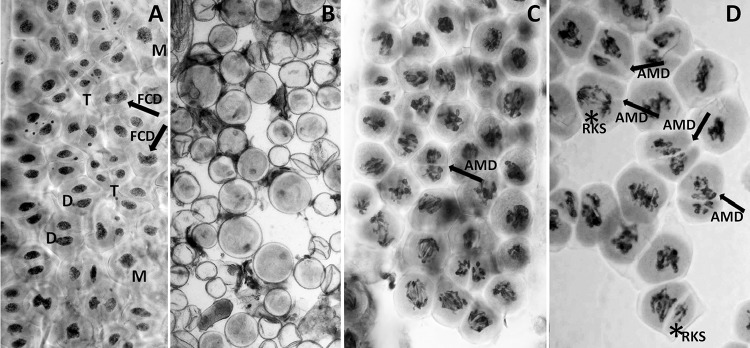
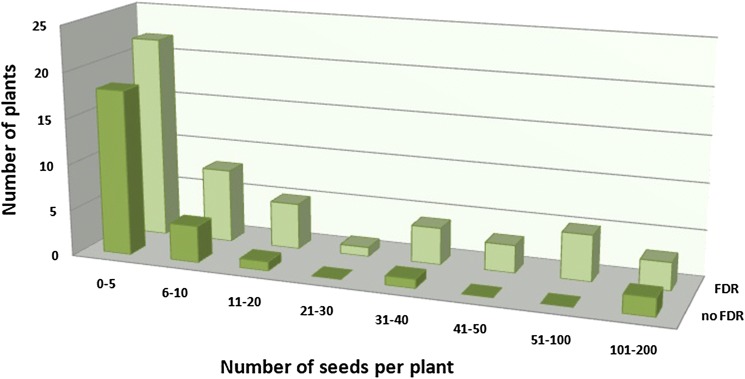
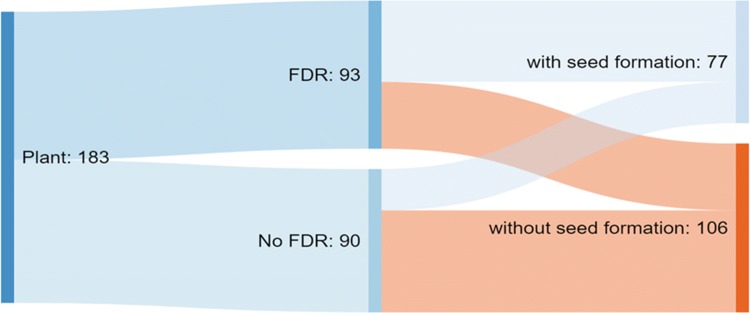
A single division meiosis mechanism of meiotic restitution is incompletely penetrant but significantly associated with restored fertility in triticale haploids (n = 21, genome formula ABR). Meiotic restitution, or failure of meiosis to produce gametes with a reduced chromosome number, can lead to the restoration of fertility in allohaploids. Meiotic restitution is of major interest for producing doubled haploids, as haploid plants undergoing meiotic restitution can often form seeds without the need to apply mitosis inhibitors to double chromosome number. We aimed to characterize meiotic restitution in a population of 183 haploids (n = 21, genome formula ABR) derived from an F wheat-rye hybrid where one parent was known to carry factors responsible for restoration of fertility in wide-cross haploids. Based on cytological analysis, approximately half of the plants analyzed were characterized by normal meiosis, while half showed at least some cytological evidence of meiotic restitution. However, this mechanism was incompletely penetrant in the population, with no individual plant showing 100% unreduced gamete formation: restitution occurred sectorially within each anther and was not observed in all the anthers of a given plant. Hence, the absence of meiotic restitution could not be confirmed conclusively for any individual plant, confounding this analysis. However, cytological observation of meiotic restitution was significantly associated with seed set, further confirming the role of meiotic restitution in fertility restoration. Our results provide insight into this mechanism of unreduced gamete formation, and provide a basis for future work identifying the genetic factors responsible for this trait.
一个单分体减数分裂机制的减数分裂修复不完全,但与黑小麦单倍体(基因组公式 ABR,n=21)的恢复育性显著相关。减数分裂修复,或减数分裂未能产生染色体数减少的配子,可导致异源单倍体的育性恢复。减数分裂修复对于产生加倍单倍体具有重要意义,因为经历减数分裂修复的单倍体植物通常可以形成种子,而无需应用有丝分裂抑制剂来加倍染色体数。我们旨在研究一个由 F 小麦-黑麦杂种衍生的 183 个单倍体(n=21,基因组公式 ABR)群体中的减数分裂修复,其中一个亲本已知携带可恢复广交单倍体育性的因子。基于细胞学分析,大约一半的分析植物表现出正常的减数分裂,而另一半则至少表现出一些减数分裂修复的细胞学证据。然而,该机制在群体中不完全穿透,没有单个植物显示 100%未减数配子形成:修复在每个花药内局部分化,并且在给定植物的所有花药中均未观察到。因此,不能为任何单个植物确定减数分裂修复的缺失,这使分析复杂化。然而,减数分裂修复的细胞学观察与结实率显著相关,进一步证实了减数分裂修复在育性恢复中的作用。我们的结果提供了对这种未减数配子形成机制的深入了解,并为未来识别负责这种性状的遗传因素的工作提供了基础。