Pulfrey Caroline Julia, Vansteenkiste Maarten, Michou Aikaterina
Laboratory of Social Psychology, Institute of Psychology, Université de Lausanne, Lausanne, Switzerland.
Department of Developmental, Personal and Social Psychology, Ghent University, Ghent, Belgium.
Front Psychol. 2019 Aug 14;10:1624. doi: 10.3389/fpsyg.2019.01624. eCollection 2019.
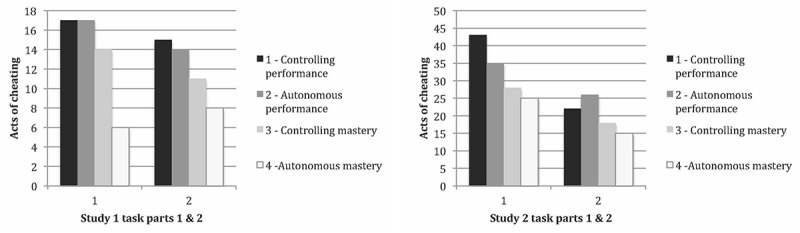
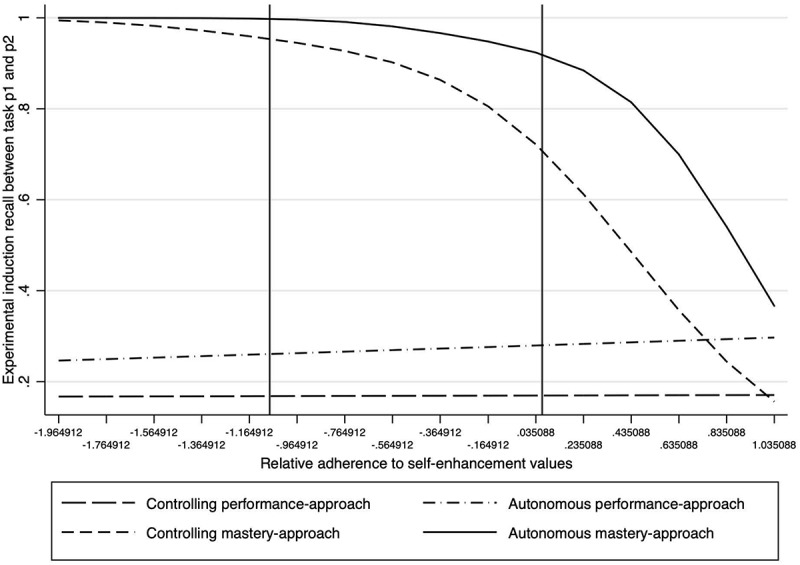
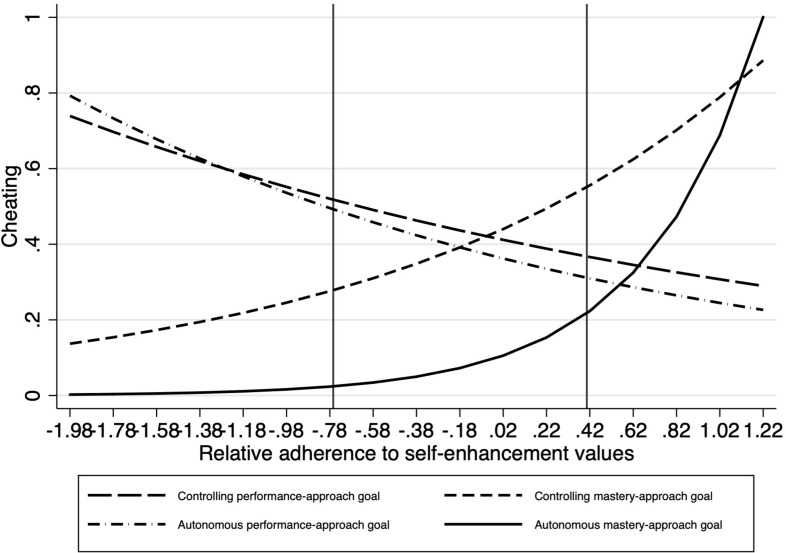
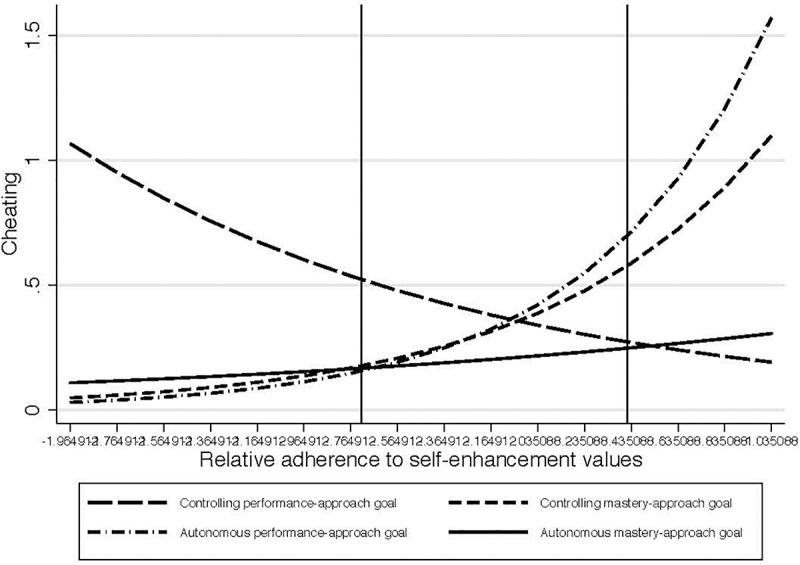
Combining principles of Achievement Goal Theory, which maintains that performance goals play a key role in individuals' likelihood of cheating, and Self-Determination Theory, which highlights the importance of autonomy support and autonomous motivation underlying achievement goals, we examined whether the combination of experimentally inducing a mastery-approach (relative to performance-approach) goal with an autonomy-supportive manner (instead of controlling) may attenuate cheating. In two experiments carried out with university students, one classroom based ( = 164) and one laboratory ( = 160), we manipulated the type of induced goal (performance- vs. mastery-approach) and style of introducing the goal (i.e., controlling vs. autonomy-supportive) by taking also into consideration participants' values. We hypothesized that the least behaviorally observed cheating would occur in a context promoting mastery-approach goals in an autonomy-supportive way and among individuals low in self-enhancement value adherence. The dependent variables in both studies consisted of two set of exercises, both including questions that could only be solved by cheating. Results of Poisson regression analyses revealed that in both studies the least cheating in the first set of exercises occurred in the autonomy-supportive/mastery-approach condition, indicating that this induced goal complex has the greatest potential to restrain academic dishonesty in the short-term. Interaction effects with self-enhancement value adherence revealed that the cheating inhibitory effects of this induced goal complex was less effective for those who value power and achievement.
成就目标理论认为成绩目标在个体作弊可能性中起关键作用,自我决定理论强调自主支持以及成就目标背后的自主动机的重要性。结合这两种理论,我们研究了以自主支持的方式(而非控制方式)实验性地诱导掌握型目标(相对于成绩型目标)是否会减少作弊行为。在针对大学生进行的两项实验中,一项是课堂实验(n = 164),另一项是实验室实验(n = 160),我们通过考虑参与者的价值观来操纵诱导目标的类型(成绩型与掌握型目标)以及引入目标的方式(即控制型与自主支持型)。我们假设,在以自主支持的方式促进掌握型目标的情境中,以及在自我提升价值认同度较低的个体中,观察到的作弊行为最少。两项研究中的因变量均由两组练习组成,两组练习都包含只能通过作弊来解决的问题。泊松回归分析结果显示,在两项研究中,第一组练习中作弊最少的情况出现在自主支持/掌握型目标条件下,这表明这种诱导目标组合在短期内抑制学术不诚实行为的潜力最大。与自我提升价值认同的交互效应表明,这种诱导目标组合对重视权力和成就的人抑制作弊的效果较差。