Rødvik Arne Kirkhorn, Tvete Ole, Torkildsen Janne von Koss, Wie Ona Bø, Skaug Ingebjørg, Silvola Juha Tapio
Department of Special Needs Education, Institute of Educational Sciences, University of Oslo, Oslo, Norway.
Cochlear Implant Unit, Department of Otorhinolaryngology, Division of Surgery and Clinical Neuroscience, Oslo University Hospital, Oslo, Norway.
Front Psychol. 2019 Aug 14;10:1813. doi: 10.3389/fpsyg.2019.01813. eCollection 2019.
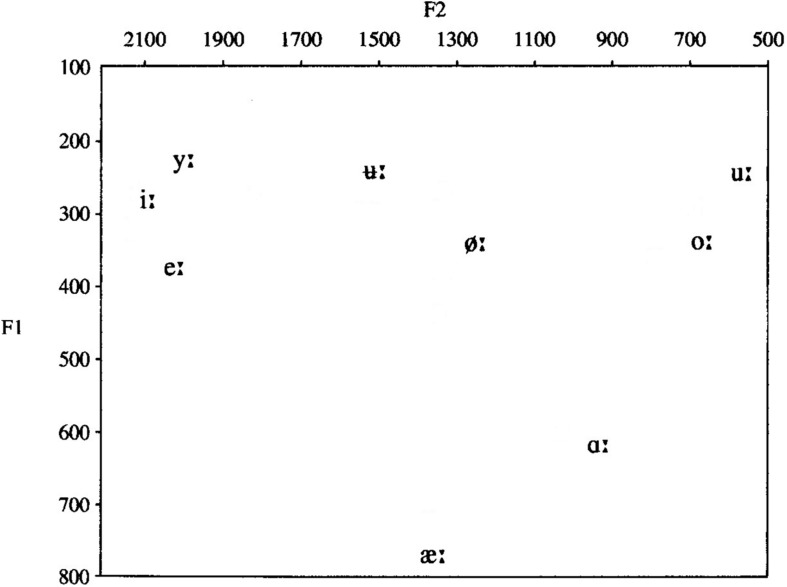
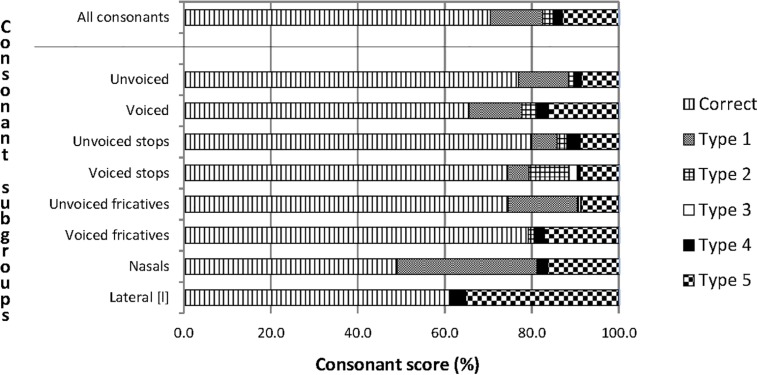
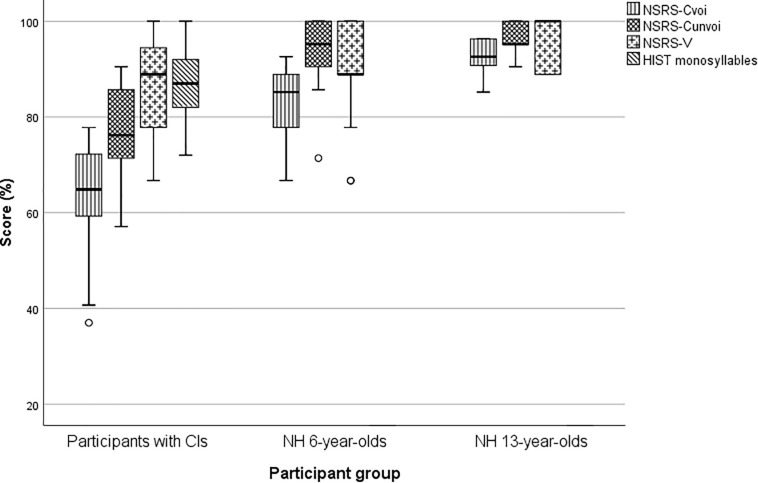
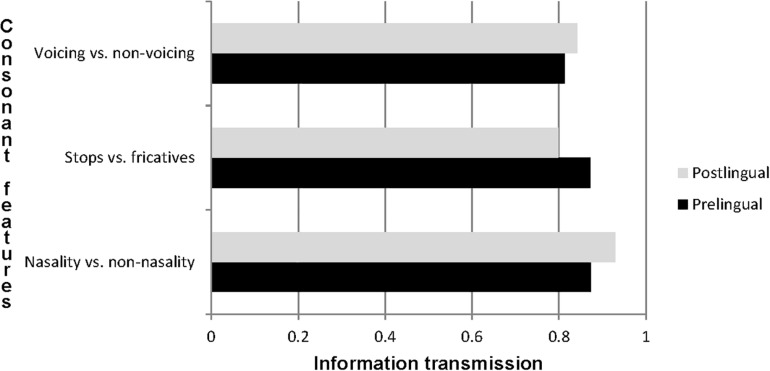
Although the majority of early implanted, profoundly deaf children with cochlear implants (CIs), will develop correct pronunciation if they receive adequate oral language stimulation, many of them have difficulties with perceiving minute details of speech. The main aim of this study is to measure the confusion of consonants and vowels in well-performing children and adolescents with CIs. The study also aims to investigate how age at onset of severe to profound deafness influences perception. The participants are 36 children and adolescents with CIs (18 girls), with a mean () age of 11.6 (3.0) years (range: 5.9-16.0 years). Twenty-nine of them are prelingually deaf and seven are postlingually deaf. Two reference groups of normal-hearing (NH) 6- and 13-year-olds are included. Consonant and vowel perception is measured by repetition of 16 bisyllabic vowel-consonant-vowel nonsense words and nine monosyllabic consonant-vowel-consonant nonsense words in an open-set design. For the participants with CIs, consonants were mostly confused with consonants with the same voicing and manner, and the mean () voiced consonant repetition score, 63.9 (10.6)%, was considerably lower than the mean () unvoiced consonant score, 76.9 (9.3)%. There was a devoicing bias for the stops; unvoiced stops were confused with other unvoiced stops and not with voiced stops, and voiced stops were confused with both unvoiced stops and other voiced stops. The mean () vowel repetition score was 85.2 (10.6)% and there was a bias in the confusions of [i:] and [y:]; [y:] was perceived as [i:] twice as often as [y:] was repeated correctly. Subgroup analyses showed no statistically significant differences between the consonant scores for pre- and postlingually deaf participants. For the NH participants, the consonant repetition scores were substantially higher and the difference between voiced and unvoiced consonant repetition scores considerably lower than for the participants with CIs. The participants with CIs obtained scores close to ceiling on vowels and real-word monosyllables, but their perception was substantially lower for voiced consonants. This may partly be related to limitations in the CI technology for the transmission of low-frequency sounds, such as insertion depth of the electrode and ability to convey temporal information.
尽管大多数早期植入人工耳蜗(CI)的极重度聋儿童在接受足够的口语语言刺激后会发展出正确的发音,但他们中的许多人在感知语音的细微细节方面存在困难。本研究的主要目的是测量人工耳蜗植入效果良好的儿童和青少年对辅音和元音的混淆情况。该研究还旨在调查重度至极重度聋发病年龄如何影响感知。参与者为36名人工耳蜗植入儿童和青少年(18名女孩),平均年龄为11.6(3.0)岁(范围:5.9 - 16.0岁)。其中29名是语前聋,7名是语后聋。纳入了两组正常听力(NH)的6岁和13岁儿童作为参照组。通过在开放集设计中重复16个双音节元音 - 辅音 - 元音无意义单词和9个单音节辅音 - 元音 - 辅音无意义单词来测量辅音和元音感知。对于人工耳蜗植入参与者,辅音大多与具有相同发声和发音方式的辅音混淆,平均浊辅音重复得分63.9(10.6)%,显著低于平均清辅音得分76.9(9.3)%。塞音存在清音化偏差;清塞音与其他清塞音混淆,而不与浊塞音混淆,浊塞音与清塞音和其他浊塞音都混淆。平均元音重复得分是85.2(10.6)%,并且在[i:]和[y:]的混淆上存在偏差;[y:]被误听为[i:]的频率是其正确重复频率的两倍。亚组分析显示,语前聋和语后聋参与者的辅音得分之间无统计学显著差异。对于正常听力参与者,辅音重复得分显著更高,浊辅音和清辅音重复得分之间的差异远低于人工耳蜗植入参与者。人工耳蜗植入参与者在元音和实词单音节上的得分接近上限,但他们对浊辅音的感知明显较低。这可能部分与人工耳蜗技术在低频声音传输方面的局限性有关,如电极的插入深度和传达时间信息的能力。