Wang Rongyun, Sun Qiuhua, Wang Fang, Liu Yuan, Li Xiang, Chen Tianhui, Wu Xiaoke, Tang Huijuan, Zhou Mengyun, Zhang Shuzhi, Xiao Yun, Huang Weijia, Wang Chi Chiu, Li Lu
School of Nursing, Zhejiang Chinese Medical University, Hangzhou, China.
School of Medicine, Shanghai Jiaotong University, Shanghai, China.
Front Oncol. 2019 Aug 16;9:730. doi: 10.3389/fonc.2019.00730. eCollection 2019.
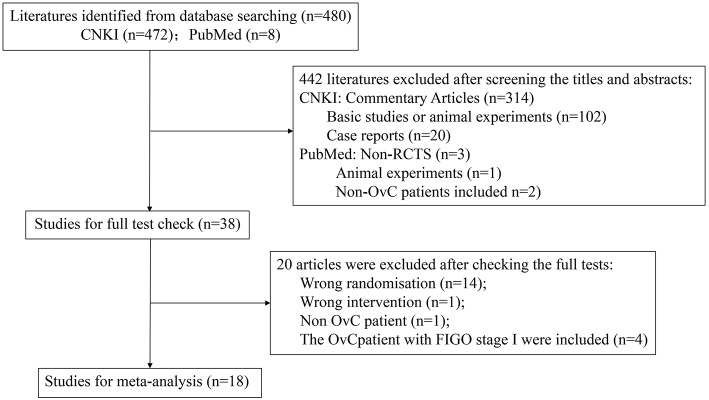
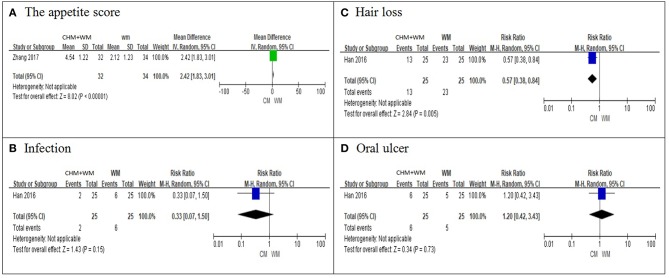
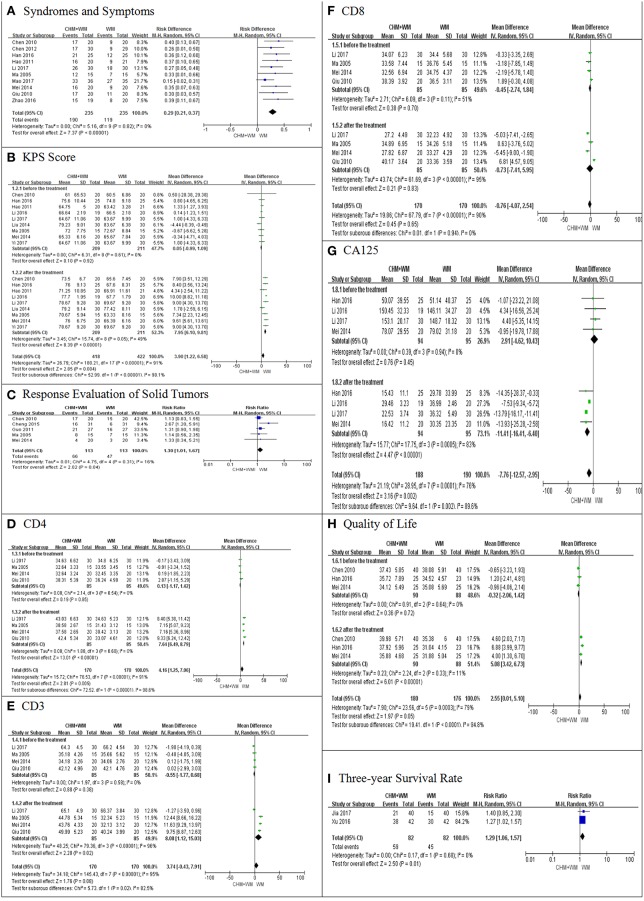
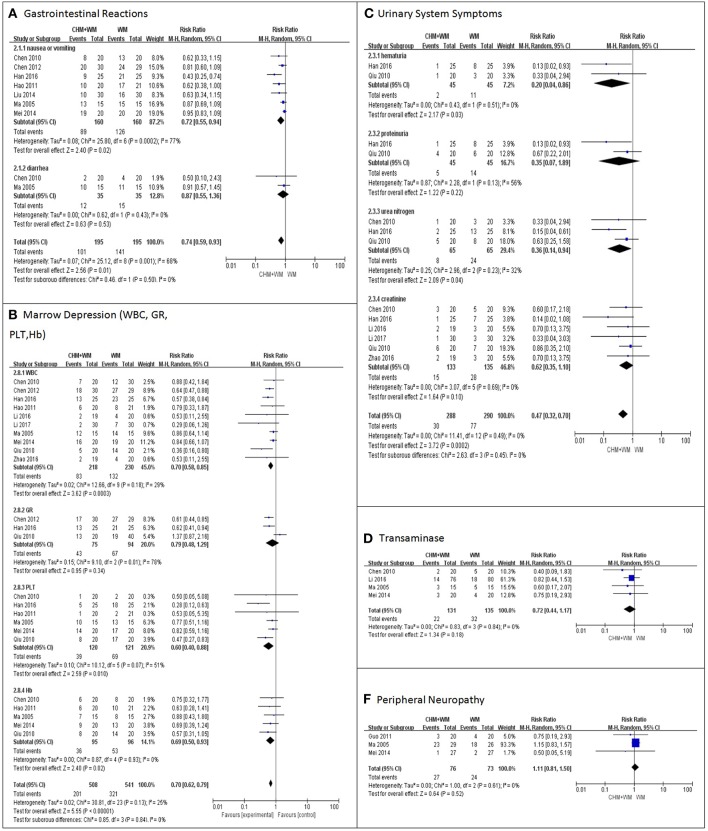
Ovarian cancer (OvC) is a malignant tumor which invades ovarian epithelium and interstitium. Reduction surgery combined with adjuvant chemotherapy is standard treatment for OvC patients, but the adverse effects due to chemotherapy still remains a major problem. While Chinese herbal medicine (CHM) therapy has a unique therapeutic effect to reduce side effects of chemotherapy by boosting immune system, the evidence of CHM in the treatment of OvC patients are limited. We conducted a systematic review to evaluate the efficacy and safety of CHM in the treatment of OvC after reduction surgery and adjuvant chemotherapy. Chinese National Knowledge Infrastructure (CNKI) and PubMed up to Dec 31st 2018 were searched to identify relevant studies. Only randomized controlled trials (RCTs) were included, and there was no limitation on language of the publication. Data were extracted from all included studies and meta-analysis was performed with Review Manager 5.3. Study quality was assessed and pooled risk ratios (RR) or mean difference (MD) with 95% CIs were used to evaluate the efficacy and safety of CHM. A total of 18 RCTs involving 975 participants were included. There was no placebo, no treatment and CHM alone. Compared with Western Medicine (WM) alone, Chinese herbal Medicine combined with WM (CHM-WM) significantly improved TCM syndromes and symptoms, KPS scores, CD4 counts, CA125 levels, and 3-years survival rate ( < 0.05). Incidences of gastrointestinal reactions, marrow depression, urinary system symptoms were significantly lower in CHM-WM group than in WM group ( < 0.01). There was no significant difference in CD3 counts, CD8 counts, quality of life, liver function, and peripheral neuropathy between the two groups ( > 0.05). The systematic review indicated that CHM combined with WM is effective and safe as a treatment for OvC patients after reduction surgery and adjuvant chemotherapy. However, more high-quality and large-scale RCTs are needed to confirm the efficacy and safety of CHM intervention.
卵巢癌(OvC)是一种侵袭卵巢上皮和间质的恶性肿瘤。减瘤手术联合辅助化疗是卵巢癌患者的标准治疗方法,但化疗引起的不良反应仍然是一个主要问题。虽然中药(CHM)疗法在通过增强免疫系统减轻化疗副作用方面具有独特的治疗效果,但中药治疗卵巢癌患者的证据有限。我们进行了一项系统评价,以评估中药在减瘤手术和辅助化疗后治疗卵巢癌的疗效和安全性。检索了截至2018年12月31日的中国知网(CNKI)和PubMed,以确定相关研究。仅纳入随机对照试验(RCT),对出版物的语言没有限制。从所有纳入研究中提取数据,并使用RevMan 5.3进行荟萃分析。评估研究质量,并使用合并风险比(RR)或平均差(MD)及95%置信区间来评估中药的疗效和安全性。共纳入18项RCT,涉及975名参与者。没有安慰剂组、无治疗组和单纯中药组。与单纯西药(WM)相比,中药联合西药(CHM-WM)显著改善了中医证候和症状、KPS评分、CD4计数、CA125水平及3年生存率(P<0.05)。CHM-WM组胃肠道反应、骨髓抑制、泌尿系统症状的发生率显著低于WM组(P<0.01)。两组之间CD3计数、CD8计数、生活质量、肝功能和周围神经病变方面无显著差异(P>0.05)。该系统评价表明,中药联合西药作为减瘤手术和辅助化疗后卵巢癌患者的治疗方法是有效且安全的。然而,需要更多高质量、大规模的RCT来证实中药干预的疗效和安全性。