Zhang Tianzi, Day John H, Su Xiaojing, Guadarrama Arthur G, Sandbo Nathan K, Esnault Stephane, Denlinger Loren C, Berthier Erwin, Theberge Ashleigh B
Department of Chemistry, University of Washington, Seattle, WA, United States.
Department of Medicine, University of Wisconsin School of Medicine and Public Health, Madison, WI, United States.
Front Bioeng Biotechnol. 2019 Aug 14;7:196. doi: 10.3389/fbioe.2019.00196. eCollection 2019.
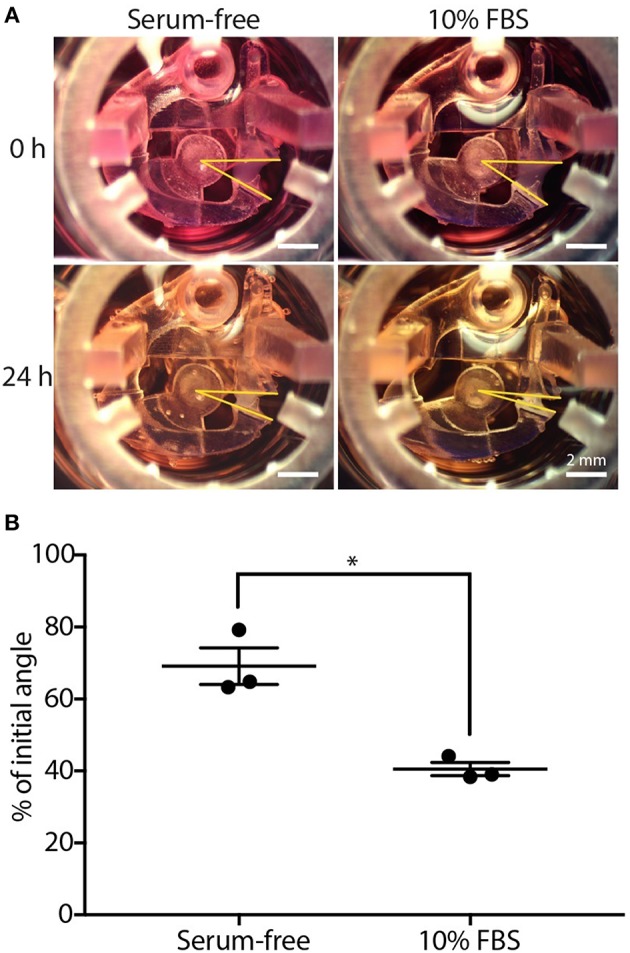
Mechanical forces have long been recognized as fundamental drivers in biological processes, such as embryogenesis, tissue formation and disease regulation. The collagen gel contraction (CGC) assay has served as a classic tool in the field of mechanobiology to study cell-induced contraction of extracellular matrix (ECM), which plays an important role in inflammation and wound healing. In a conventional CGC assay, cell-laden collagen is loaded into a cell culture vessel (typically a well plate) and forms a disk-shaped gel adhering to the bottom of the vessel. The decrement in diameter or surface area of the gel is used as a parameter to quantify the degree of cell contractility. In this study, we developed a microscale CGC assay with an engineered well plate insert that uses surface tension forces to load and manipulate small volumes (14 μL) of cell-laden collagen. The system is easily operated with two pipetting steps and the microscale device moves dynamically as a result of cellular forces. We used a straightforward one-dimensional measurement as the gel contraction readout. We adapted a conventional lung fibroblast CGC assay to demonstrate the functionality of the device, observing significantly more gel contraction when human lung fibroblasts were cultured in serum-containing media vs. serum-free media ( ≤ 0.05). We further cocultured eosinophils and fibroblasts in the system, two important cellular components that lead to fibrosis in asthma, and observed that soluble factors from eosinophils significantly increase fibroblast-mediated gel contraction ( ≤ 0.01). Our microscale CGC device provides a new method for studying downstream ECM effects of intercellular cross talk using 7- to 35-fold less cell-laden gel than traditional CGC assays.
长期以来,机械力一直被认为是生物过程中的基本驱动力,如胚胎发育、组织形成和疾病调控。胶原凝胶收缩(CGC)试验一直是力学生物学领域研究细胞诱导的细胞外基质(ECM)收缩的经典工具,而ECM收缩在炎症和伤口愈合中起着重要作用。在传统的CGC试验中,将含有细胞的胶原加载到细胞培养容器(通常是微孔板)中,并形成附着在容器底部的盘状凝胶。凝胶直径或表面积的减小被用作量化细胞收缩程度的参数。在本研究中,我们开发了一种微型CGC试验,使用一种经过工程设计的微孔板插入物,该插入物利用表面张力加载和操作少量(14 μL)含有细胞的胶原。该系统通过两个移液步骤即可轻松操作,并且由于细胞力的作用,微型装置会动态移动。我们使用直接的一维测量作为凝胶收缩的读数。我们采用传统的肺成纤维细胞CGC试验来证明该装置的功能,观察到当人肺成纤维细胞在含血清培养基中培养时比在无血清培养基中培养时凝胶收缩明显更多(≤0.05)。我们还在该系统中共培养了嗜酸性粒细胞和成纤维细胞,这是哮喘中导致纤维化的两个重要细胞成分,并观察到嗜酸性粒细胞的可溶性因子显著增加了成纤维细胞介导的凝胶收缩(≤0.01)。我们的微型CGC装置提供了一种新方法,用于研究细胞间相互作用的下游ECM效应,与传统CGC试验相比,使用的含有细胞的凝胶量减少了7至35倍。