Center for Breast Cancer, Research Institute and Hospital, National Cancer Center, Goyang, Korea.
Division of Breast and Thyroid, Department of Surgery, Keimyung University School of Medicine, Daegu, Korea.
Cancer Res Treat. 2020 Apr;52(2):426-437. doi: 10.4143/crt.2018.382. Epub 2019 Sep 3.
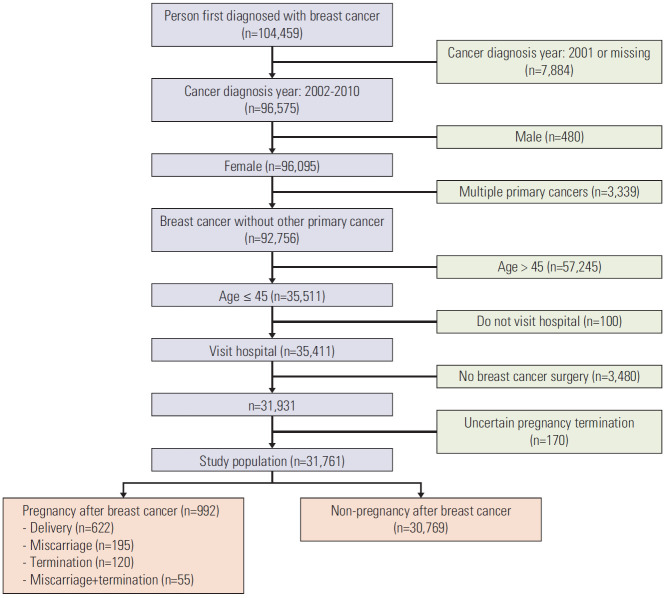
The purpose of this study was to determine the rate and outcomes of pregnancies subsequent to breast cancer in Korea, and the effect of such pregnancies on the prognosis of women who survived breast cancer and subsequently conceived.
We followed a total of 31,761 Korean women 45 years of age or younger who were treated for primary breast cancer from 2002 to 2010. We also included follow-up surveys that were conducted through December 2011. We identified recurrence and mortality from breast cancer using data linked to the Korea National Health Insurance database. We used propensity score matching of the study cohort to analyze the risks of recurrence and mortality from breast cancer depending on pregnancy.
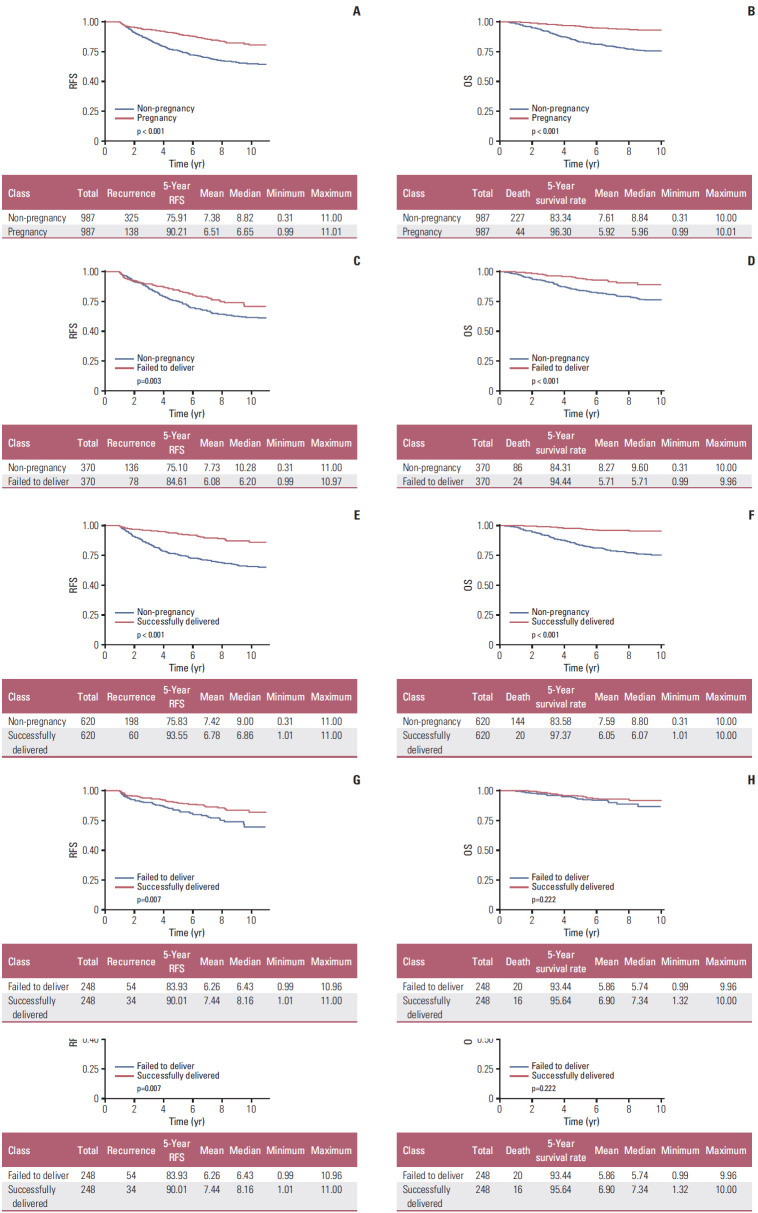
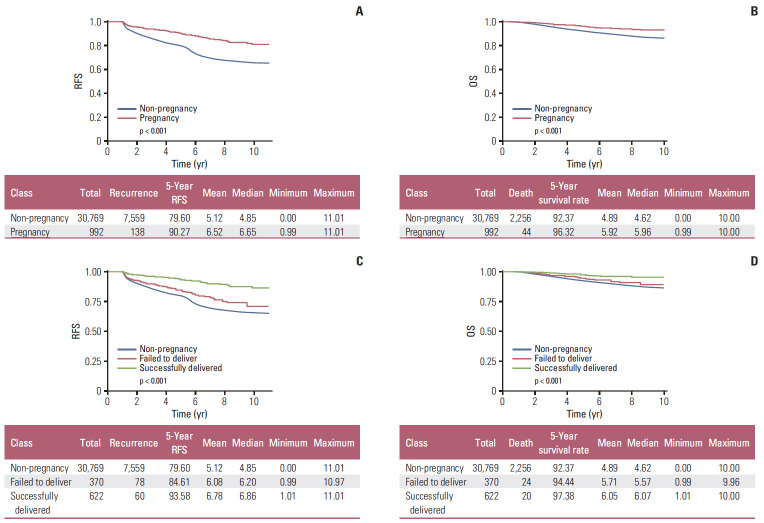
Within our sample, 992 women (3.1%) became pregnant after receiving treatment for breast cancer. Of those, 622 (67.5%) successfully delivered; the remaining 370 (32.5%) failed to deliver. After propensity score matching, we found that the women who became pregnant after breast cancer did not have a different risk of recurrence (hazard ratio [HR], 0.503; 95% confidence interval [CI], 0.434 to 0.584) and death (HR, 0.520; 95% CI, 0.397 to 0.681), compared with those who did not conceive after breast cancer treatment.
Our study is the first to report outcomes for Korean women who survived breast cancer and subsequently conceived. Women who survived breast cancer and subsequently became pregnant did not show a poorer survival outcome, compared with those who did not become pregnant.
本研究旨在确定韩国乳腺癌患者后续妊娠的发生率和结局,以及这些妊娠对乳腺癌存活后受孕女性的预后的影响。
我们随访了 2002 年至 2010 年间接受原发性乳腺癌治疗的共 31761 名 45 岁及以下的韩国女性,还包括截至 2011 年 12 月进行的随访调查。我们使用与韩国国家健康保险数据库相关联的数据来识别乳腺癌的复发和死亡情况。我们使用研究队列的倾向评分匹配来分析妊娠对乳腺癌复发和死亡风险的影响。
在我们的样本中,992 名(3.1%)接受乳腺癌治疗后怀孕。其中,622 名(67.5%)成功分娩,其余 370 名(32.5%)未分娩。经过倾向评分匹配后,我们发现乳腺癌后怀孕的女性复发风险(风险比[HR],0.503;95%置信区间[CI],0.434 至 0.584)和死亡风险(HR,0.520;95% CI,0.397 至 0.681)与乳腺癌治疗后未怀孕的女性没有差异。
我们的研究是第一个报告韩国乳腺癌存活后受孕女性结局的研究。与未怀孕的女性相比,乳腺癌存活后受孕的女性生存结局并未显示更差。