Zhang Xiaohao, Gong Pengyu, Sheng Lei, Lin Yanni, Fan Qiqi, Zhang Yun, Bao Yuanfei, Li Shizhan, Du Hongcai, Chen Zhonglun, Ding Caixia, Wang Huaiming, Xu Pengfei, Zhang Min, Scalzo Fabien, Liebeskind David S, Xie Yi, Liu Dezhi
Department of Neurology, Jiangsu Provincial Second Chinese Medicine Hospital, Second Affiliated Hospital of Nanjing University of Chinese Medicine, Nanjing, Jiangsu, China.
Department of Neurology, Jinling Hospital, Medical School of Nanjing University, Nanjing, Jiangsu, China.
Aging (Albany NY). 2019 Sep 3;11(17):6839-6850. doi: 10.18632/aging.102215.
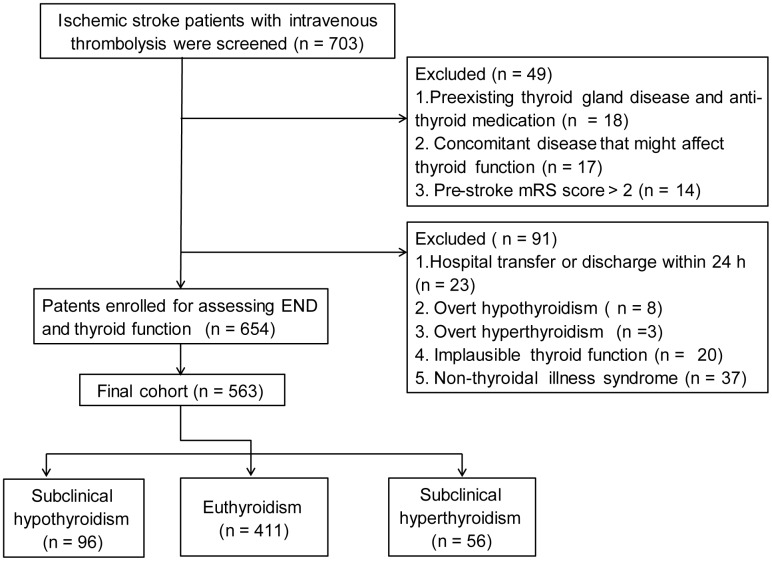
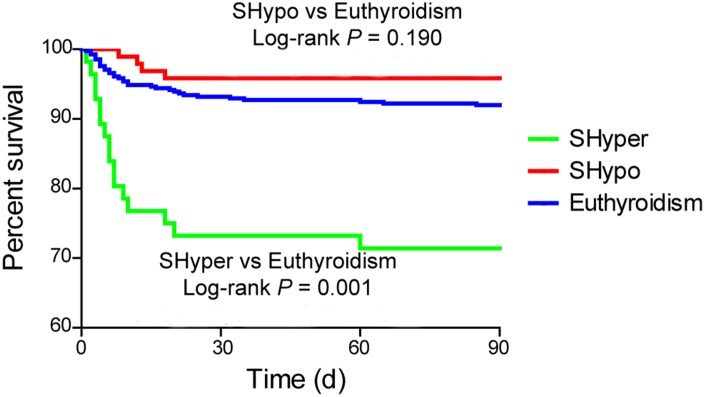
Data regarding the association between subclinical thyroid dysfunction and clinical outcomes in ischemic stroke patients with intravenous thrombolysis (IVT) are limited. We aimed to investigate the predictive value of subclinical thyroid dysfunction in END, functional outcome and mortality at 3 months among IVT patients. We prospectively recruited 563 IVT patients from 5 stroke centers in China. Thyroid function status was classified as subclinical hypothyroidism, subclinical hyperthyroidism (SHyper) and euthyroidism. The primary outcome was END, defined as ≥ 4 point in the NIHSS score within 24 h after IVT. Secondary outcomes included 3-month functional outcome and mortality. Of the 563 participants, END occurred in 14.7%, poor outcome in 50.8%, and mortality in 9.4%. SHyper was an independent predictor of END [odd ratio (OR), 4.35; 95% confidence interval [CI], 1.86-9.68, = 0.003], 3-month poor outcome (OR, 3.24; 95% CI, 1.43-7.33, = 0.005) and mortality [hazard ratio, 2.78; 95% CI, 1.55-5.36, = 0.003]. Subgroup analysis showed that there was no significant relationship between SHyper and clinical outcomes in IVT patients with endovascular therapy. In summary, SHyper is associated with increased risk of END, and poor outcome and mortality at 3 months in IVT patients without endovascular therapy.
关于亚临床甲状腺功能障碍与接受静脉溶栓(IVT)的缺血性中风患者临床结局之间关联的数据有限。我们旨在研究亚临床甲状腺功能障碍对IVT患者3个月时发生症状性颅内出血(END)、功能结局和死亡率的预测价值。我们前瞻性地从中国5个卒中中心招募了563例IVT患者。甲状腺功能状态分为亚临床甲状腺功能减退、亚临床甲状腺功能亢进(SHyper)和甲状腺功能正常。主要结局为END,定义为IVT后24小时内美国国立卫生研究院卒中量表(NIHSS)评分≥4分。次要结局包括3个月时的功能结局和死亡率。在563名参与者中,END发生率为14.7%,不良结局发生率为50.8%,死亡率为9.4%。SHyper是END的独立预测因素[比值比(OR),4.35;95%置信区间(CI),1.86 - 9.68,P = 0.003]、3个月时不良结局(OR,3.24;95% CI,1.43 - 7.33,P = 0.005)和死亡率[风险比,2.78;95% CI,1.55 - 5.36,P = 0.003]。亚组分析显示,在接受血管内治疗的IVT患者中,SHyper与临床结局之间无显著关系。总之,在未接受血管内治疗的IVT患者中,SHyper与END风险增加、3个月时不良结局和死亡率相关。