Department of Pathobiology, Institute of Pathology, University of Veterinary Medicine, Veterinaerplatz 1, 1210, Vienna, Austria.
Nature Research Centre, Vilnius, Lithuania.
Malar J. 2019 Sep 3;18(1):305. doi: 10.1186/s12936-019-2940-6.
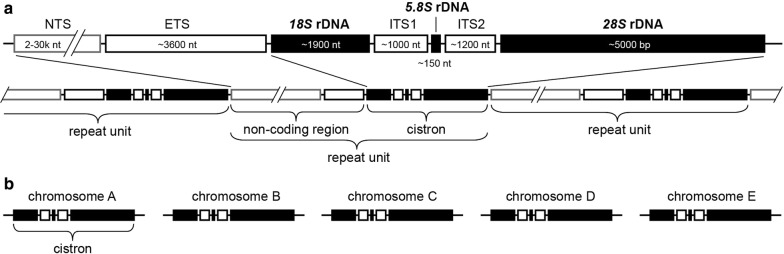
Plasmodium species feature only four to eight nuclear ribosomal units on different chromosomes, which are assumed to evolve independently according to a birth-and-death model, in which new variants originate by duplication and others are deleted throughout time. Moreover, distinct ribosomal units were shown to be expressed during different developmental stages in the vertebrate and mosquito hosts. Here, the 18S rDNA sequences of 32 species of avian haemosporidian parasites are reported and compared to those of simian and rodent Plasmodium species.
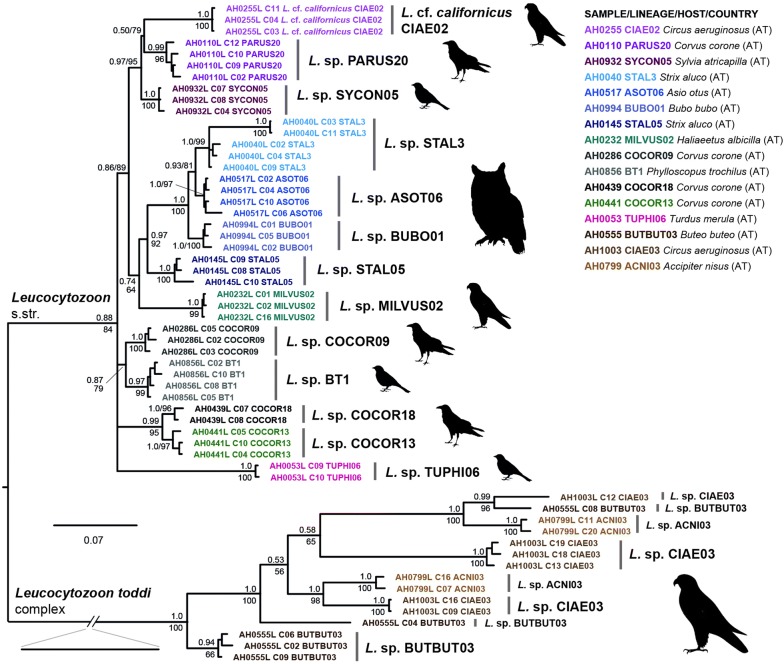
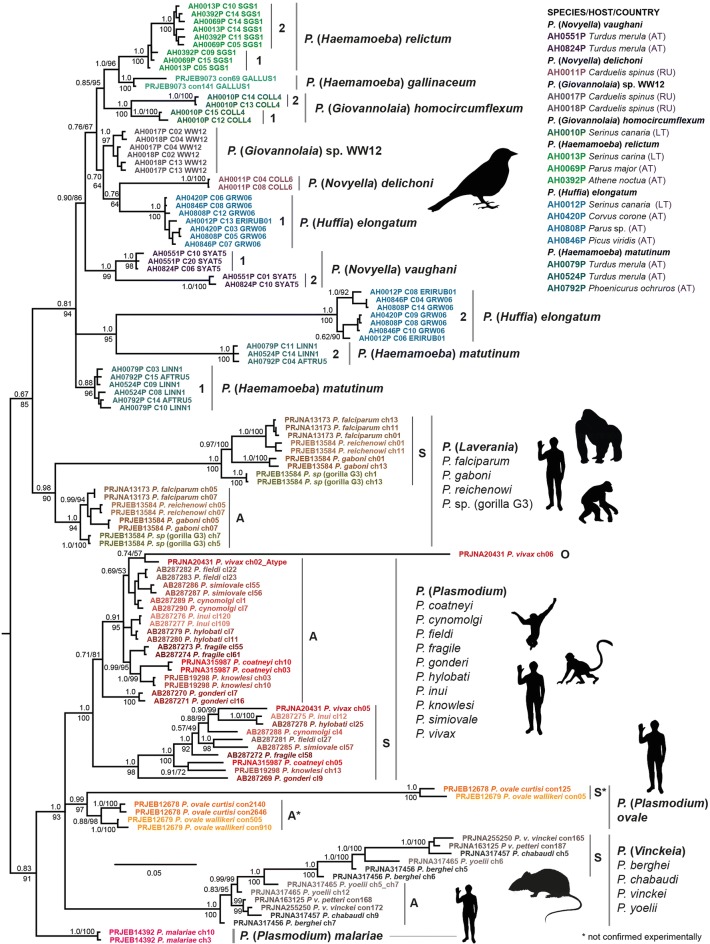
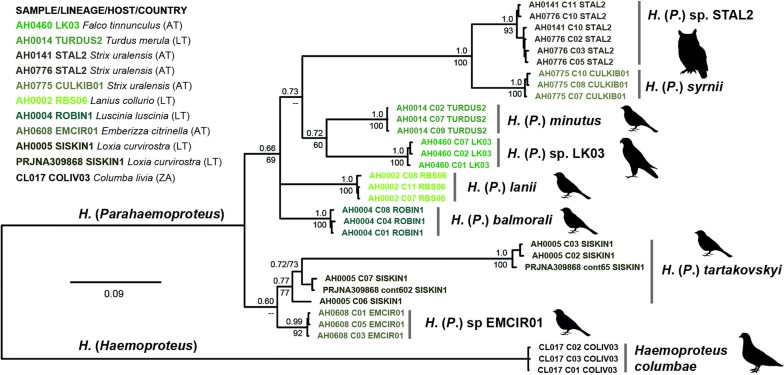
Almost the entire 18S rDNAs of avian haemosporidians belonging to the genera Plasmodium (7), Haemoproteus (9), and Leucocytozoon (16) were obtained by PCR, molecular cloning, and sequencing ten clones each. Phylogenetic trees were calculated and sequence patterns were analysed and compared to those of simian and rodent malaria species. A section of the mitochondrial CytB was also sequenced.
Sequence patterns in most avian Plasmodium species were similar to those in the mammalian parasites with most species featuring two distinct 18S rDNA sequence clusters. Distinct 18S variants were also found in Haemoproteus tartakovskyi and the three Leucocytozoon species, whereas the other species featured sets of similar haplotypes. The 18S rDNA GC-contents of the Leucocytozoon toddi complex and the subgenus Parahaemoproteus were extremely high with 49.3% and 44.9%, respectively. The 18S sequences of several species from all three genera showed chimeric features, thus indicating recombination.
Gene duplication events leading to two diverged main sequence clusters happened independently in at least six out of seven avian Plasmodium species, thus supporting evolution according to a birth-and-death model like proposed for the ribosomal units of simian and rodent Plasmodium species. Patterns were similar in the 18S rDNAs of the Leucocytozoon toddi complex and Haemoproteus tartakovskyi. However, the 18S rDNAs of the other species seem to evolve in concerted fashion like in most eukaryotes, but the presence of chimeric variants indicates that the ribosomal units rather evolve in a semi-concerted manner. The new data may provide a basis for studies testing whether differential expression of distinct 18S rDNA also occurs in avian Plasmodium species and related haemosporidian parasites.
疟原虫属的物种在不同染色体上只有四到八个核核糖体单位,这些单位被认为是根据一种“诞生-死亡”模型独立进化的,在这个模型中,新的变体通过复制产生,而其他变体随着时间的推移而被删除。此外,在脊椎动物和蚊子宿主的不同发育阶段,不同的核糖体单位被显示出被表达。在这里,报告了 32 种禽血孢子虫寄生虫的 18S rDNA 序列,并与灵长类和啮齿类疟原虫物种的序列进行了比较。
通过 PCR、分子克隆和测序,获得了属于疟原虫属(7 种)、血孢子虫属(9 种)和白细胞虫属(16 种)的禽血孢子虫的几乎完整的 18S rDNA,每个克隆获得了 10 个克隆。计算了系统发育树,并对序列模式进行了分析,并与灵长类和啮齿类疟原虫物种的序列模式进行了比较。还对线粒体 CytB 的一部分进行了测序。
大多数禽疟原虫物种的序列模式与哺乳动物寄生虫相似,大多数物种具有两个明显的 18S rDNA 序列簇。在 Haemoproteus tartakovskyi 和三种白细胞虫物种中也发现了不同的 18S 变体,而其他物种则具有相似的单倍型组。Leucocytozoon toddi 复合体和副血孢子虫亚属的 18S rDNA GC 含量极高,分别为 49.3%和 44.9%。来自所有三个属的几个物种的 18S 序列显示出嵌合特征,表明存在重组。
导致两个分化的主要序列簇的基因复制事件至少在七种禽疟原虫中的六种中独立发生,因此支持了类似于灵长类和啮齿类疟原虫的核糖体单位所提出的“诞生-死亡”模型的进化。白细胞虫 toddi 复合体和 Haemoproteus tartakovskyi 的 18S rDNAs 模式相似。然而,其他物种的 18S rDNAs 似乎以协同方式进化,就像大多数真核生物一样,但嵌合变体的存在表明核糖体单位更像是以半协同的方式进化。新数据可能为研究提供基础,以检验在禽疟原虫和相关血孢子虫寄生虫中是否也存在不同的 18S rDNA 的差异表达。