Synthetic Bioactive Molecules Section, Laboratory of Bioorganic Chemistry, NIDDK, National Institutes of Health, Bethesda, Maryland 20892.
National Center for Advancing Translational Sciences, National Institutes of Health, Rockville, Maryland 20850.
J Biol Chem. 2019 Nov 15;294(46):17654-17668. doi: 10.1074/jbc.RA119.010201. Epub 2019 Sep 3.
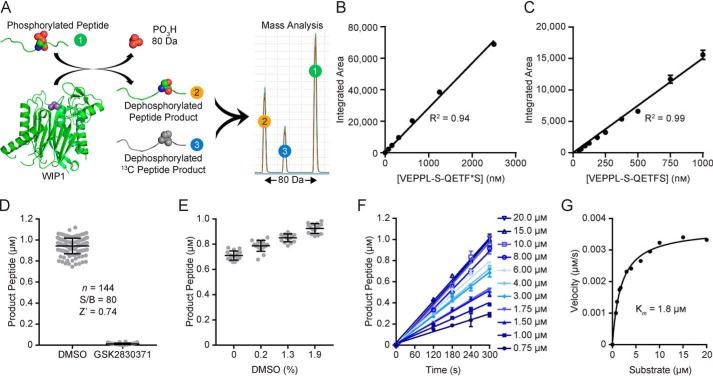
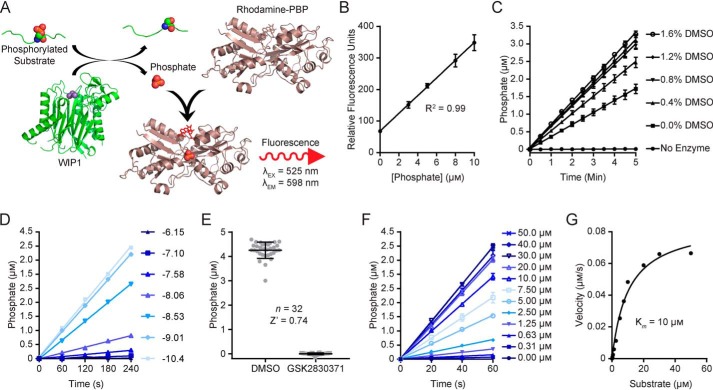
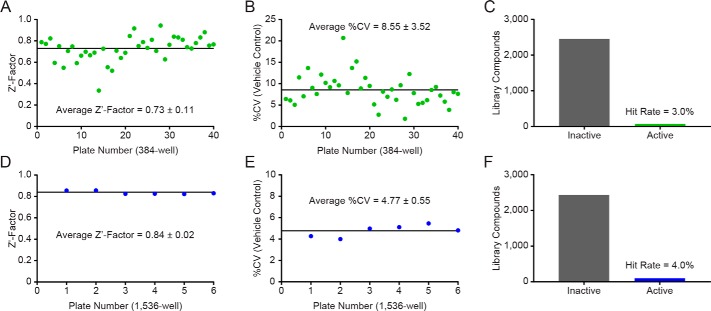
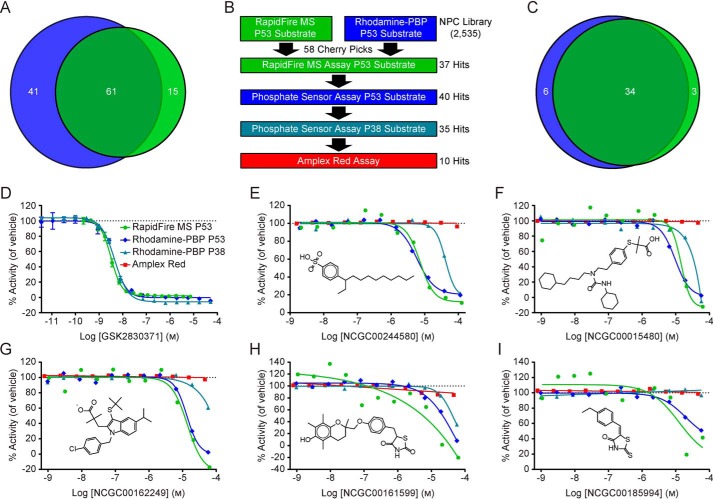
WT P53-Induced Phosphatase 1 (WIP1) is a member of the magnesium-dependent serine/threonine protein phosphatase (PPM) family and is induced by P53 in response to DNA damage. In several human cancers, the WIP1 protein is overexpressed, which is generally associated with a worse prognosis. Although WIP1 is an attractive therapeutic target, no potent, selective, and bioactive small-molecule modulator with favorable pharmacokinetics has been reported. Phosphatase enzymes are among the most challenging targets for small molecules because of the difficulty of achieving both modulator selectivity and bioavailability. Another major obstacle has been the availability of robust and physiologically relevant phosphatase assays that are suitable for high-throughput screening. Here, we describe orthogonal biochemical WIP1 activity assays that utilize phosphopeptides from native WIP1 substrates. We optimized an MS assay to quantify the enzymatically dephosphorylated peptide reaction product in a 384-well format. Additionally, a red-shifted fluorescence assay was optimized in a 1,536-well format to enable real-time WIP1 activity measurements through the detection of the orthogonal reaction product, P We validated these two optimized assays by quantitative high-throughput screening against the National Center for Advancing Translational Sciences (NCATS) Pharmaceutical Collection and used secondary assays to confirm and evaluate inhibitors identified in the primary screen. Five inhibitors were further tested with an orthogonal WIP1 activity assay and surface plasmon resonance binding studies. Our results validate the application of miniaturized physiologically relevant and orthogonal WIP1 activity assays to discover small-molecule modulators from high-throughput screens.
WT P53 诱导的磷酸酶 1(WIP1)是依赖镁的丝氨酸/苏氨酸蛋白磷酸酶(PPM)家族的成员,并且响应于 DNA 损伤由 P53 诱导。在几种人类癌症中,WIP1 蛋白过表达,通常与预后较差相关。尽管 WIP1 是一个有吸引力的治疗靶点,但尚未报道具有良好药代动力学的有效、选择性和生物活性的小分子调节剂。由于难以同时实现调节剂选择性和生物利用度,因此磷酸酶酶是小分子最具挑战性的靶标之一。另一个主要障碍是缺乏适合高通量筛选的稳健且与生理相关的磷酸酶测定法。在这里,我们描述了利用天然 WIP1 底物的磷酸肽的正交生化 WIP1 活性测定法。我们优化了 MS 测定法,以在 384 孔格式中定量酶促去磷酸化肽反应产物。此外,优化了红色移位荧光测定法,以在 1,536 孔格式中实时检测正交反应产物 P 来实现 WIP1 活性测量。我们通过针对国家转化医学科学中心(NCATS)药物库的高通量筛选对这两种优化的测定法进行了验证,并使用二次测定法来确认和评估在初级筛选中鉴定的抑制剂。进一步使用正交 WIP1 活性测定法和表面等离子体共振结合研究测试了五种抑制剂。我们的结果验证了从小分子文库中发现小分子调节剂的小型化生理相关和正交 WIP1 活性测定法的应用。