
德国万古霉素耐药性的上升:来自德国抗菌药物耐药性监测(ARS)的数据。
The rise in vancomycin-resistant in Germany: data from the German Antimicrobial Resistance Surveillance (ARS).
机构信息
1Robert Koch Institute, Department 3: Infectious Disease Epidemiology, Unit 37: Healthcare-associated Infections, Surveillance of Antibiotic Resistance and Consumption, Robert Koch Institute, Nordufer 20, 13353 Berlin, Germany.
2Robert Koch Institute, Department 3: Infectious Disease Epidemiology, Unit 34: HIV/AIDS, STI and Blood-borne Infections, Robert Koch Institute, Nordufer 20, 13353 Berlin, Germany.
出版信息
Antimicrob Resist Infect Control. 2019 Aug 28;8:147. doi: 10.1186/s13756-019-0594-3. eCollection 2019.
BACKGROUND
Due to limited therapeutic options, vancomycin-resistant (VREF) is of great clinical significance. Recently, rising proportions of vancomycin resistance in enterococcal infections have been reported worldwide. This study aims to describe current epidemiological trends of VREF in German hospitals and to identify factors that are associated with an increased likelihood of vancomycin resistance in clinical isolates.
METHODS
2012 to 2017 data from routine vancomycin susceptibility testing of 35,906 clinical isolates from 148 hospitals were analysed using data from the German System. Descriptive statistical analyses and uni- and multivariable regression analyses were performed to investigate the impact of variables, such as year of sampling, age and region, on vancomycin resistance in clinical isolates.
RESULTS
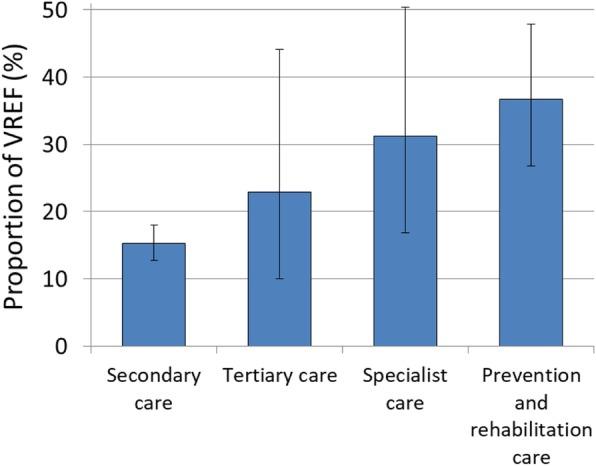
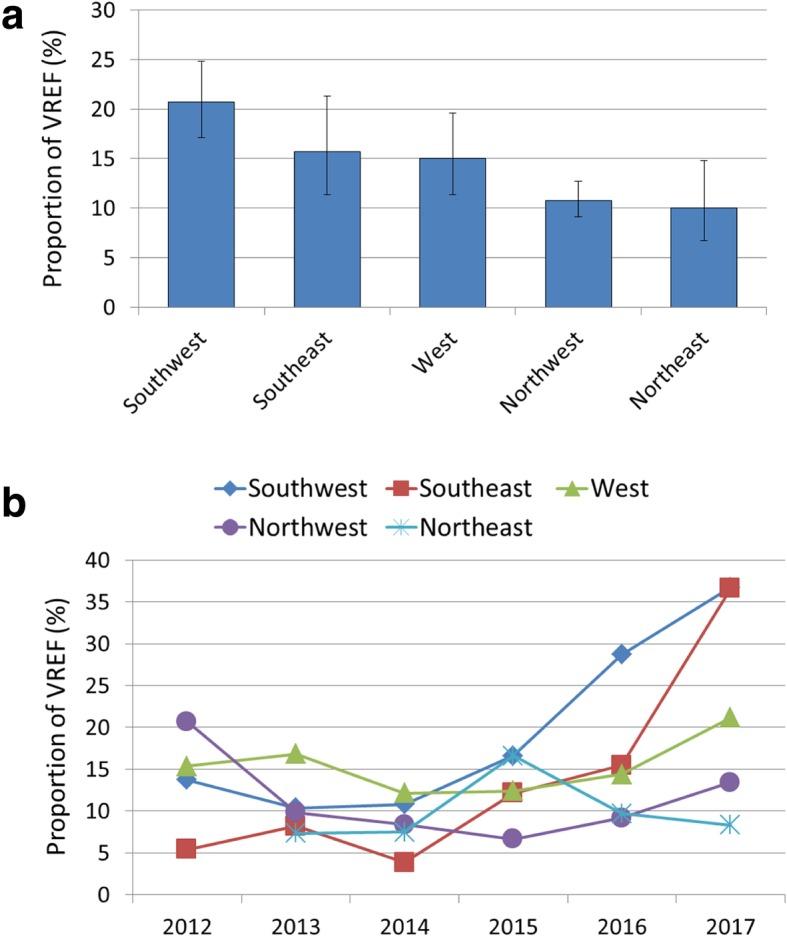
From 2014 onwards the proportions of clinical isolates exhibiting resistance to vancomycin increased from 11.2% (95% confidence interval [CI] 9.4-13.3%) to 26.1% (95% CI 23.1-29.4%) in 2017. The rise of VREF proportions is primarily observed in the southern regions of Germany, whereas northern regions do not show a major increase. In the Southwest and Southeast, VREF proportions increased from 10.8% (95% CI 6.9-16.5%) and 3.8% (95% CI 3.0-11.5%) in 2014 to 36.7% (95% CI 32.9-40.8%) and 36.8% (95% CI 29.2-44.7%) in 2017, respectively. VREF proportions were considerably higher in isolates from patients aged 40-59 years compared to younger patients. Further regression analyses show that in relation to secondary care hospitals, samples collected in specialist care hospitals and prevention and rehabilitation care centres are more likely to be vancomycin-resistant (odds ratios: 2.4 [95% CI 1.2-4.6] and 2.4 [95% CI 1.9-3.0], respectively). No differences in VREF proportions were found between female and male patients as well as between different clinical specimens.
CONCLUSION
The proportion of VREF is increasing in German hospitals, particularly in southern regions in Germany. Increased efforts in infection control and antibiotic stewardship activities accounting for local resistance patterns are necessary to combat the spread of VREF in Germany.
背景
由于治疗选择有限,万古霉素耐药(VREF)具有重要的临床意义。最近,全世界范围内肠球菌感染的万古霉素耐药比例不断上升。本研究旨在描述德国医院中 VREF 的当前流行趋势,并确定与临床分离株万古霉素耐药率增加相关的因素。
方法
使用德国系统的数据,对 2012 年至 2017 年来自 148 家医院的 35906 例临床分离株进行常规万古霉素药敏试验的数据分析。采用描述性统计分析和单变量及多变量回归分析,研究了采样年份、年龄和地区等变量对临床分离株万古霉素耐药性的影响。
结果
自 2014 年以来,2017 年临床分离株万古霉素耐药比例从 11.2%(95%置信区间[CI]9.4-13.3%)上升至 26.1%(95%CI 23.1-29.4%)。德国南部地区 VREF 比例的上升尤为明显,而北部地区则没有明显增加。在西南部和东南部,2014 年 VREF 比例从 10.8%(95%CI 6.9-16.5%)和 3.8%(95%CI 3.0-11.5%)上升至 2017 年的 36.7%(95%CI 32.9-40.8%)和 36.8%(95%CI 29.2-44.7%)。与年轻患者相比,40-59 岁患者的分离株 VREF 比例明显更高。进一步的回归分析表明,与二级护理医院相比,在专科护理医院和预防康复护理中心采集的样本更有可能对万古霉素产生耐药性(优势比:2.4[95%CI 1.2-4.6]和 2.4[95%CI 1.9-3.0])。VREF 比例在女性和男性患者以及不同临床标本之间没有差异。
结论
德国医院 VREF 的比例正在上升,特别是在德国南部地区。为了控制 VREF 在德国的传播,有必要加强感染控制和抗生素管理活动,以应对当地耐药模式。


 Zotero 插件