Brinkwirth Simon, Feig Marcel, Noll Ines, Eckmanns Tim, Dörre Achim, Haller Sebastian, Willrich Niklas
Unit 37: Healthcare-Associated Infections, Surveillance of Antibiotic Resistance and Consumption, Department of Infectious Disease Epidemiology, Robert Koch Institute, Seestraße 10, 13353, Berlin, Germany.
Department of Infectious Disease Epidemiology, Postgraduate Training for Applied Epidemiology (PAE), Robert Koch Institute, Seestraße 10, 13353, Berlin, Germany.
Antimicrob Resist Infect Control. 2025 Jan 30;14(1):4. doi: 10.1186/s13756-025-01522-9.
Antimicrobial resistance is a global threat to public health, with methicillin-resistant Staphylococcus aureus (MRSA) and vancomycin-resistant Enterococcus faecium (VREfm) being major contributors. Despite their clinical impact, comprehensive assessments of changes of the burden of bloodstream infections in terms of Disability-Adjusted Life Years (DALYs) and attributable deaths over time are lacking, particularly in Germany.
We used data from the Antimicrobial Resistance Surveillance system, which covered about 30% of German hospitals. Bloodstream infections were defined by a VREfm or MRSA-positive blood culture. We estimated incidences as a first step to further use these rates to calculate DALYs and attributable deaths using the Burden of Communicable Disease in Europe toolkit. The analysis included stratification by age, sex and region.
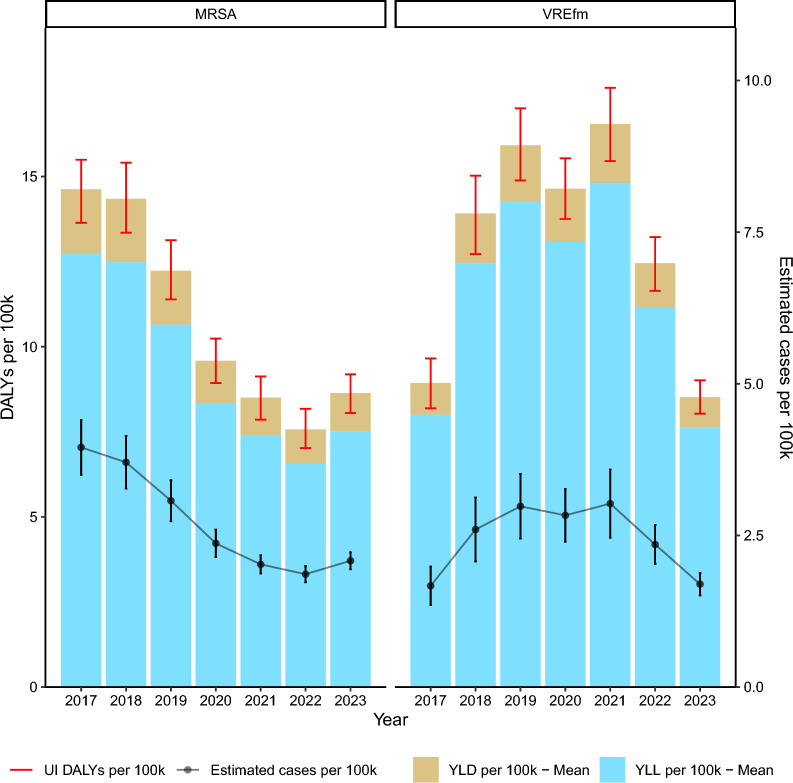
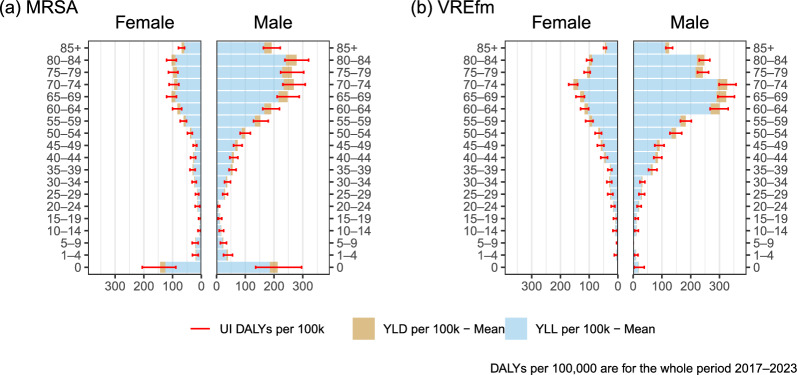
From 2017 to 2023, 6262 MRSA and 5442 VREfm blood culture-positive isolates were identified. The incidence of MRSA bloodstream infections decreased from 4.0 to 2.1 per 100,000 population, with estimated DALYs decreasing from 14.6 to 8.6 per 100,000 and attributable deaths from 591 to 316. Conversely, VREfm-BSI incidence doubled from 1.7 to a peak of 3.0 (2021) before declining back to 1.7 per 100,000 in 2023, with estimated DALYs increasing from 8.9 to 16.5 and then decreasing to 8.5 per 100,000 and attributable deaths increasing from 317 to 327. Men and people over 60 years had the highest burden, with noticeable regional differences.
MRSA and VREfm bloodstream infections followed different trends in the past and now present a comparable burden in Germany. Both pathogens pose a significant threat, particularly to hospitalised older aged men. Our findings highlight the need for targeted prevention and continued surveillance of MRSA and VREfm to reduce infections and their impact.
抗菌药物耐药性是对公共卫生的全球性威胁,耐甲氧西林金黄色葡萄球菌(MRSA)和耐万古霉素屎肠球菌(VREfm)是主要促成因素。尽管它们对临床有影响,但缺乏对血流感染负担随时间变化的伤残调整生命年(DALYs)和归因死亡的全面评估,尤其是在德国。
我们使用了抗菌药物耐药性监测系统的数据,该系统覆盖了约30%的德国医院。血流感染由VREfm或MRSA阳性血培养定义。我们将发病率估计作为第一步,以进一步利用这些率,使用欧洲传染病负担工具包来计算DALYs和归因死亡。分析包括按年龄、性别和地区分层。
2017年至2023年,共鉴定出6262株MRSA和5442株VREfm血培养阳性分离株。MRSA血流感染的发病率从每10万人4.0例降至2.1例,估计DALYs从每10万人14.6例降至8.6例,归因死亡从591例降至316例。相反,VREfm血流感染的发病率从每10万人1.7例翻倍至峰值3.0例(2021年),然后在2023年降至每10万人1.7例,估计DALYs从每10万人8.9例增加至16.5例,然后降至8.5例,归因死亡从317例增加至327例。男性和60岁以上人群的负担最高,存在明显的地区差异。
MRSA和VREfm血流感染在过去呈现不同趋势,目前在德国造成的负担相当。这两种病原体都构成重大威胁,尤其是对住院老年男性。我们的研究结果强调了针对性预防以及对MRSA和VREfm持续监测以减少感染及其影响的必要性。