Baillargeon Jacques, Raji Mukaila A, Urban Randall J, Lopez David S, Williams Stephen B, Westra Jordan R, Kuo Yong-Fang
Department of Preventive Medicine and Community Health, University of Texas Medical Branch, Galveston.
Sealy Center on Aging, University of Texas Medical Branch, Galveston.
Mayo Clin Proc Innov Qual Outcomes. 2019 Aug 23;3(3):276-284. doi: 10.1016/j.mayocpiqo.2019.06.007. eCollection 2019 Sep.
To examine the incidence of screening, diagnosis, and treatment of hypogonadism among men treated with opioids in the United States.
Using one of the nation's largest commercial insurance databases, we identified 53,888 men aged 20 years or older who had 90 or more days of opioid prescriptions in a single 12-month period between January 1, 2010, and December 31, 2017, with no history of hypogonadism or testosterone therapy in the preceding 12 months. We matched this cohort to 53,888 men with 14 or fewer days of opioid prescriptions based on age, opioid initiation date, opioid indication, and comparable exclusion criteria. We assessed whether men, 14 or fewer days after initiation of opioid treatment, received a serum testosterone test, a diagnosis of hypogonadism, or a prescription for testosterone therapy. All men were followed up until they lost coverage from the commercial insurance plan, experienced one of the study outcomes, or the end of study (December 31, 2017).
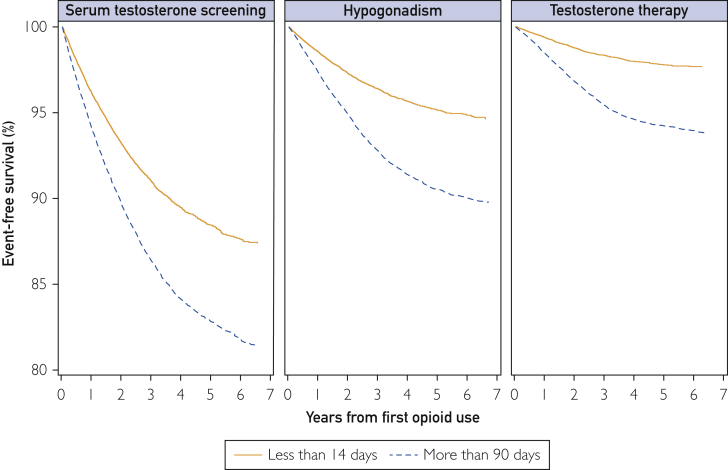
In the multivariable analyses-adjusting for age, year of opioid initiation, region, comorbid disease, glucocorticoid use, and health care utilization-the 53,888 prolonged opioid users, in comparison with 53,888 short-term users, had an increased incidence of serum testosterone screening (5991 [17.15%; 95% CI, 16.70%-17.61%] vs 3514 [11.55%; 95% CI, 11.11%-12.01%] at 5 years; hazard ratio [HR], 1.46; 95% CI, 1.38-1.55), hypogonadism diagnosis (3125 [9.44%; 95% CI, 9.09%-9.80%] vs 1421 [4.85%; 95% CI, 4.55%-5.16%; HR, 1.74; 95% CI, 1.60-1.90]), and receipt of testosterone therapy (1919 [5.76%; 95% CI, 5.49%-6.05%] vs 631 [2.21%; 95% CI, 2.04%-2.43%; HR, 2.41; 95% CI, 2.13-2.74]). Each of these findings persisted across multiple sensitivity analyses.
Prolonged opioid exposure was associated with increased rates of screening, diagnosis, and treatment for opioid-induced hypogonadism, but these rates were much lower than expected based on previous serum-based studies.
研究美国接受阿片类药物治疗的男性性腺功能减退症的筛查、诊断及治疗发生率。
利用美国最大的商业保险数据库之一,我们确定了53888名年龄在20岁及以上的男性,他们在2010年1月1日至2017年12月31日的单个12个月期间有90天或更长时间的阿片类药物处方,且在之前12个月内无性腺功能减退症或睾酮治疗史。我们根据年龄、阿片类药物起始日期、阿片类药物适应证及类似的排除标准,将该队列与53888名阿片类药物处方天数为14天或更少的男性进行匹配。我们评估了在开始阿片类药物治疗14天或更短时间后,男性是否接受了血清睾酮检测、性腺功能减退症诊断或睾酮治疗处方。所有男性均随访至其失去商业保险计划覆盖、经历研究结局之一或研究结束(2017年12月31日)。
在多变量分析中,对年龄、阿片类药物起始年份、地区、合并疾病、糖皮质激素使用及医疗保健利用情况进行校正后,与53888名短期使用者相比,53888名长期阿片类药物使用者血清睾酮筛查发生率增加(5年时为5991例[17.15%;95%CI,16.70%-17.61%]对3514例[11.55%;95%CI,11.11%-12.01%];风险比[HR],1.46;95%CI,1.38-1.55)、性腺功能减退症诊断率增加(3125例[9.44%;95%CI,9.09%-9.80%]对1421例[4.85%;95%CI,4.55%-5.16%;HR,1.74;95%CI,1.60-1.90])以及接受睾酮治疗率增加(1919例[5.76%;95%CI,5.49%-6.05%]对631例[2.21%;95%CI,2.04%-2.43%;HR,2.41;95%CI,2.13-2.74])。这些发现中的每一项在多次敏感性分析中均持续存在。
长期暴露于阿片类药物与阿片类药物所致性腺功能减退症的筛查、诊断及治疗率增加相关,但这些比率远低于基于以往血清学研究的预期。