Sippel Lauren M, Watkins Laura E, Pietrzak Robert H, Hoff Rani, Harpaz-Rotem Ilan
National Center for PTSD Executive Division, White River Junction, VT, USA.
Department of Psychiatry, Geisel School of Medicine at Dartmouth, Hanover, NH, USA.
Eur J Psychotraumatol. 2019 Aug 9;10(1):1646091. doi: 10.1080/20008198.2019.1646091. eCollection 2019.
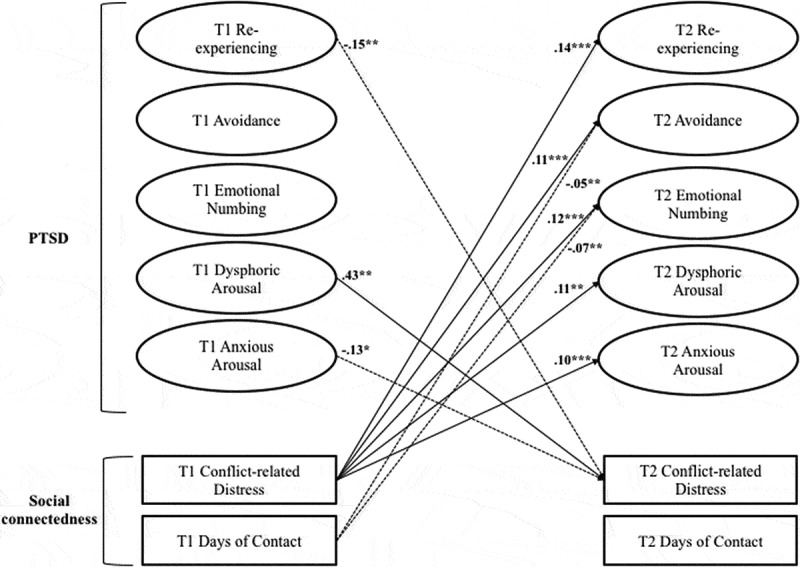
Elucidating whether PTSD symptoms predict poorer social connectedness over time (i.e. social erosion) and/or that poor social connectedness contributes to maintenance of PTSD (i.e. social causation) has implications for PTSD treatment and relapse prevention. Most extant research has been cross-sectional and examined overall PTSD symptoms. Evidence of longitudinal associations among heterogeneous PTSD symptom clusters and social connectedness could provide insight into more nuanced targets for intervention. Using data from 1,491 U.S. military veterans in residential treatment for PTSD at 35 Department of Veterans Affairs facilities, we evaluated a two-wave cross-lagged panel model including a five-factor model of PTSD and two aspects of social connectedness. PTSD, quality of connectedness (i.e. degree of distress related to interpersonal conflict), and structural social support (i.e. number of days of contact with supportive loved ones) in the past 30 days were assessed at baseline and 4 months after discharge. The largest effect was greater severity of PTSD dysphoric arousal symptoms (i.e. irritability/anger, poor concentration, and sleep problems) at baseline predicting more conflict-related distress at follow-up (β = 0.43). Post-hoc symptom-level analyses indicated that irritability/anger drove this association. In addition, conflict-related distress predicted greater PTSD symptom severity across all five clusters (β's = 0.10 to 0.14, 's < 0.01). More days of contact predicted lower severity of avoidance and numbing symptoms (β's = -.05 and -.07, 's < 0.01), along with individual symptoms within these clusters, plus flashbacks. Results support both social erosion and social causation models. Engaging loved ones in veterans' treatment and targeting dysphoric arousal symptoms, particularly anger and irritability, may improve long-term PTSD and relationship outcomes, respectively.
阐明创伤后应激障碍(PTSD)症状是否会随着时间的推移预示着较差的社会联系(即社会侵蚀),以及/或者较差的社会联系是否会导致PTSD的维持(即社会因果关系),这对PTSD的治疗和复发预防具有重要意义。大多数现有研究都是横断面研究,并考察了PTSD的总体症状。PTSD异质症状群与社会联系之间纵向关联的证据,可能会为更细致入微的干预目标提供见解。利用来自35个退伍军人事务部设施中接受PTSD住院治疗的1491名美国退伍军人的数据,我们评估了一个两波交叉滞后面板模型,该模型包括PTSD的五因素模型和社会联系的两个方面。在基线和出院后4个月评估过去30天内的PTSD、联系质量(即与人际冲突相关的痛苦程度)和结构性社会支持(即与支持性亲人接触的天数)。最大的影响是,基线时PTSD烦躁不安唤醒症状(即易怒/愤怒、注意力不集中和睡眠问题)的严重程度越高,预示着随访时与冲突相关的痛苦越多(β = 0.43)。事后症状水平分析表明,易怒/愤怒驱动了这种关联。此外,与冲突相关的痛苦预示着所有五个症状群中PTSD症状的严重程度更高(β值 = 0.10至0.14,p值 < 0.01)。更多的接触天数预示着回避和麻木症状的严重程度较低(β值 = -0.05和-0.07,p值 < 0.01),以及这些症状群中的个体症状,再加上闪回。结果支持社会侵蚀和社会因果关系模型。让亲人参与退伍军人的治疗,并针对烦躁不安唤醒症状,特别是愤怒和易怒,可能分别改善长期PTSD和人际关系结果。