Cho Jun Woo, Park Ki Sung, Bae Jin Young
Department of Thoracic and Cardiovascular Surgery, School of Medicine, Catholic University of Daegu, Daegu, South Korea.
Department of Obstetrics and Gynecology, School of Medicine, Catholic University of Daegu, Daegu, South Korea.
Regen Ther. 2019 Aug 24;11:207-211. doi: 10.1016/j.reth.2019.07.009. eCollection 2019 Dec.
Chronic obstructive pulmonary disease (COPD) is a fatal disease that shortens one's life expectancy and reduces the quality of life of patients. The current known treatments for COPD can only act to alleviate the symptoms. Recently, stem cells have demonstrated efficacy in various medical areas. The aim of this study was to investigate the possibility of using human Wharton's jelly-derived mesenchymal stem cells (MSC)s for lung recovery in a COPD mouse model.
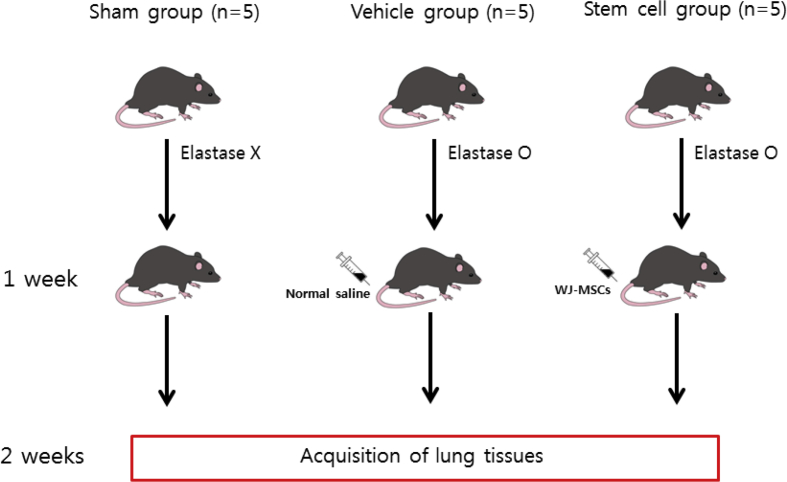
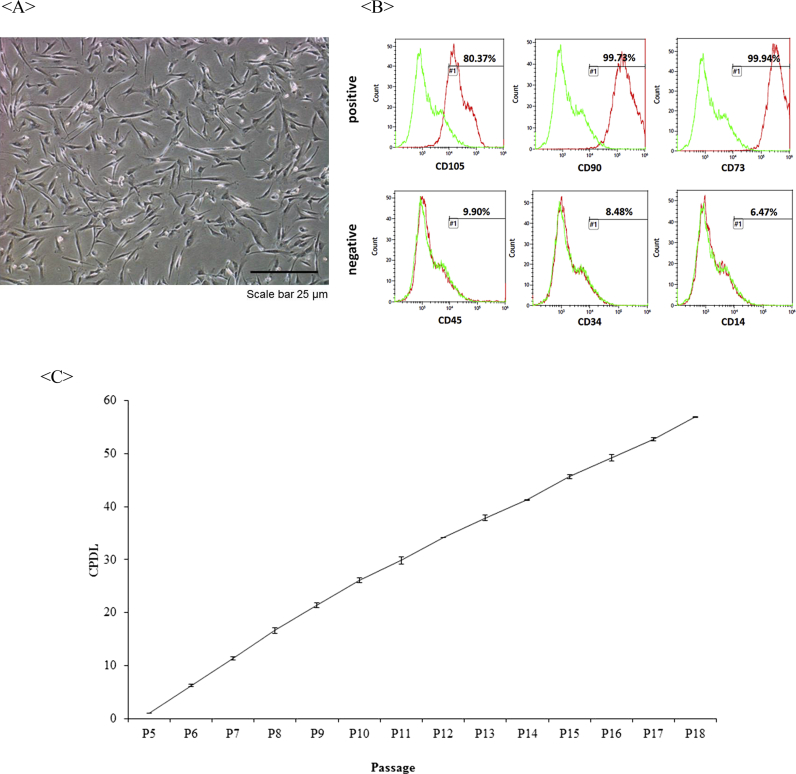
Human Wharton's jelly was obtained during natural delivery or caesarean section from healthy women. Wharton's jelly-derived MSC was confirmed with expression of CD14, CD34, CD45, CD73, CD90, and CD105 using flow cytometry. Mice model (C57BL/6) of COPD were induced by injecting 10 μL elastase into the trachea and they were divided into three treatment groups (sham, vehicle, stem cell). The sham group was not induced COPD, nor provided any treatment; the vehicle group comprised of COPD-induced mice treated with normal saline; the stem cell group comprised of COPD-induced mice treated with Wharton's jelly-derived MSCs. The vehicle and mesenchymal stem cells (5 × 10 cells) were injected in tail vein 7 days following COPD induction. Mice were euthanized 7 days after vehicle and stem cell injection, and pathologic findings were confirmed. Mean Linear Intercept (MLI) was measured after emphysema-induced alveoli were identified.
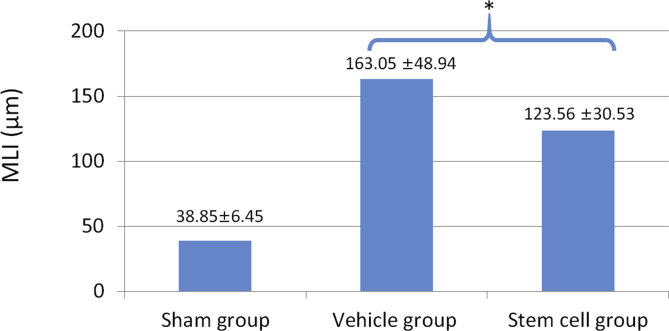
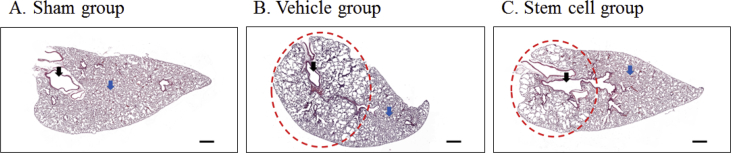
Cell surface markers were positive for CD105, CD90, and CD73 and negative for CD45, CD34, and CD14. Pathological tests showed that COPD-induced mice had significantly increased emphysema volume as compared with that in the sham group. The degree of emphysema in the stem cell group was reduced based on pathologic findings. The mean MLI of the sham group was measured as 38.85 ± 6.45. The mean MLI of the vehicle and stem cell groups were 163.05 ± 48.94 and 123.59 ± 30.53, respectively, and there was a statistically significant difference between the two groups (p = 0.008).
Though the number of mice in the experiment was not large, human Wharton's jelly-derived MSCs showed pulmonary regenerative effects in the COPD mouse model. Although we cannot confirm the effects of Wharton's jelly-derived MSCs in COPD through this experiment, it can be used as a basis for a larger clinical experiment.
慢性阻塞性肺疾病(COPD)是一种致命疾病,会缩短人的预期寿命并降低患者的生活质量。目前已知的COPD治疗方法只能缓解症状。最近,干细胞在各个医学领域已显示出疗效。本研究的目的是探讨在COPD小鼠模型中使用人脐带华通氏胶间充质干细胞(MSC)促进肺恢复的可能性。
在自然分娩或剖宫产时从健康女性获取人脐带华通氏胶。使用流式细胞术通过检测CD14、CD34、CD45、CD73、CD90和CD105的表达来确认脐带华通氏胶来源的MSC。通过向气管内注射10μL弹性蛋白酶诱导建立COPD小鼠模型(C57BL/6),并将其分为三个治疗组(假手术组、载体组、干细胞组)。假手术组未诱导COPD,也未给予任何治疗;载体组由用生理盐水治疗的COPD诱导小鼠组成;干细胞组由用脐带华通氏胶来源的MSC治疗的COPD诱导小鼠组成。在诱导COPD 7天后,将载体和间充质干细胞(5×10个细胞)经尾静脉注射。在注射载体和干细胞7天后对小鼠实施安乐死,并确认病理结果。在识别出肺气肿诱导的肺泡后测量平均线性截距(MLI)。
细胞表面标志物CD105、CD90和CD73呈阳性,而CD45、CD34和CD14呈阴性。病理检查显示,与假手术组相比,COPD诱导小鼠的肺气肿体积显著增加。根据病理结果,干细胞组的肺气肿程度有所减轻。假手术组的平均MLI为38.85±6.45。载体组和干细胞组的平均MLI分别为163.05±48.94和123.59±30.53,两组之间存在统计学显著差异(p = 0.008)。
尽管实验中的小鼠数量不多,但人脐带华通氏胶来源的MSC在COPD小鼠模型中显示出肺再生作用。虽然通过本实验我们无法确认脐带华通氏胶来源的MSC对COPD的作用,但它可作为更大规模临床试验的基础。