National Center for Protein Science Shanghai, State Key Laboratory of Molecular Biology, CAS Center for Excellence in Molecular Cell Science, Shanghai Institute of Biochemistry and Cell Biology, University of Chinese Academy of Sciences, Chinese Academy of Sciences, Shanghai 200031, China.
Shanghai Science Research Center, Chinese Academy of Sciences, Shanghai 201210, China.
Proc Natl Acad Sci U S A. 2019 Sep 24;116(39):19513-19522. doi: 10.1073/pnas.1903976116. Epub 2019 Sep 6.
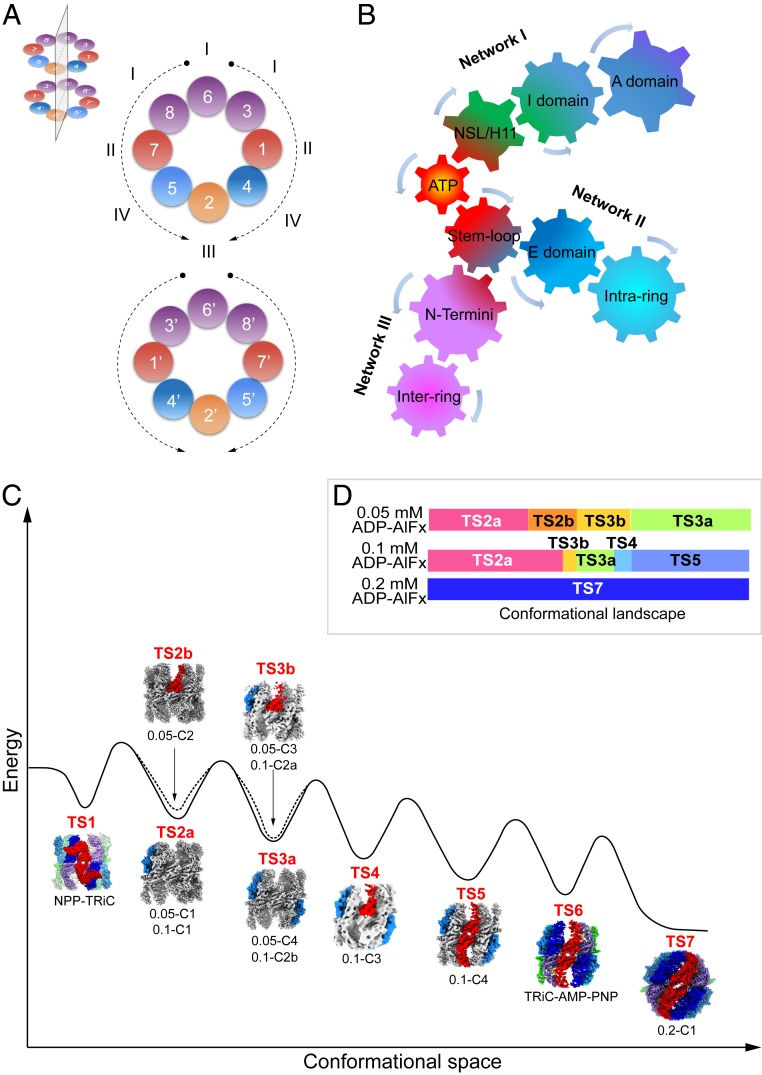
TRiC/CCT assists the folding of ∼10% of cytosolic proteins through an ATP-driven conformational cycle and is essential in maintaining protein homeostasis. Here, we determined an ensemble of cryo-electron microscopy (cryo-EM) structures of yeast TRiC at various nucleotide concentrations, with 4 open-state maps resolved at near-atomic resolutions, and a closed-state map at atomic resolution, revealing an extra layer of an unforeseen N-terminal allosteric network. We found that, during TRiC ring closure, the CCT7 subunit moves first, responding to nucleotide binding; CCT4 is the last to bind ATP, serving as an ATP sensor; and CCT8 remains ADP-bound and is hardly involved in the ATPase-cycle in our experimental conditions; overall, yeast TRiC consumes nucleotide in a 2-ring positively coordinated manner. Our results depict a thorough picture of the TRiC conformational landscape and its allosteric transitions from the open to closed states in more structural detail and offer insights into TRiC subunit specificity in ATP consumption and ring closure, and potentially in substrate processing.
TRiC/CCT 通过一个 ATP 驱动的构象循环协助折叠约 10%的细胞质蛋白,对维持蛋白质的内稳态至关重要。在这里,我们确定了不同核苷酸浓度下酵母 TRiC 的一组冷冻电子显微镜(cryo-EM)结构,其中 4 个开放状态图谱解析到近原子分辨率,一个封闭状态图谱解析到原子分辨率,揭示了一个意想不到的未预料到的 N 端变构网络的额外层次。我们发现,在 TRiC 环闭合过程中,CCT7 亚基首先移动,响应核苷酸结合;CCT4 是最后一个结合 ATP 的,充当 ATP 传感器;而 CCT8 仍然结合 ADP,在我们的实验条件下几乎不参与 ATP 酶循环;总的来说,酵母 TRiC 以 2 个环的方式消耗核苷酸,呈正协调关系。我们的结果以更详细的结构描绘了 TRiC 构象景观及其从开放状态到关闭状态的变构转变,并为 TRiC 亚基在 ATP 消耗和环闭合以及潜在的底物加工方面的特异性提供了深入的了解。