Wellcome Sanger Institute, Hinxton, Cambridge, CB10 1SA, UK.
Nat Commun. 2019 Sep 6;10(1):4053. doi: 10.1038/s41467-019-12023-w.
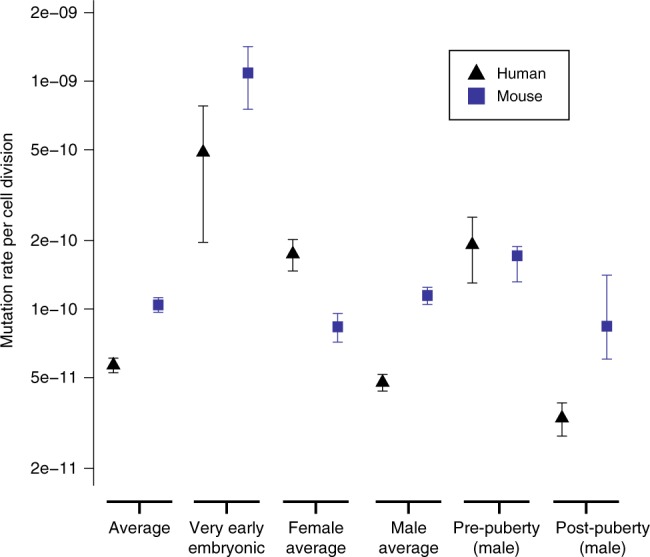
Whole genome sequencing (WGS) studies have estimated the human germline mutation rate per basepair per generation (~1.2 × 10) to be higher than in mice (3.5-5.4 × 10). In humans, most germline mutations are paternal in origin and numbers of mutations per offspring increase with paternal and maternal age. Here we estimate germline mutation rates and spectra in six multi-sibling mouse pedigrees and compare to three multi-sibling human pedigrees. In both species we observe a paternal mutation bias, a parental age effect, and a highly mutagenic first cell division contributing to the embryo. We also observe differences between species in mutation spectra, in mutation rates per cell division, and in the parental bias of mutations in early embryogenesis. These differences between species likely result from both species-specific differences in cellular genealogies of the germline, as well as biological differences within the same stage of embryogenesis or gametogenesis.
全基因组测序(WGS)研究估计,人类每代每个碱基的生殖系突变率(~1.2×10)高于小鼠(3.5-5.4×10)。在人类中,大多数生殖系突变来自父系,并且每个后代的突变数量随着父系和母系年龄的增加而增加。在这里,我们估计了六个多兄弟姐妹小鼠家系的生殖系突变率和突变谱,并与三个多兄弟姐妹人类家系进行了比较。在这两个物种中,我们都观察到了父系突变偏倚、父母年龄效应以及对胚胎有高度诱变作用的第一次细胞分裂。我们还观察到了物种之间在突变谱、每个细胞分裂的突变率以及早期胚胎发生中突变的亲代偏倚方面的差异。这些物种间的差异可能是由于生殖系的细胞谱系的物种特异性差异以及胚胎发生或配子发生的同一阶段的生物学差异所致。