Department of Medicine, University of California, San Francisco, San Francisco, CA, USA.
Department of Health, Behavior, and Society, Johns Hopkins Bloomberg School of Public Health, Baltimore, MD, USA.
Cult Health Sex. 2020 Apr;22(sup1):111-126. doi: 10.1080/13691058.2019.1659999. Epub 2019 Sep 9.
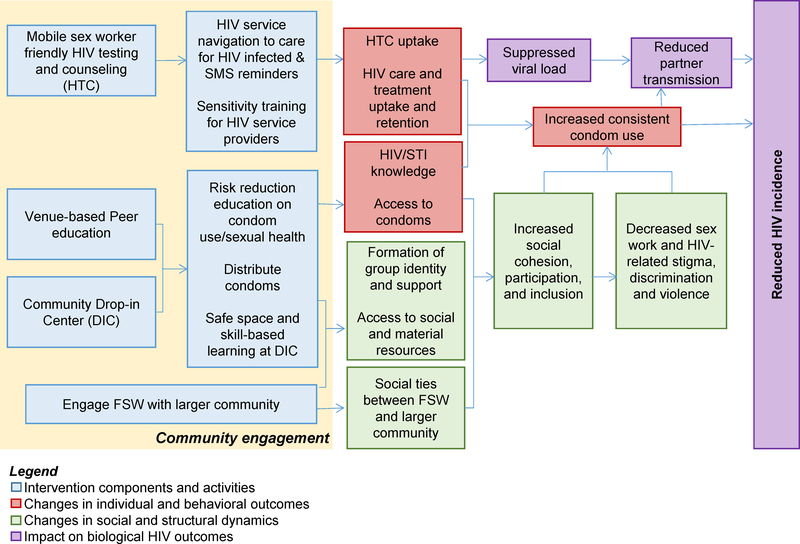
Globally, female sex workers bear a disproportionate burden of HIV, with those in sub-Saharan Africa being among the most affected. Community empowerment approaches have proven successful at preventing HIV among this population. These approaches facilitate a process whereby sex workers take collective ownership over programmes to address the barriers they face in accessing their health and human rights. Limited applications of such approaches have been documented in Africa. We describe the community empowerment process among female sex workers in Iringa, Tanzania, in the context of a randomised controlled trial of a community empowerment-based model of combination HIV prevention. We conducted 24 in-depth interviews with participants from the intervention community and 12 key informant interviews with HIV care providers, police, venue managers, community advisory board members and research staff. Content analysis was employed, and salient themes were extracted. Findings reveal that the community empowerment process was facilitated by the meaningful engagement of sex workers in programme development, encouraging sex worker ownership over the programme, providing opportunities for solidarity and capacity building, and forming partnerships with key stakeholders. Through this process, sex workers mobilised their collective agency to access their health and human rights including HIV prevention, care and treatment.
在全球范围内,女性性工作者承受着不成比例的艾滋病毒负担,其中撒哈拉以南非洲地区的性工作者受影响最为严重。社区赋权方法已被证明在预防该人群中的艾滋病毒方面取得了成功。这些方法促进了性工作者对解决其在获得健康和人权方面面临的障碍的方案采取集体所有权的过程。在非洲,已经记录了这些方法的有限应用。我们在坦桑尼亚伊林加的一项基于社区赋权的艾滋病毒综合预防模型的随机对照试验背景下,描述了女性性工作者中的社区赋权过程。我们对干预社区的参与者进行了 24 次深入访谈,并对艾滋病毒护理提供者、警察、场地经理、社区咨询委员会成员和研究人员进行了 12 次关键知情人访谈。采用了内容分析,并提取了突出的主题。研究结果表明,性工作者在方案制定中有意义的参与、鼓励性工作者对方案的拥有、提供团结和能力建设的机会以及与主要利益攸关方建立伙伴关系,促进了社区赋权过程。通过这个过程,性工作者调动了他们的集体能动性,以获得包括艾滋病毒预防、护理和治疗在内的健康和人权。