Department of Physical Education, Graduate Program in Physical Education, Federal University of Rio Grande do Norte, Natal, RN, Brazil.
Department of Physical Education, Federal University of Rio Grande do Norte, Natal, RN, Brazil.
Clin Interv Aging. 2019 Aug 5;14:1407-1418. doi: 10.2147/CIA.S207254. eCollection 2019.
Acute reduction in blood pressure (BP) following an exercise session is evidenced in controlled settings with formal supervision in hypertensive older populations. This study investigated the effect of a self-selected exercise (SSE)-intensity session on ambulatory BP in hypertensive older women in a "real-world" setting.
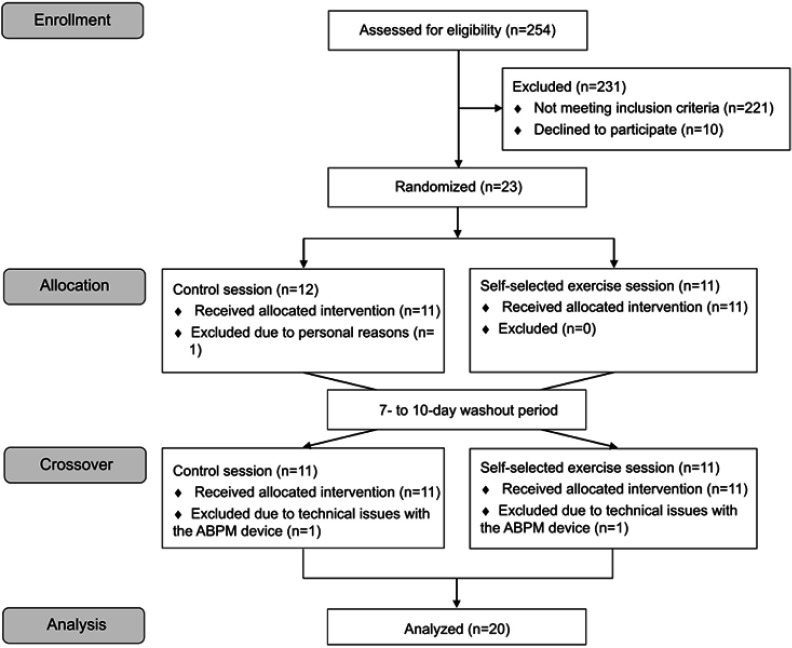
Twenty inactive older women with hypertension (64.9±4.5 years) were included in this randomized, controlled, crossover trial. After baseline assessments, participants performed 30 minutes of an SSE-intensity session on an outdoor track and a control session, separated by 7-10 days. Heart rate (HR), rating of perceived exertion (RPE), and affective response were assessed. Ambulatory BP was monitored for 20 hours following both sessions. Paired -tests and generalized estimation were used for data analysis.
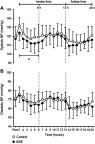
Participants exercised at 5.1±1.1 km/h, spent ~90% of the exercise time at moderate-vigorous intensity (≥40% of heart rate reserve). SSE-intensity session was reported as light (RPE 11.0±1.5) and pleasant (affect 3.4±1.2). SSE-intensity session elicited reductions in systolic BP in the first 6 hours postexercise (6.0 mmHg, CI 2.7-9.3 mmHg; 0.001). Average systolic BP in the 20-hour (-3.4 mmHg, CI -5.9 to -0.9 mmHg; =0.010) and awake (-4.0 mmHg, CI -6.4 to -1.6 mmHg; =0.003) periods were lower following SSE-intensity session compared to control session. No differences were observed in average systolic BP during asleep period and diastolic BP during the 20-hour awake and asleep periods between the SSE-intensity session and control session (>0.05).
An SSE-intensity session elicited a reduction in ambulatory systolic BP in inactive older women with hypertension during awake and 20-hour periods. Also, the SSE-intensity session was reported as light and pleasant.
在有正式监督的受控环境中,已证明高血压老年人群在进行运动后血压会出现急性下降。本研究旨在调查在“真实世界”环境中,自我选择运动(SSE)强度对高血压老年女性动态血压的影响。
本随机对照交叉试验纳入了 20 名不活跃的高血压老年女性(64.9±4.5 岁)。在基线评估后,参与者在户外跑道上进行 30 分钟的 SSE 强度运动,然后进行控制运动,两次运动间隔 7-10 天。评估心率(HR)、感知用力程度(RPE)和情感反应。两次运动后 20 小时内监测动态血压。采用配对检验和广义估计进行数据分析。
参与者以 5.1±1.1km/h 的速度运动,约 90%的运动时间处于中高强度(≥40%心率储备)。SSE 强度运动被报告为轻度(RPE 11.0±1.5)和愉悦(情感 3.4±1.2)。SSE 强度运动可在运动后 6 小时内降低收缩压(6.0mmHg,CI 2.7-9.3mmHg;0.001)。20 小时(-3.4mmHg,CI -5.9 至 -0.9mmHg;=0.010)和清醒期(-4.0mmHg,CI -6.4 至 -1.6mmHg;=0.003)的平均收缩压均低于对照组。SSE 强度运动与对照组相比,20 小时清醒和睡眠期间的平均收缩压和舒张压无差异(>0.05)。
SSE 强度运动可降低高血压老年女性在清醒期和 20 小时期间的动态收缩压。此外,SSE 强度运动被报告为轻度和愉悦。