Woodward Elizabeth, Sachschal Juliane, Beierl Esther T, Ehlers Anke
Department of Experimental Psychology, University of Oxford, Oxford, UK.
Oxford Health NHS Foundation Trust, Oxford, UK.
Eur J Psychotraumatol. 2019 Aug 27;10(1):1651476. doi: 10.1080/20008198.2019.1651476. eCollection 2019.
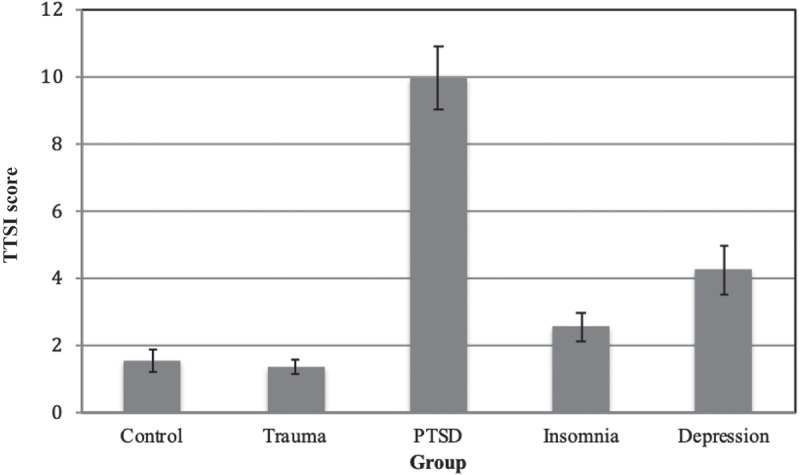
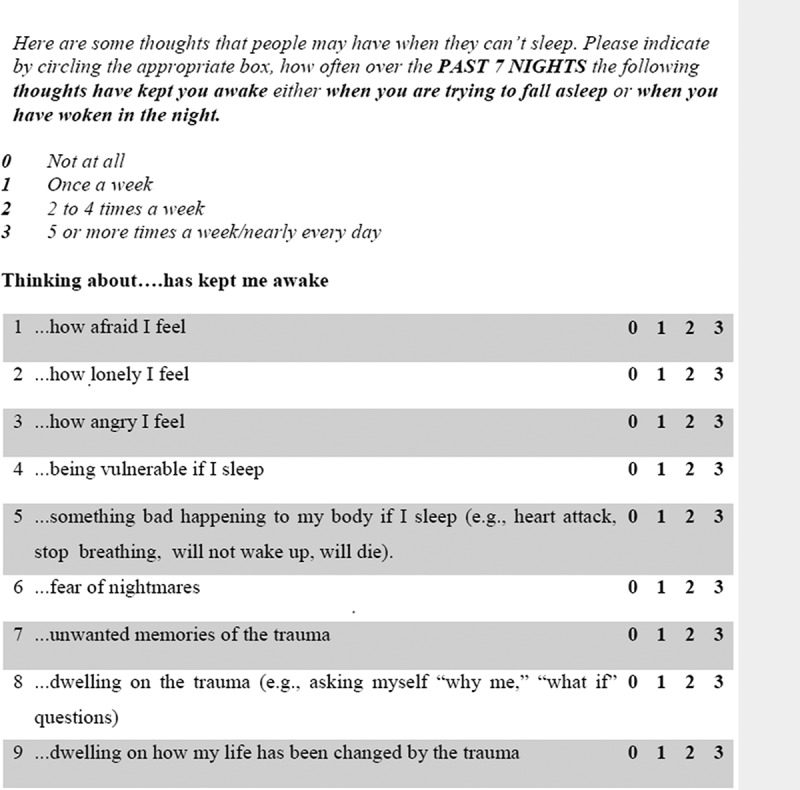
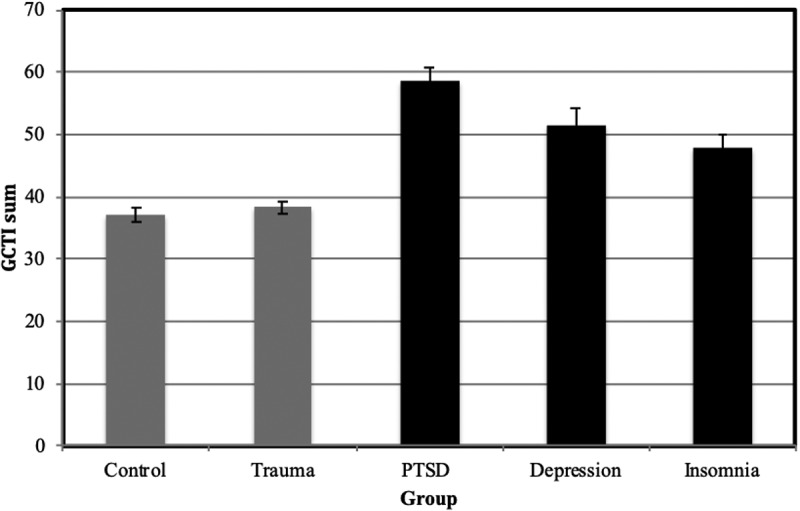
: Pre-sleep cognitive activity and arousal have long been implicated in the maintenance of insomnia. However, despite high comorbidity between insomnia and posttraumatic stress disorder (PTSD), pre-sleep thoughts in PTSD and their associations with disturbed sleep, have not yet been investigated. : This study presents the development and preliminary validation of a brief self-report measure of the content of trauma-related pre-sleep thoughts: the Trauma Thoughts before Sleep Inventory (TTSI). : Participants (N = 285) were recruited online into five groups: three groups with clinical symptoms, 1) PTSD; 2) depression without PTSD; 3) insomnia without depression or PTSD; and two healthy control groups 4) nontrauma-exposed controls; 5) trauma-exposed controls. The questionnaire was administered at baseline, and for a subsample ( 157) again one week later to assess test-retest reliability. At baseline, participants also completed questionnaires of sleep quality, PTSD and depression symptoms, and insomnia-related thoughts. : The TTSI had good reliability and validity; it discriminated participants with PTSD from those with depression and insomnia, those with depression from insomnia, and correlated with existing measures of pre-sleep thoughts, self-reported pre-sleep arousal and poor sleep. : The results support the utility of the TTSI for measuring thoughts that keep people with PTSD awake, although replication in an independent clinical sample is required.
睡前认知活动和唤醒长期以来一直被认为与失眠的维持有关。然而,尽管失眠与创伤后应激障碍(PTSD)之间存在高度共病现象,但PTSD患者的睡前想法及其与睡眠障碍的关联尚未得到研究。
睡前创伤思维量表(TTSI)。
参与者(N = 285)通过网络招募,分为五组:三组有临床症状,1)PTSD;2)无PTSD的抑郁症;3)无抑郁症或PTSD的失眠症;以及两组健康对照组,4)未接触创伤的对照组;5)接触创伤的对照组。问卷在基线时进行发放,一周后对一个子样本(157人)再次发放以评估重测信度。在基线时,参与者还完成了睡眠质量、PTSD和抑郁症状以及与失眠相关想法的问卷。
TTSI具有良好的信度和效度;它能够区分PTSD患者与抑郁症和失眠症患者、抑郁症患者与失眠症患者,并且与现有的睡前想法测量、自我报告的睡前唤醒和睡眠质量差的测量相关。
研究结果支持TTSI在测量使PTSD患者保持清醒的想法方面的效用,尽管需要在独立的临床样本中进行重复验证。