Zhou Jiayi, Du Yan, Lu Yiling, Luan Baoxin, Xu Congjian, Yu Yinhua, Zhao Hongbo
Obstetrics and Gynecology Hospital, Fudan University, Shanghai, China.
Department of Obstetrics and Gynecology of Shanghai Medical School, Fudan University, Shanghai, China.
Front Oncol. 2019 Aug 21;9:802. doi: 10.3389/fonc.2019.00802. eCollection 2019.
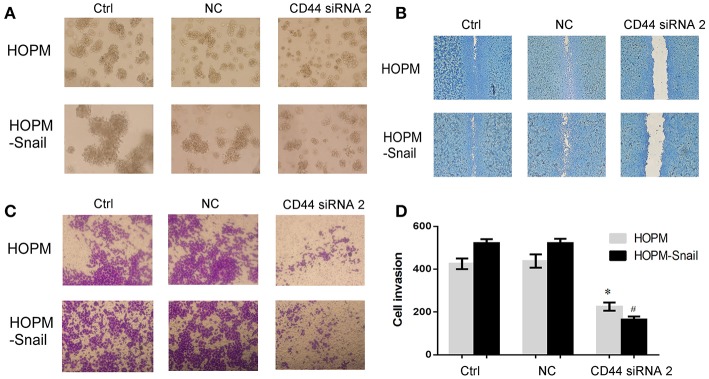
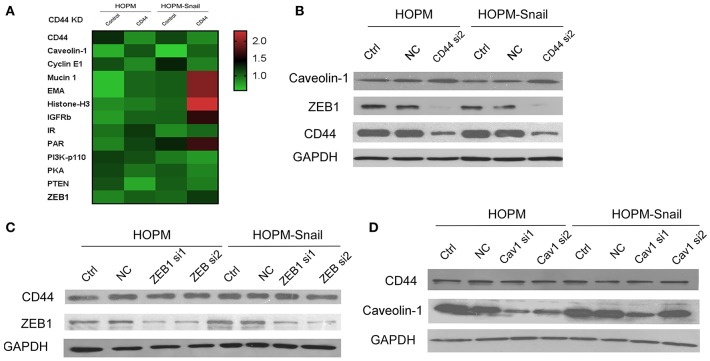
CD44, a transmembrane glycoprotein, is involved in the generation of a stem cell niche and maintaining stem cell quiescence. The aim of this study was to evaluate its contribution to ovarian cancer prognosis and progression, as well as explore the possible mechanisms. The expression of CD44 in tissue microarray of 90 ovarian cancer patients was detected by immunohistochemistry. Kaplan-Meier method and Cox proportional hazard model were used to evaluate the factors associated with 5-year overall survival and disease-free survival. CD44 was knocked down by small interfering RNA, the expression of Snail, ZEB1, and Caveolin-1 in a stable Snail-expressing ovarian cancer cell line HO8910PM-Snail (HOPM-Snail) and its control cell line HO8910PM-vector (HOPM) was detected by western blotting analysis. Cell clone formation, migration, and invasion of HOPM-Snail and HOPM cells with CD44 silencing were examined by 3-D culture assay, wound healing assay, and transwell assay, respectively. Over-expression of CD44 was associated with advanced histological grade ( = 0.014) and FIGO stage ( = 0.001). Multivariate analysis showed that CD44 expression was an independent prognostic factor to predict both overall survival ( = 0.004) and disease-free survival ( = 0.025) of ovarian cancer patients. Down-regulation of CD44 expression by small silencing RNA abrogated both basal Snail expression and TGF-β1-induced Snail expression in HOPM and HOPM-Snail cells. In addition, CD44 knockdown caused a decrease in ZEB1 expression. RPPA data indicated that Caveolin-1 may be another regulative target of CD44, and western blotting analysis confirmed that CD44 knockdown caused an increase in Caveolin-1 expression. However, there was no noticeable reciprocal regulation among ZEB1, Caveolin-1, and Snail. Moreover, CD44 knockdown caused a decrease in cell clone formation, migration, and invasion of HOPM and HOPM-Snail cells. As both Snail and ZEB1 are crucial inducers of epithelial-to-mesenchymal transition (EMT), our data suggested that CD44 may be crucial for the EMT process of ovarian cancer. Therefore, CD44 may be a potential prognostic marker as well as treatment target for ovarian cancer.
CD44是一种跨膜糖蛋白,参与干细胞微环境的形成并维持干细胞的静止状态。本研究旨在评估其对卵巢癌预后和进展的影响,并探讨可能的机制。采用免疫组织化学方法检测90例卵巢癌患者组织芯片中CD44的表达。应用Kaplan-Meier法和Cox比例风险模型评估与5年总生存率和无病生存率相关的因素。通过小分子干扰RNA敲低CD44,采用蛋白质免疫印迹分析检测稳定表达Snail的卵巢癌细胞系HO8910PM-Snail(HOPM-Snail)及其对照细胞系HO8910PM-载体(HOPM)中Snail、ZEB1和小窝蛋白-1(Caveolin-1)的表达。分别通过三维培养试验、伤口愈合试验和Transwell试验检测CD44沉默后HOPM-Snail和HOPM细胞的克隆形成、迁移和侵袭能力。CD44的过表达与高级别组织学分级(P = 0.014)和国际妇产科联盟(FIGO)分期(P = 0.001)相关。多因素分析显示,CD44表达是预测卵巢癌患者总生存率(P = 0.004)和无病生存率(P = 0.025)的独立预后因素。小分子干扰RNA下调CD44表达可消除HOPM和HOPM-Snail细胞中基础Snail表达以及转化生长因子-β1(TGF-β1)诱导的Snail表达。此外,敲低CD44导致ZEB1表达降低。反向蛋白质阵列分析(RPPA)数据表明,Caveolin-1可能是CD44的另一个调控靶点,蛋白质免疫印迹分析证实敲低CD44导致Caveolin-1表达增加。然而,ZEB1、Caveolin-1和Snail之间未发现明显的相互调控。此外,敲低CD44导致HOPM和HOPM-Snail细胞的克隆形成、迁移和侵袭能力降低。由于Snail和ZEB1都是上皮-间质转化(EMT)的关键诱导因子,我们的数据表明CD44可能对卵巢癌的EMT过程至关重要。因此,CD44可能是卵巢癌潜在预后标志物和治疗靶点。