Pandey Arunabh, Kumar Brind
Department of Civil Engineering, Indian Institute of Technology (Banaras Hindu University), Varanasi, 221005, India.
Heliyon. 2019 Aug 28;5(8):e02256. doi: 10.1016/j.heliyon.2019.e02256. eCollection 2019 Aug.
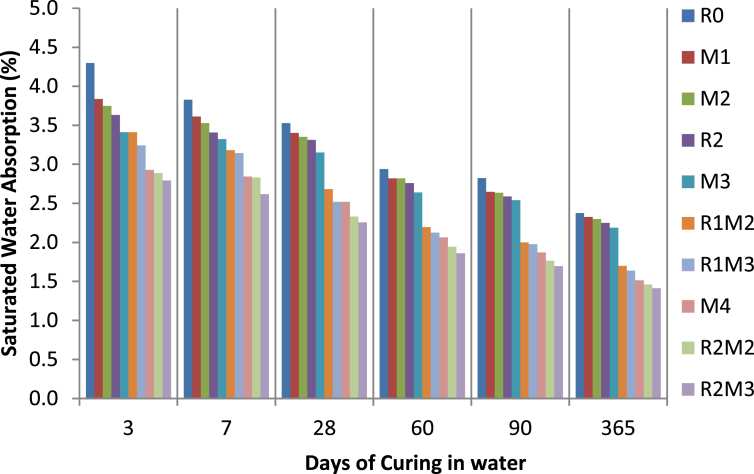
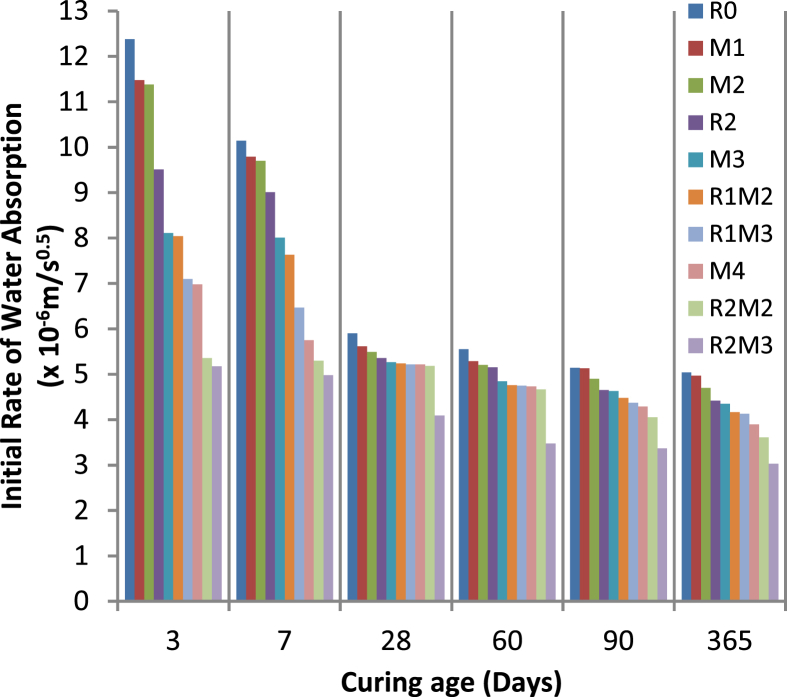
The effects of rice straw ash (RSA) and microsilica (MS) on durability properties (water absorption and chloride ion penetration) of M40 grade Pavement Quality Concrete (PQC) were studied. Ten concrete samples were prepared by partially substituting cement with RSA and MS in various proportions. A significant reduction was observed in the water absorption and chloride ion penetration in concrete samples with an increase in the curing age as well as with an increase in the proportion of MS and RSA. The maximum reduction in water absorption and chloride ion penetration was observed in R2M3 (10% RSA and 7.5% MS) as compared to control concrete (R0). The analytical relationships were developed between the above-mentioned parameters and curing age of concrete. A linear equation was established between the initial and secondary rate of water absorption of concrete and also between the chloride ion penetration of concrete at 10-20 mm and 25-35 mm depth. Both these equations were applicable to all the concrete samples of this study. Predictive charts were generated between the above-mentioned parameters and days of curing in water.
研究了稻草灰(RSA)和微硅粉(MS)对M40级路面质量混凝土(PQC)耐久性性能(吸水率和氯离子渗透)的影响。通过用不同比例的RSA和MS部分替代水泥制备了10个混凝土样品。随着养护龄期的增加以及MS和RSA比例的增加,观察到混凝土样品的吸水率和氯离子渗透显著降低。与对照混凝土(R0)相比,在R2M3(10% RSA和7.5% MS)中观察到吸水率和氯离子渗透的最大降低。建立了上述参数与混凝土养护龄期之间的分析关系。建立了混凝土初始和二次吸水率之间以及10 - 20 mm和25 - 35 mm深度处混凝土氯离子渗透之间的线性方程。这两个方程适用于本研究的所有混凝土样品。生成了上述参数与水中养护天数之间的预测图表。