Center for Esophageal Diseases and Swallowing, Center for Gastrointestinal Biology and Disease, Division of Gastroenterology and Hepatology, Chapel Hill, North Carolina.
Department of Pathology and Laboratory Medicine, University of North Carolina School of Medicine, Chapel Hill, North Carolina.
Clin Gastroenterol Hepatol. 2020 Jun;18(7):1483-1492.e2. doi: 10.1016/j.cgh.2019.08.050. Epub 2019 Sep 6.
BACKGROUND & AIMS: Eosinophilic esophagitis (EoE) is chronic and recurs if treatment is discontinued. We aimed to determine rates of recurrence, and whether initial treatment with oral viscous budesonide (OVB) resulted in less recurrence than fluticasone from a multidose inhaler (MDI).
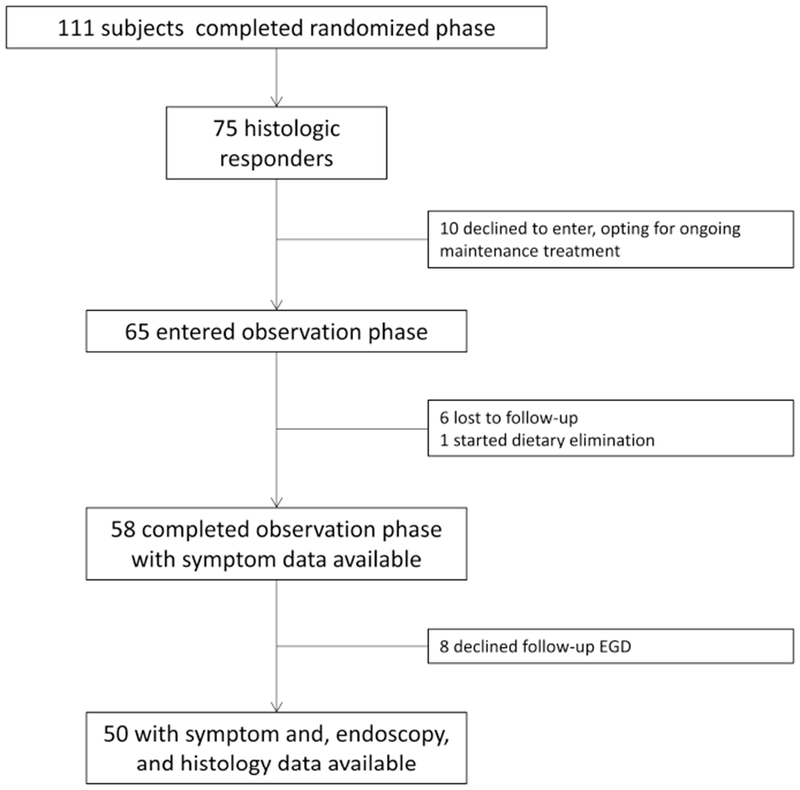
This was the observation phase of a randomized, double-blind, double-dummy trial comparing OVB with MDI for initial EoE treatment. Subjects with a histologic response (<15 eosinophils/high-power field) in the trial entered an observation phase in which treatment was discontinued and symptoms were monitored. Patients underwent an endoscopy or a biopsy when symptoms recurred or at 1 year. We analyzed time to symptom recurrence and assessed endoscopic severity and histologic relapse (≥15 eosinophils/high-power field) at follow-up endoscopy.
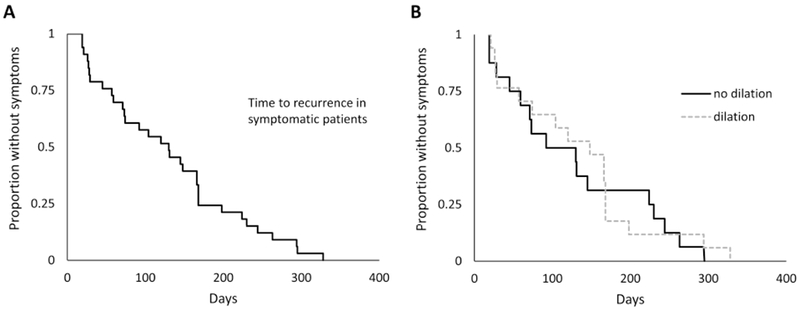
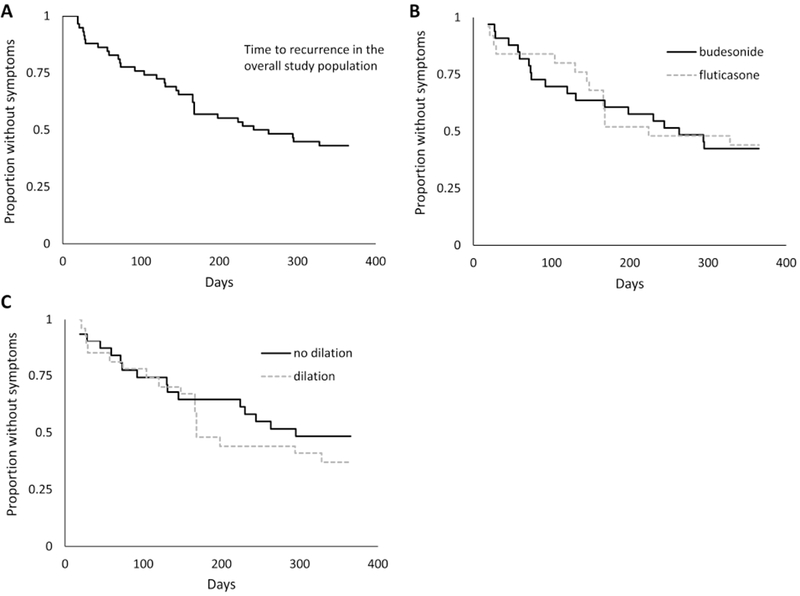
Thirty-three of the 58 subjects (57%) had symptom recurrence before 1 year. The overall median time to symptom recurrence was 244 days. There was no difference in the rate of symptom recurrence for subjects treated with OVB vs MDI (hazard ratio, 1.04; 95% CI, 0.52-2.08). At symptom recurrence, 78% of patients had histologic relapse. The patients had significant increases in mean Dysphagia Symptom Questionnaire score (3.8 vs 8.7; P < .001), and the EoE Endoscopic Reference Score (1.3 vs 4.6; P < .001) compared with end of treatment.
EoE disease activity recurred rapidly after initial histologic response to topical steroids (either OVB or MDI). Because most subjects had recurrent endoscopic and histologic signs not reliably detected by symptoms, maintenance therapy should be recommended in EoE patients achieving histologic response to topical steroids. Clinicaltrials.gov no: NCT02019758.
嗜酸性食管炎(EoE)是一种慢性疾病,如果停止治疗,会复发。我们旨在确定复发率,以及初始口服布地奈德混悬液(OVB)治疗是否比多剂量吸入剂(MDI)氟替卡松的复发率更低。
这是一项比较 OVB 与 MDI 初始治疗 EoE 的随机、双盲、双模拟试验的观察阶段。在试验中出现组织学反应(<15 个嗜酸性粒细胞/高倍视野)的受试者进入观察阶段,停止治疗并监测症状。当症状复发或 1 年后,患者接受内镜检查或活检。我们分析症状复发的时间,并评估随访内镜检查时的内镜严重程度和组织学复发(≥15 个嗜酸性粒细胞/高倍视野)。
58 名受试者中有 33 名(57%)在 1 年内出现症状复发。总体中位症状复发时间为 244 天。接受 OVB 治疗与 MDI 治疗的受试者症状复发率无差异(危险比,1.04;95%CI,0.52-2.08)。在症状复发时,78%的患者出现组织学复发。与治疗结束时相比,患者的吞咽困难症状问卷评分(3.8 分比 8.7 分;P<0.001)和 EoE 内镜参考评分(1.3 分比 4.6 分;P<0.001)显著增加。
在接受局部类固醇(OVB 或 MDI)治疗后组织学反应,EoE 疾病活动迅速复发。由于大多数患者出现了无法通过症状可靠检测到的内镜和组织学复发迹象,因此建议在 EoE 患者对局部类固醇治疗有组织学反应时进行维持治疗。Clinicaltrials.gov 编号:NCT02019758。