
用微生物群落接种玉米:对不同土壤中根际活性、养分获取和早期生长的对比影响
Maize Inoculation with Microbial Consortia: Contrasting Effects on Rhizosphere Activities, Nutrient Acquisition and Early Growth in Different Soils.
作者信息
Bradáčová Klára, Sittinger Maximilian, Tietz Katharina, Neuhäuser Benjamin, Kandeler Ellen, Berger Nils, Ludewig Uwe, Neumann Günter
机构信息
Institute of Crop Science (340h), Universität Hohenheim, Fruwirthstraße 20, 70593 Stuttgart, Germany.
Julius Kühn-Institut, Institute for Biological Control, Heinrichstraße 243, 64287 Darmstadt, Germany.
出版信息
Microorganisms. 2019 Sep 7;7(9):329. doi: 10.3390/microorganisms7090329.
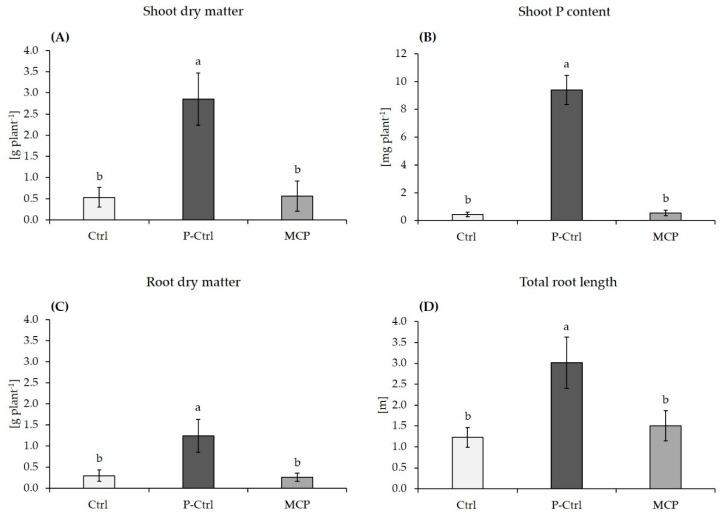
The benefit of plant growth-promoting microorganisms (PGPMs) as plant inoculants is influenced by a wide range of environmental factors. Therefore, microbial consortia products (MCPs) based on multiple PGPM strains with complementary functions, have been proposed as superior, particularly under challenging environmental conditions and for restoration of beneficial microbial communities in disturbed soil environments. To test this hypothesis, the performance of a commercial MCP inoculant based on 22 PGPM strains was investigated in greenhouse experiments with maize on three soils with contrasting pH, organic matter content and microbial activity, under different P and N fertilization regimes. Interestingly, the MCP inoculant stimulated root and shoot growth and improved the acquisition of macronutrients only on a freshly collected field soil with high organic matter content, exclusively in combination with stabilized ammonium fertilization. This was associated with transiently increased expression of in the root tissue, a gene responsive to exogenous auxin supply, suggesting root growth promotion by microbial auxin production as a major mode of action of the MCP inoculant. High microbial activity was indicated by intense expression of soil enzyme activities involved in C, N and P cycling in the rhizosphere (cellulase, leucine peptidase, alkaline and acid phosphatases) but without MCP effects. By contrast, the MCP inoculation did not affect maize biomass production or nutrient acquisition on soils with very little C and low microbial activity, although moderate stimulation of rhizosphere enzymes involved in N and P cycling was recorded. There was also no indication for MCP-induced solubilization of Ca-phosphates on a calcareous sub-soil fertilized with rock-phosphate. The results demonstrate that the combination of multiple PGPM strains with complementary properties as MCP inoculants does not necessarily translate into plant benefits in challenging environments. Thus, a better understanding of the conditions determining successful MCP application is mandatory.
促进植物生长的微生物(PGPMs)作为植物接种剂的益处受到多种环境因素的影响。因此,基于具有互补功能的多种PGPM菌株的微生物群落产品(MCPs)已被认为更具优势,特别是在具有挑战性的环境条件下以及用于恢复受干扰土壤环境中的有益微生物群落。为了验证这一假设,在温室实验中,研究了一种基于22种PGPM菌株的商业MCP接种剂在三种pH、有机质含量和微生物活性不同的土壤上,在不同的磷和氮施肥制度下对玉米的性能。有趣的是,MCP接种剂仅在新采集的高有机质含量的田间土壤上,且仅与稳定态铵肥结合使用时,才刺激了根和地上部生长并改善了大量养分的获取。这与根组织中对外源生长素供应有响应的一个基因的瞬时表达增加有关,表明微生物产生生长素促进根生长是MCP接种剂的主要作用方式。根际参与碳、氮和磷循环的土壤酶活性(纤维素酶、亮氨酸肽酶、碱性和酸性磷酸酶)的强烈表达表明微生物活性高,但未观察到MCP的影响。相比之下,MCP接种对碳含量极低且微生物活性低的土壤上的玉米生物量生产或养分获取没有影响,尽管记录到对参与氮和磷循环的根际酶有适度刺激。在用磷矿粉施肥的石灰性底土上,也没有迹象表明MCP能诱导磷酸钙的溶解。结果表明,具有互补特性的多种PGPM菌株组合作为MCP接种剂在具有挑战性的环境中不一定能给植物带来益处。因此,必须更好地了解决定MCP成功应用的条件。


 Zotero 插件